Managing business finances becomes much easier when planned spending and actual financial results are reviewed side by side. A finance budget versus actuals comparison helps businesses understand whether they are spending within budget, generating the expected revenue, and moving toward their financial goals.
Instead of reviewing financial numbers in isolation, a budget versus actuals report puts budgeted amounts, actual results, dollar variances, and percentage variances into one clear view. This makes it easier to identify unexpected expenses, revenue shortfalls, favorable results, and areas that may require corrective action.
A well-organized finance budget versus actuals template can also save time during monthly, quarterly, and annual financial reviews. Whether you manage a small business, department, project, or finance team, this type of template provides a practical framework for monitoring financial performance.
In this guide, you will learn what a budget versus actuals report is, why it matters, how to use a template, and how to interpret financial variances effectively.
What Is a Finance Budget Versus Actuals Report?
A finance budget versus actuals report compares the financial amounts a business expected to receive or spend with what actually happened during a specific period.
The budget represents the financial plan. Actuals represent the real results recorded by the business. The difference between these two figures is called a variance.
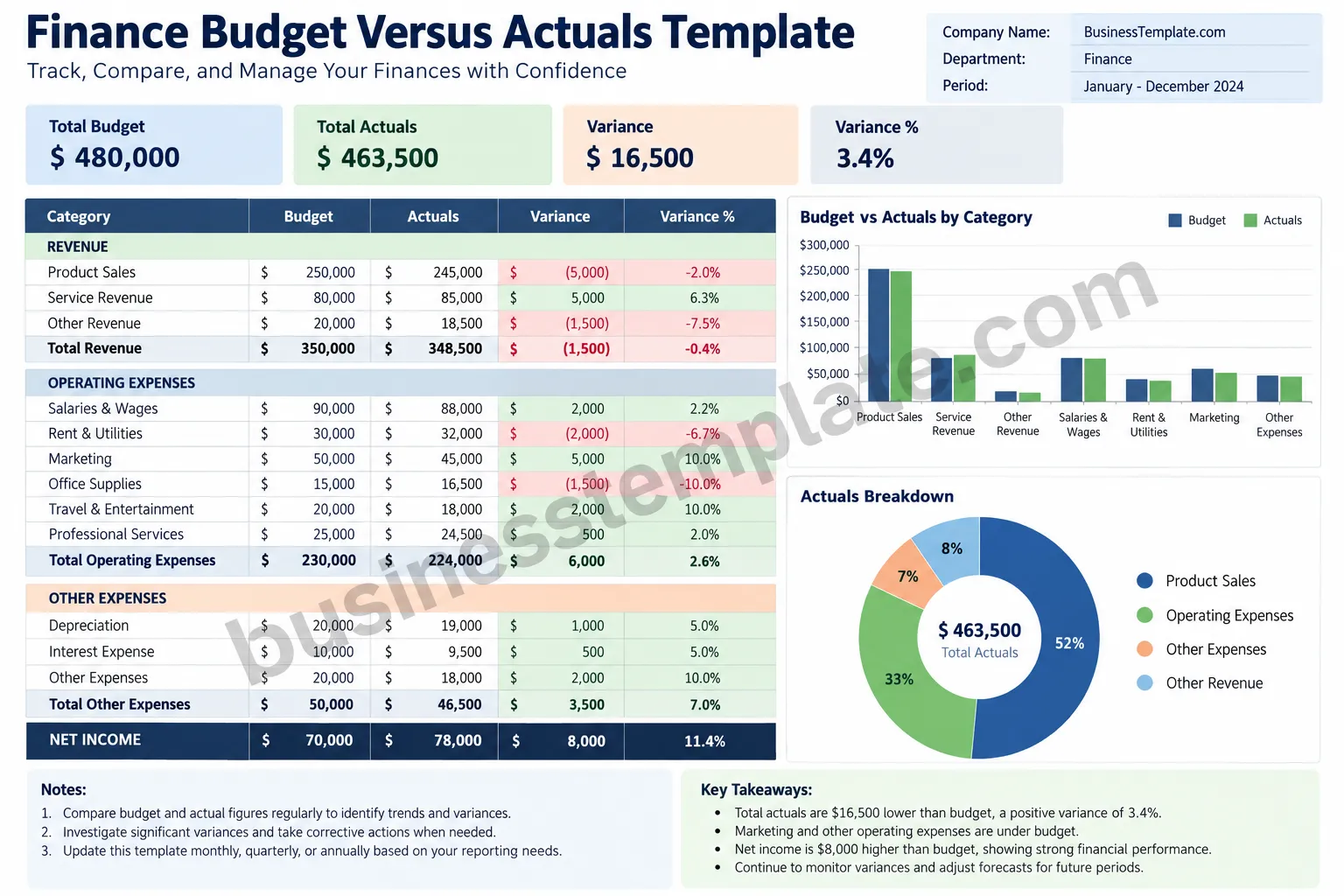
For example, suppose a company budgets $50,000 for marketing but spends $45,000. The company has a $5,000 favorable expense variance because actual spending was lower than planned.
On the other hand, if the company budgets $30,000 for rent and utilities but spends $32,000, the $2,000 difference represents an unfavorable expense variance.
A typical finance budget versus actuals report may include:
- Budgeted revenue
- Actual revenue
- Budgeted expenses
- Actual expenses
- Dollar variance
- Variance percentage
- Net income or operating profit
- Notes explaining significant differences
Why Compare Budget and Actual Financial Results?
Budget monitoring is not simply an accounting exercise. It provides management with information that can support better financial planning and resource allocation.
Identify Financial Variances
The most obvious benefit is the ability to quickly identify differences between expectations and actual performance. A significant variance can indicate changing market conditions, unexpected costs, stronger-than-expected sales, or inaccurate assumptions in the original budget.
Control Business Expenses
Regularly comparing actual expenses against the approved budget can help businesses identify spending categories that are consistently above plan. Finance teams can investigate the cause before a small variance becomes a larger financial problem.
Improve Financial Forecasting
Historical budget versus actual results can provide useful information when preparing future forecasts. If certain expenses regularly exceed their budget, future financial plans can be adjusted to use more realistic assumptions.
Support Management Decisions
Decision-makers can use financial variance analysis to determine where additional resources may be needed and where spending can potentially be reduced. The report provides a structured starting point for financial discussions.
Key Sections of a Finance Budget Versus Actuals Template
A practical template should make important financial information easy to scan. The exact categories will depend on the organization, but several components are useful in most businesses.
Revenue Section
The revenue section tracks expected income against actual income. Businesses may divide revenue into product sales, service revenue, subscriptions, consulting income, or other sources.
For example, a revenue table might show:
- Product Sales
- Service Revenue
- Other Revenue
- Total Revenue
Comparing these categories can show whether revenue growth is coming from the sources originally expected in the budget.
Operating Expenses
Operating expenses represent the regular costs required to operate the business. Common categories include salaries, rent, utilities, marketing, office supplies, travel, and professional services.
Breaking expenses into categories is important because a total expense figure may hide significant changes within individual accounts.
Other Expenses
Depending on the business, a template may include depreciation, interest expense, taxes, or other non-operating costs. Separating these items from ordinary operating expenses can make financial analysis easier.
Net Income
Net income provides a high-level view of the financial outcome after revenue and applicable expenses have been considered. Comparing budgeted and actual net income can help management understand the overall financial effect of individual variances.
How to Calculate Budget Versus Actual Variance
Calculating a dollar variance is straightforward:
Variance = Actual Amount − Budget Amount
For example, if budgeted revenue is $100,000 and actual revenue is $110,000:
$110,000 − $100,000 = $10,000 variance
For percentage analysis, businesses commonly use:
Variance % = (Actual Amount − Budget Amount) ÷ Budget Amount × 100
Using the same example, the percentage variance would be 10%.
However, whether a positive or negative variance is considered favorable depends on the type of financial category. Higher revenue is generally favorable, while higher expenses are generally unfavorable. Therefore, the numbers should always be interpreted in context rather than judged solely by their mathematical sign.
How to Use a Finance Budget Versus Actuals Template
1. Define the Reporting Period
Start by selecting the period you want to analyze. A budget versus actuals report can be prepared monthly, quarterly, annually, or for a specific project period.
2. Enter the Approved Budget
Enter the original or approved budget figures into the template. Use consistent account categories so that the budget can be compared directly with accounting data.
3. Add Actual Financial Data
Enter actual revenue and expenses from your accounting records, bank statements, financial system, or other reliable sources. Make sure the reporting period matches the budget period.
4. Calculate Variances
Calculate both dollar and percentage variances. Automated spreadsheet formulas can make this process faster and reduce repetitive calculations.
5. Investigate Significant Differences
Do not treat every variance as equally important. Focus attention on material or unusual differences. For example, a small office supply variance may require little investigation, while a major payroll or revenue variance may require a detailed review.
6. Add Explanatory Notes
Use notes to explain important variances. A short explanation can make the report much more useful during management meetings and future financial reviews.
How to Interpret Favorable and Unfavorable Variances
Variance interpretation depends on whether the account represents revenue or an expense.
For revenue, actual results above budget are generally described as favorable because the business generated more income than expected. Actual revenue below budget may require further investigation.
For expenses, the interpretation is often reversed. Spending below budget may be favorable, while spending above budget may be unfavorable.
Possible reasons for variances include:
- Changes in customer demand
- Unexpected operating costs
- Changes in supplier pricing
- Hiring or staffing changes
- Timing differences
- One-time purchases
- Changes in sales volume
- Incorrect original budget assumptions
The goal is not simply to eliminate every variance. Some differences are normal and can result from legitimate business decisions or changing conditions. The more important objective is to understand why meaningful variances occurred.
Practical Tips for Better Budget Versus Actual Analysis
Review Financial Results Regularly
Waiting until the end of the year can make financial problems harder to address. Monthly or quarterly reviews allow businesses to identify trends earlier and respond when there is still time to adjust.
Use Consistent Categories
Budget categories should match the categories used in actual financial reporting whenever possible. Consistent classification makes comparisons more accurate and easier to understand.
Focus on Material Variances
Set practical thresholds for investigation. For example, your finance team may choose to review any variance above a specific dollar amount or percentage. The threshold should reflect the size and complexity of the organization.
Look for Trends
A single variance may not tell the full story. If an expense category exceeds budget for several consecutive months, the pattern may indicate that the original budget needs to be revised.
Connect Variances to Forecasts
Budget versus actual analysis becomes more useful when the findings are incorporated into future forecasts. If actual results consistently differ from the original assumptions, update the forecast rather than continuing to rely on outdated expectations.
Benefits of Using a Printable Finance Template
A printable finance budget versus actuals template can be useful during financial meetings, planning sessions, and internal reviews. A clean layout allows team members to see the key numbers without navigating a complicated financial system.
A well-designed template can help you:
- Organize financial information in one place
- Compare planned and actual performance quickly
- Highlight important variances
- Prepare for budget review meetings
- Document explanations for financial differences
- Support monthly and quarterly reporting
For organizations that prefer digital workflows, the same structure can also be recreated in spreadsheet software and enhanced with formulas, conditional formatting, dashboards, and charts.
Common Mistakes to Avoid
Even a good budget versus actuals template can produce confusing results if the underlying process is inconsistent.
- Using mismatched periods: Make sure budget and actual data cover the same reporting period.
- Ignoring timing differences: Some expenses or revenues may be recorded in a different month than originally expected.
- Focusing only on totals: Review individual categories to understand what is driving the overall result.
- Failing to explain major variances: Add notes so decision-makers understand significant changes.
- Using outdated forecasts: Update future expectations when actual results reveal important changes.
When Should You Use a Budget Versus Actuals Template?
This type of financial template can be used by businesses of many sizes and industries. It is particularly useful for monthly management reporting, departmental budget reviews, project financial tracking, annual budget monitoring, and financial planning.
Small businesses can use it to monitor cash-related spending and revenue performance. Larger organizations can adapt the structure for individual departments, business units, cost centers, or projects.
The template can also be customized with additional fields such as year-to-date results, prior-year actuals, forecast amounts, variance explanations, responsible departments, and management comments.
Conclusion
A finance budget versus actuals process provides a practical way to understand how real financial performance compares with the original plan. By reviewing revenue, expenses, variances, and net income together, businesses can identify important differences and make better-informed financial decisions.
The most effective approach is to review results regularly, investigate meaningful variances, document the reasons behind major differences, and use the findings to improve future forecasts. A clear finance budget versus actuals template makes this process easier by putting essential financial information into a consistent and readable format.
Whether you are preparing a monthly finance report or conducting an annual budget review, a structured budget versus actuals template can help turn raw financial figures into useful management information.
