A social media marketing follower questionnaire Template is a structured set of questions designed to help a brand understand the people who follow its social channels. Instead of relying only on follower counts, likes, or impressions, a well-designed questionnaire can reveal why people follow an account, what content they value, how often they interact, which formats they prefer, and what they expect from the brand.
The strongest questionnaires are not simply long lists of questions. They connect each question to a marketing decision. For example, a question about preferred content can guide a content calendar, while a question about posting frequency can influence scheduling. Questions about trust, purchasing behavior, customer service, and brand perception can also help connect social media activity with broader business objectives.
Current social-media survey guidance commonly groups questions around audience characteristics, platform behavior, content preferences, engagement, brand perception, product feedback, customer support, and loyalty. These categories make the questionnaire easier to analyze because responses can be compared according to a clear purpose rather than treated as unrelated comments.

What a follower questionnaire should accomplish
The primary purpose is to turn follower feedback into usable audience insight. A follower is not automatically an active customer, advocate, or highly engaged community member. A questionnaire can help distinguish these groups by asking about motivations, behavior, preferences, and expectations. That makes the resulting information more useful than a simple demographic profile.
A strong questionnaire should also explain what the respondent is being asked to evaluate. If the objective is content planning, questions should focus on formats, topics, usefulness, frequency, and preferred timing. If the objective is customer experience, the questionnaire should emphasize satisfaction, service interactions, communication preferences, and areas for improvement. Mixing unrelated objectives can make the survey unnecessarily long and weaken the quality of the answers.
Another important goal is comparability. Questions that use consistent response scales can be repeated later, allowing a marketing team to compare changes over time. For example, a five-point satisfaction question can be used before and after a content strategy change. Open-ended questions still have an important role, but they work best when used selectively to explain the patterns found in structured responses.

Core sections to include
A practical follower questionnaire usually begins with a short introduction explaining why feedback matters and approximately how long the questionnaire takes. Personal information should be limited to what is genuinely useful. A brand may need broad age ranges, location, or professional context for segmentation, but collecting unnecessary personal details can create friction and reduce willingness to respond.
The next section should establish social-media behavior. Ask which platforms the respondent uses, which account they follow, how often they check social media, and how they normally interact with brands. These questions establish behavioral context before the questionnaire moves into opinions about the specific brand.
The central section should address content and engagement. Useful questions can examine preferred formats, favorite topics, ideal posting frequency, reasons for commenting or sharing, and the types of posts that encourage a respondent to stop scrolling. A final feedback section can then ask what should change, what should remain, and what the respondent would like to see next.

Audience profile questions
Audience profile questions should be purposeful rather than exhaustive. Depending on the brand, useful fields may include age range, general location, professional category, customer status, and familiarity with the brand. If the questionnaire is intended for a broad public audience, include a “prefer not to say” option where appropriate.
It is often more useful to ask about relevance than to collect a large amount of demographic information. For example, “Which of these best describes your relationship with our brand?” can separate prospective customers, recent customers, repeat customers, partners, and casual followers. That classification may provide more actionable insight than a long demographic section.
For international audiences, wording should also be culturally clear. A social media marketing follower questionnaire template uk may need examples, spelling conventions, or response categories appropriate to respondents in the United Kingdom, while a questionnaire intended for a global audience should avoid assumptions tied to one country.

Platform and usage questions
Platform questions help determine where the audience is most active. Ask which networks respondents use regularly and which one they prefer for interacting with the brand. If a company maintains several channels, the questionnaire can ask whether the respondent follows the brand on one, several, or all of them.
Usage frequency is another useful dimension. Instead of asking only whether someone uses social media, ask how often they check it and when they are generally most active. These answers can help marketers investigate whether content timing should differ between platforms or audience segments.
Device questions can also be helpful when the questionnaire is connected to content-format decisions. Someone who mainly consumes short-form video on a mobile screen may have different preferences from someone who primarily reads professional posts on a desktop. The purpose is not to stereotype users, but to understand context when interpreting their answers.

Questions about content preferences
Content questions should identify what followers find useful, interesting, entertaining, credible, or relevant. A simple multiple-choice question might ask respondents to select the formats they prefer, such as short videos, images, educational posts, product demonstrations, customer stories, polls, articles, or live sessions.
Topic questions can go deeper. Ask which subjects followers want to see more often and which subjects they consider repetitive. This can expose a gap between what a marketing team thinks is valuable and what its audience actually wants. An open-ended question such as “What topic would you like us to explain next?” can produce specific ideas for future content.
It is also useful to distinguish content that attracts attention from content that creates value. A post may receive reactions because it is entertaining, while another may receive fewer visible interactions but generate useful website visits or inquiries. Questionnaire responses should therefore be interpreted alongside other performance information rather than treated as a replacement for channel analytics.

When measuring content quality, use neutral wording. “How useful do you find our educational posts?” is more informative than “How much do you love our educational posts?” because the second question encourages a favorable answer. Clear wording reduces bias and makes the responses easier to interpret.
Rating scales can be useful for content evaluation, but they should have balanced options. A five-point scale might range from very dissatisfied to very satisfied or from very unlikely to very likely. Keep the meaning of the scale consistent throughout the questionnaire so that respondents do not have to reinterpret the response options from one question to the next.
Open-ended questions should be limited to moments where detailed explanation is valuable. Asking respondents to write a long answer after every question can increase abandonment. A better structure is to use mostly simple response types and reserve one or two open fields for the insights that cannot be captured through predefined choices.

Engagement and relationship questions
Follower engagement is broader than likes and comments. A questionnaire can ask whether respondents save useful posts, share content with others, send direct messages, click links, watch videos to completion, participate in polls, or use social channels when researching a purchase. These behaviors help explain what engagement means to the particular audience.
Questions about motivation are especially valuable. A follower might follow a brand because of educational content, product information, entertainment, customer support, promotions, community participation, or professional relevance. Understanding the dominant motivations can help the marketing team decide what the account should consistently deliver.
Trust is another important dimension. Respondents can be asked how credible they find the brand’s posts, how clearly sponsored content is presented, and what makes them more likely to believe a claim. These questions should be phrased neutrally and should not assume that followers already trust the brand.

Questions about frequency and timing
Posting frequency should be investigated from the audience perspective rather than assumed from industry habits. Ask whether respondents would prefer more frequent updates, the same frequency, or fewer posts. A follow-up question can ask what makes the current frequency feel appropriate or excessive.
Timing questions can identify broad patterns without pretending that one ideal posting time applies to every person. Respondents might choose morning, midday, afternoon, evening, or no preference. These answers can then be compared with actual engagement patterns to determine whether a scheduling experiment is justified.
The questionnaire can also ask whether followers want different frequencies for different content types. For example, a respondent may welcome frequent short updates but prefer detailed educational posts only once or twice a week. This distinction can produce a more nuanced content strategy than a single question about posting frequency.

Choosing a document or form format
The best format depends on how the questionnaire will be distributed, completed, reviewed, and analyzed. A social media marketing follower questionnaire template excel can be useful when responses need to be organized in rows and columns for sorting or analysis. A social media marketing follower questionnaire template google sheets can serve a similar purpose when several team members need shared access to response data.
For a traditional document workflow, a social media marketing follower questionnaire template word or social media marketing follower questionnaire template doc can be appropriate when the questionnaire needs branding, explanatory text, printable sections, or editorial review before distribution. A social media marketing follower questionnaire template google docs is useful when collaborators need to review and revise the wording together.
For a polished printable version, a social media marketing follower questionnaire template pdf can preserve the visual structure across devices and printers. If the questionnaire is intended for a presentation or internal workshop, a social media marketing follower questionnaire template ppt can be adapted into slides that explain the research process and response categories.

For spreadsheet-oriented workflows, the phrase social media marketing follower questionnaire template excel describes a useful structure when each respondent occupies a row and each question occupies a column. Keep the response fields standardized so categories can be filtered and compared without extensive manual cleaning.
A form-based workflow can be more suitable when respondents will complete the questionnaire through a link. A social media marketing follower questionnaire template google forms can be structured around multiple-choice questions, scales, checkboxes, and short written responses. The key is to keep the number of required fields reasonable and make the sequence logical from the respondent’s perspective.
When evaluating a social media marketing follower questionnaire template free download or a social media marketing follower questionnaire template download, verify what the resource actually provides before promising a particular file or format. A search result, preview image, or template listing is not automatically evidence that a specific document is available in every format.

A social media marketing follower questionnaire template free may be attractive for a small team that needs a starting structure without committing to a paid resource. However, the important evaluation criteria remain question quality, relevance, editability, privacy considerations, and suitability for the intended audience. The label alone does not determine whether a questionnaire is well designed.
The phrase social media marketing follower questionnaire template free can also reflect different expectations. Some readers may want a ready-to-edit document, while others want a bank of questions or a form structure. Clarify the intended use before selecting a format so that the questionnaire does not need to be rebuilt later.
Likewise, a social media marketing follower questionnaire template google docs and a social media marketing follower questionnaire template google sheets serve different purposes. One is primarily a collaborative document format, while the other is better suited to structured response management. The right choice should follow the research workflow rather than the popularity of a particular format.

How to write better questions
Write one idea per question. A question such as “How useful and entertaining do you find our videos?” asks respondents to evaluate two separate characteristics. Someone could find a video highly useful but not entertaining, making the answer ambiguous. Separate those dimensions when both are important to the marketing decision.
Avoid leading language. Questions should not imply that the brand expects a positive response. Instead of asking whether followers agree that the content is “excellent,” ask them to rate content quality using a balanced scale. Neutral wording protects the usefulness of the data and makes criticism easier for respondents to express.
Use answer choices that cover realistic possibilities. If asking how often someone interacts with posts, include a range from very frequent interaction to little or no interaction. Always consider an “other” or “not applicable” option when the listed choices may not cover the audience’s situation.

Question order also matters. Start with simple behavioral questions, move into content preferences, then ask evaluative questions, and finish with optional open-ended feedback. This sequence allows respondents to understand the context before being asked to judge the brand.
Keep the introduction concise. Explain what the questionnaire is about, why feedback matters, whether responses will be associated with identifying information, and how much time respondents should expect to spend. Avoid making promises about confidentiality or anonymity unless the collection process genuinely supports them.
Pilot the questionnaire before broad distribution. A small internal test can reveal ambiguous wording, duplicate questions, missing response options, inconsistent scales, and unnecessary fields. The goal of a pilot is not to prove the questionnaire works; it is to discover where respondents may misunderstand or abandon it.

How to analyze follower responses
Begin by cleaning the response data. Standardize spelling variations, remove accidental duplicates where appropriate, and check for incomplete responses. Do not automatically discard incomplete questionnaires if the usable answers still provide relevant information; instead, decide in advance how missing responses will be treated.
Next, summarize structured questions using counts, percentages, averages, or other suitable descriptive measures. For example, you might compare the proportion of respondents who prefer video with those who prefer educational text posts. If the sample is small or non-random, describe the findings as feedback from respondents rather than assuming they represent the entire follower population.
Open-ended answers require qualitative review. Group similar comments into themes such as requests for tutorials, complaints about frequency, praise for product demonstrations, or interest in behind-the-scenes material. Keep the original meaning of responses intact and avoid turning a handful of comments into a claim about the entire audience.

Turning responses into marketing decisions
The value of a questionnaire comes from what happens after data collection. If followers consistently request educational content, translate that theme into specific content experiments. If respondents say they prefer fewer promotional posts, consider adjusting the balance between promotional and informational material and then compare subsequent performance.
Segmenting responses can reveal differences hidden by overall averages. For example, new followers may want introductory material while long-term customers may want advanced product information. A business audience may prefer professional explanations while consumers may favor demonstrations and practical examples. Segmentation makes the findings more useful without requiring an enormous questionnaire.
Use the findings to create hypotheses rather than treating them as automatic instructions. If many respondents say they prefer evening posts, that is a reason to test evening publishing, not proof that evening publishing will always produce better performance. Combine questionnaire feedback with observed channel behavior and business outcomes.

Common mistakes to avoid
One common mistake is creating a questionnaire that tries to answer every marketing question at once. A follower survey can become unwieldy when it covers brand awareness, customer satisfaction, product research, demographics, content planning, purchasing behavior, customer service, and campaign evaluation in one long sequence. Separate research projects when their objectives are substantially different.
Another mistake is asking questions that the marketing team cannot act upon. If a response will not influence a decision, it may not belong in the questionnaire. Every question should have a clear reason for being there, whether that reason is segmentation, content planning, experience improvement, campaign evaluation, or hypothesis development.
A third mistake is focusing only on positive feedback. A useful questionnaire makes it comfortable for respondents to identify content they dislike, information they find confusing, or experiences they believe need improvement. Balanced feedback is more valuable than a questionnaire designed merely to collect praise.

Practical Solution
Start with one clear objective. For most follower research, a practical objective is to understand who follows the account, why they follow it, what content they value, how they engage, and what they want to see next. Write those objectives down before drafting questions. Then create sections that directly support each objective rather than beginning with a generic list of survey questions.
A useful working structure is to begin with five to eight audience-context questions, followed by platform and usage questions, then content-preference questions, engagement questions, satisfaction questions, and one or two open feedback prompts. Keep sensitive or identifying questions optional unless they are genuinely required. Use consistent scales and make required questions easy to answer.
Choose the response format according to the workflow. A social media marketing follower questionnaire template google forms can work well for direct respondent collection, while a social media marketing follower questionnaire template excel can support structured analysis after responses are collected. A social media marketing follower questionnaire template word or document-based version may be preferable for client review, internal approval, or printing.

Before distribution, test every question with several people who were not involved in writing it. Ask them what they think each question means, whether any answer choice is missing, and whether any question feels repetitive. Revise unclear wording before collecting a larger response set. This small quality-control step can prevent substantial cleanup later.
After collection, create a short findings document that separates observed responses from interpretation. For example, “Respondents most frequently selected short video” is a description of the collected answers, while “short video should become the primary format” is a strategic recommendation. Keeping those statements separate makes the analysis more credible.
Finally, connect the findings to an action plan. Select a small number of changes, define what will be tested, establish the relevant performance measures, and review results after an appropriate period. A questionnaire should become part of an iterative learning process rather than a one-time exercise that ends when the responses are counted.

Using the questionnaire as a recurring research tool
Follower research can be repeated when the marketing strategy changes, when the audience changes substantially, or when the team needs to investigate a specific uncertainty. Repeating the exact same questionnaire too frequently can create fatigue, so use a stable core of questions and rotate a smaller set of diagnostic questions when appropriate.
A recurring questionnaire becomes more useful when the team maintains consistent definitions. If “frequent engagement” means one thing in one survey and something else later, comparisons become difficult. Keep the wording, response scale, and interpretation consistent whenever the purpose is to measure change over time.
Document the decisions made from each survey cycle. Record which findings influenced content, scheduling, community management, or campaign planning. This creates an institutional record showing not only what followers said, but how the marketing team responded and what happened afterward.

Privacy and respondent trust
Questionnaire design should respect the amount of information respondents reasonably expect to provide. Avoid collecting sensitive personal information unless there is a legitimate purpose and an appropriate process for handling it. When demographic information is useful, broad categories are often sufficient for marketing analysis.
Explain how responses will be used in straightforward language. If responses are intended for internal strategy, say so. If quotes may be used in public materials, obtain the appropriate permission rather than assuming that survey participation grants unrestricted publication rights.
Trust also affects response quality. People are more likely to provide useful criticism when the questionnaire feels neutral, concise, and purposeful. A short introduction, sensible question order, clear response options, and respectful wording can make the entire research process feel more professional.

Final format considerations
When selecting a reusable template, look beyond its appearance. Check whether the questions can be edited, whether the structure matches the research objective, whether response fields are easy to analyze, and whether the format works for the audience’s devices. A visually attractive questionnaire can still be ineffective if its questions are biased or difficult to answer.
Some teams may specifically search for a social media marketing follower questionnaire template pdf because they need a stable printable layout. Others may look for a social media marketing follower questionnaire template google sheets because collaboration and data organization are more important. Neither format is universally superior; the correct choice depends on how responses will be collected and used.
Similarly, a social media marketing follower questionnaire template ppt can be useful for presenting the research structure to stakeholders, while a social media marketing follower questionnaire template doc may be better for drafting and review. A social media marketing follower questionnaire template download should only be selected when the actual resource and file format have been verified rather than inferred from a search listing.

The phrase social media marketing follower questionnaire template free is useful when searching for a starting point, but the real value is in adapting the questions to the audience and business objective. Likewise, a social media marketing follower questionnaire template free download should not be treated as automatically suitable simply because it is easy to obtain. Review the question wording, response structure, privacy considerations, and intended use before distributing it.
For teams working in different environments, a social media marketing follower questionnaire template uk may be selected for regional wording and audience context, while other teams may need a more international version. The questionnaire should always reflect the people being surveyed rather than forcing respondents into assumptions built for a different market.

Reference Examples
A social media marketing follower questionnaire Template can take several visual forms, but the most useful examples share a common characteristic: the structure makes the research objective visible. A strong reference can show how demographic questions are separated from platform behavior, how content preferences are grouped, how rating scales are presented, or how open feedback is positioned at the end. Looking at real questionnaire layouts can help marketers assess whether a proposed form feels balanced, readable, and purposeful before they adapt the structure for their own followers.
The following visual references illustrate different ways to present survey questions, audience information, response scales, and marketing research material. They are useful for comparing document hierarchy, question grouping, visual clarity, and the relationship between questionnaire design and later analysis. They should be treated as design references rather than universal models: the right social media marketing follower questionnaire Template will depend on the brand, audience, research objective, distribution method, and decisions that the resulting feedback needs to support.

Media Viewer Survey Graph – Reader Approval Responses
Source: Wikimedia Foundation

Media Viewer – Survey Graph – Respondents by Group – May 5 2014
Source: Wikimedia Foundation

Survey results for Vector 2022 initial response survey
Source: Wikimedia Foundation
Marketing Pre-Campaign Questionnaire Template
Source: Template.net
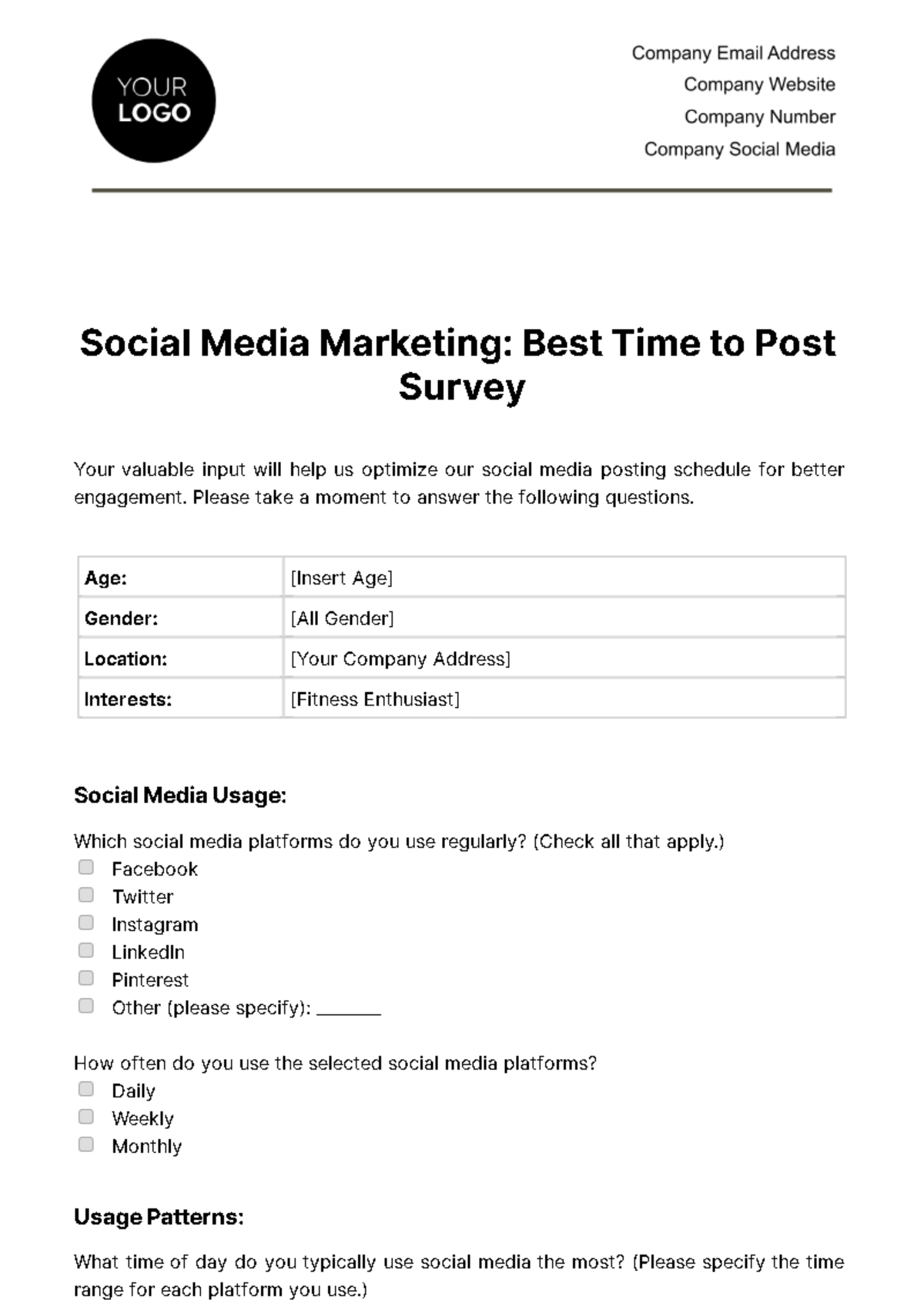
Social Media Marketing: Best Time to Post Survey Template
Source: Template.net
