A construction security incident report is a factual record of an event that affects site access, perimeter control, property, materials, equipment, information, or the security of a construction project. The most useful construction security incident Template is not merely a blank page. It gives supervisors and security personnel a consistent way to capture the time, location, event type, evidence, people involved, actions taken, notifications, and follow-up responsibilities.
Security events on a jobsite can include unauthorized entry, theft, vandalism, damaged fencing, suspicious activity, lost access credentials, tampering with equipment, or a breach of a restricted area. A good record does not decide blame at the scene. Instead, it preserves observable facts so management can review the event, protect evidence, communicate with the right parties, and decide whether additional investigation or reporting is needed.
The strongest template also separates the initial factual record from later analysis. That distinction matters because a first report is often completed while the site is being secured and information is still incomplete. A clear form lets the reporter state what was seen, what was heard, what was discovered, and what actions were taken without presenting an early theory as a confirmed cause.
What a construction security incident template should accomplish
A useful form should make the first record fast enough to complete during a busy site response while still preserving enough detail for later review. The header normally identifies the project, contractor or subcontractor, site address, report number, date, time, reporting person, and exact area. Security-specific fields can then identify the incident category, access point, perimeter zone, storage area, equipment location, or other controlled location involved.
The narrative section is the center of the record. It should encourage a chronological description rather than conclusions. For example, a reporter might record that a section of temporary fencing was found displaced at 03:45, a padlock was damaged, and several material bundles were no longer in the storage area. That is stronger than stating that a particular person committed theft when the reporter did not personally observe the event.
Evidence fields should also be explicit. A construction security incident template can include spaces for CCTV camera numbers, photographs, damaged locks, access-control records, visitor logs, vehicle descriptions, witness contact details, police reference numbers, and attached sketches. If an item is unavailable, the form can record that it was not available at the time of the initial report rather than leaving an ambiguous blank.

A useful layout then connects immediate response with follow-up. The reporter can record whether an area was secured, whether access was restricted, whether damaged fencing or locks were isolated, whether security personnel or management were notified, and who owns the next action. This prevents the report from becoming only a historical narrative; it becomes a working record for closing the incident.
Core fields to include in the form
Project identification should be precise enough that someone reviewing the record months later can identify the correct job without guessing. Include project name, project number, site address, client or principal contractor where relevant, reporting contractor, and the exact work zone. For large projects, add building, level, grid, gate, laydown area, room, or other location identifiers that fit the site.
The incident header should capture both the event time and the report time. Those two values can differ substantially, especially when an overnight patrol discovers damage that occurred earlier. The form should also record how the incident was discovered, such as routine patrol, employee observation, CCTV review, access-control alert, delivery inspection, or notification by another contractor.

People and organizations involved should be recorded carefully. Names, roles, employer or trade, contact information, and witness status can be useful, but a report should distinguish between a witness, an affected party, a reporter, and a person merely mentioned in the account. If identity is uncertain, describe the uncertainty rather than converting a partial description into a definite identification.
The incident classification should be broad enough to cover the security risks found on construction projects. Useful categories include unauthorized access, trespass, theft, attempted theft, vandalism, property damage, suspicious activity, lost credential, damaged security control, vehicle-related security event, material loss, and other. A near miss can also be recorded when a security weakness was discovered before loss or damage occurred.
How to write the incident narrative
The narrative should answer a simple sequence: what was observed, where it was observed, when it was observed, what condition existed, what changed, and what was done next. Use plain language and measurable descriptions. “North fence panel was leaning inward with a cut section approximately one metre wide” is more useful than “security was badly compromised.”
A good report separates direct observations from information supplied by another person. If a worker says a vehicle was seen near the gate, identify that as a witness account. If CCTV later shows a vehicle entering the area, record that as evidence reviewed after the initial observation. This distinction creates a more reliable timeline and reduces the chance that assumptions become embedded as facts.

Avoid emotional language, accusations, unsupported estimates, and speculative motive. If the value of missing materials has not been verified, state that an inventory review is pending. If a person was seen near a restricted zone but there is no evidence of unauthorized entry, record the observation without labeling the person a trespasser.
Security events that the template should cover
Unauthorized access is one of the most important categories because construction sites often change shape as work progresses. Gates, temporary fencing, hoardings, doors, stairwells, lifts, storage compounds, and partially completed structures can create changing access paths. The form should identify the precise entry point and the condition that permitted or suggested unauthorized access.
Theft records should capture the location, item description, quantity, identifying marks or serial information when available, last known presence, discovery time, inventory source, witness information, and evidence preserved. A construction security incident template should not force the reporter to calculate a final loss during the first response. A later inventory review can establish the confirmed quantity and value.

Vandalism and property damage deserve similar treatment. Record the damaged item, exact location, visible condition, photographs, possible time window, and any access or surveillance information. A damaged lock, cut fence, broken window, defaced sign, or tampered control panel may be important even when no property is missing because it can reveal a weakness in the site’s security controls.
Security-related vehicle events can also be significant. A report should identify the vehicle, location, time, direction of travel, visible damage, gate or barrier condition, and any available witness or surveillance information. When the event also causes an injury, the security record should coordinate with the project’s separate safety reporting process rather than replacing it.

Reports involving worker injury or compensation issues should remain factual and should not make medical or legal conclusions. Record the event, observed condition, treatment or response information that the reporter is authorized to document, witnesses, and notifications. Any formal claim or medical record should follow the project’s established process.

Evidence, witnesses, and attachments
Evidence should be preserved in a way that maintains its context. A report can identify photographs by sequence number, CCTV by camera and time range, access records by system or gate, and physical evidence by a simple item identifier. If an item is handed to police or another authority, record the transfer according to the project’s evidence procedure.
Witness information should focus on what the person actually observed. Useful fields include name, employer, role, contact method, time of observation, location, and a short statement. The report should avoid coaching witnesses toward a preferred explanation. Independent accounts can later be compared with photographs, CCTV, access records, delivery records, and inventory information.

Supporting records can include site maps, gate logs, delivery records, inventory sheets, photographs, security patrol notes, correspondence, and repair records. The template should provide an attachment index so the main report does not become overloaded with copied material while still showing what evidence exists and where it is stored.

A hazardous-material event may also require security documentation when access restrictions, unauthorized entry, damaged storage, or interference with controlled materials is involved. The security report should focus on the security facts and coordinate with the project’s safety and environmental records where necessary.

Immediate response and escalation
The form should include a short response checklist because documentation should follow safe site control, not replace it. Depending on the event, immediate actions may include restricting access, isolating a damaged area, protecting workers from hazards, preserving relevant evidence, checking whether anyone needs medical assistance, notifying site leadership, and contacting emergency services or law enforcement when appropriate.
Security response should be proportionate to the event. A minor damaged sign may require a maintenance action and management notification, while a suspected break-in may require controlled access, evidence preservation, inventory review, CCTV preservation, and external notification according to site policy. The template should therefore allow the reporter to describe actions without forcing every event into the same response path.

Escalation fields should identify who was notified, when the notification occurred, how it was made, and any reference number. This can include the site manager, security lead, project manager, client representative, contractor management, insurer, or law enforcement where relevant. Do not state that a notification is legally required unless the relevant rule has been checked.

OSHA considerations and the limits of a security form
A construction security incident report is an internal or project-specific record; it is not automatically the same thing as an OSHA recordkeeping form. OSHA’s recordkeeping rule identifies Forms 300, 300-A, and 301, or equivalent forms, for recordable work-related injuries and illnesses. A security event with no work-related injury or illness may not fit those injury-recording criteria. :contentReference[oaicite:0]{index=0}
This distinction matters when someone searches for a construction security incident template osha. A form can be designed to capture security facts that may later support safety review, but it should not be labeled as an official OSHA form unless it actually is one. If a security event results in a recordable injury or illness, the organization should evaluate that outcome under the applicable OSHA rules rather than relying on the title of the internal security report.
OSHA also has separate reporting rules for severe work-related events. Federal OSHA states that work-related fatalities must be reported within eight hours, while inpatient hospitalizations, amputations, and losses of an eye generally must be reported within 24 hours under 29 CFR 1904.39. The reporting duty depends on the facts of the event, so a security report should help preserve those facts rather than attempt to make the legal determination itself. :contentReference[oaicite:1]{index=1}
Choosing PDF, Word, and spreadsheet formats
Format should follow the workflow. A construction security incident template pdf can be useful when a project needs a consistent printable record, controlled page layout, or a stable report package. A Word-based version is useful when the organization needs to adjust headings, add project branding, or modify narrative prompts.
The phrase construction security incident template word usually signals a need for an editable document structure rather than a specialized reporting system. The phrase construction security incident template excel can indicate a need for structured rows, incident registers, or summary tracking. A spreadsheet can work well for an incident log, but it is usually less suitable for a long narrative unless the workbook is deliberately designed for that purpose.
A hybrid workflow can be practical: use a short field form for the initial event, then transfer confirmed information into a controlled incident record or register. The important issue is not the file extension. It is whether the record captures facts consistently, protects sensitive information, preserves supporting evidence, and makes follow-up responsibilities visible.
California and Florida considerations
Searches for construction security incident template california and construction security incident template florida should be treated as jurisdiction-sensitive searches, not as proof that one universal state form exists. Construction companies can have obligations arising from state rules, occupational safety requirements, contracts, insurance arrangements, law enforcement procedures, and client policies. A general template should therefore leave room for the project’s own reporting references.
For California projects, a security report may need to coexist with workplace safety records and other project documentation. The same principle applies in Florida: the internal security record should be designed around the project’s actual contract, safety plan, emergency procedures, and relevant state or local requirements. A template can support those processes, but it should not be presented as an official state form unless the issuing authority confirms that status.
When a client or authority provides a required reporting format, use that requirement as the controlling source. An internal construction security incident template can then act as a supplementary record if it adds useful operational detail without creating conflicting facts or duplicate reporting obligations.
Incident registers and recurring security patterns
A single report explains one event; a register helps reveal patterns across a project. Useful register fields include incident number, date, project zone, category, severity, immediate control, responsible owner, status, and closure date. The register should link back to the full incident record rather than trying to store every narrative detail in one row.
Trend review can identify repeated problems such as unsecured gates, damaged fencing, poor lighting, uncontrolled visitor access, recurring material losses, or equipment stored in vulnerable locations. The purpose is not simply to count incidents. The more valuable question is whether repeated events point to a control weakness that can be corrected.

A good register also supports closure. Each corrective action should have an owner, due date, completion status, and verification note. If a damaged gate was repaired, record the repair and the date. If lighting was added, record the installation and later inspection. This turns incident reporting into a feedback loop rather than a filing exercise.
Practical Solution
Start with a one-page initial record that a supervisor or security officer can complete quickly. Put project identity, exact location, date and time, reporter, incident category, immediate condition, and a large factual narrative area near the top. Add dedicated fields for access point, property or equipment affected, witnesses, evidence, notifications, and immediate actions. Keep root-cause analysis and corrective-action verification in later sections so the first account remains factual.
Next, create a controlled follow-up process. Assign one person to preserve evidence, one person to coordinate notifications when required, and one person to own corrective actions. The same report number should remain attached to photographs, CCTV references, inventory checks, witness statements, repair records, and later investigation notes. If the event affects worker safety, evaluate the incident separately under the relevant occupational safety rules.
Finally, review the completed report for factual quality before closure. Confirm that dates and times are consistent, locations are specific, witnesses are distinguished from involved parties, evidence references can be located, and conclusions are clearly separated from observations. If the record will be used for insurance, litigation, regulatory review, or law enforcement, follow the organization’s document-retention and evidence procedures and obtain appropriate professional advice.
Common mistakes to avoid
One common mistake is writing the report as a story designed to prove a theory. Security records are stronger when they state observable facts first and identify later findings separately. Another mistake is leaving the location vague. “Jobsite” is rarely enough for a large project; a gate number, building, level, storage compound, or grid reference can make the record far more useful.
A second mistake is recording only the loss and not the security condition that surrounded it. If materials are missing, record the storage condition, access control, fencing, lighting, surveillance coverage, inventory status, and last known check where those facts are available. These details can help management identify the control weakness that needs correction.
A third mistake is treating every event as a safety incident or every safety incident as a security event. The categories overlap, but they are not identical. A damaged fence with no injury is primarily a security or property event; a worker injury caused by a falling object is a safety event; a break-in that results in an injury may require both security and occupational safety review.
How to evaluate a template before adopting it
Test the form against realistic scenarios before making it the project standard. Try an unauthorized entry, a suspected theft, vandalism, a damaged access gate, a lost credential, suspicious activity, and a security event that also causes an injury. If the reporter cannot record the essential facts without improvising new fields, the template needs revision.
Check whether the form distinguishes report date from incident date, direct observation from witness information, immediate actions from corrective actions, and initial facts from later conclusions. Also check whether the record has enough space for a clear narrative and whether attachments can be indexed without making the main document difficult to review.
A final quality check should consider access control and confidentiality. Security records can contain sensitive information about site vulnerabilities, access points, surveillance coverage, witnesses, property losses, and law enforcement contacts. Store them according to the project’s information-handling rules and limit access to people who need the record for response, investigation, management, safety, insurance, or legal purposes.
Using the right wording for search and document needs
Someone searching construction security incident template pdf is often looking for a stable report layout, while someone searching construction security incident template word may want an editable structure. A construction security incident template excel request may instead reflect a need for a register or incident tracker. These are different operational needs, so the same form should not be forced into every format.
The phrase incident report construction template is broader and may return forms centered on injuries, near misses, or general site events. A security-focused record should add access control, perimeter condition, surveillance, property loss, evidence, and notification fields that a general safety form may not emphasize. Likewise, incident report template construction site can be useful as a starting point, but it should be reviewed for security-specific gaps.

A search for free construction incident report template can indicate a need for a starting structure without purchasing specialized document design. The phrase security incident reporting template is more specific and should lead to a form that records security controls and evidence. If a reader searches construction security incident template free or construction security incident template free download, the practical question remains the same: does the form capture the facts required for this project’s actual security workflow?


Reference Examples
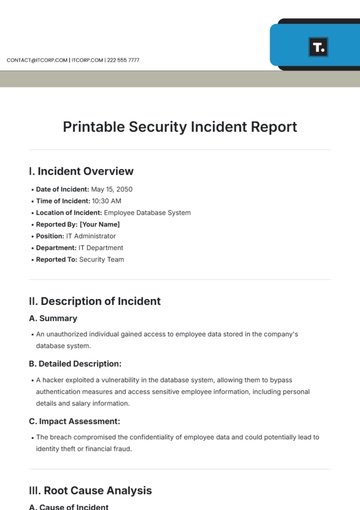
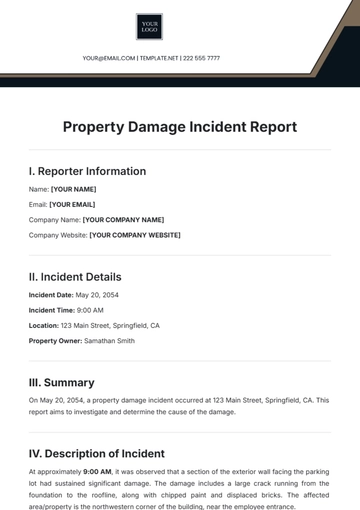
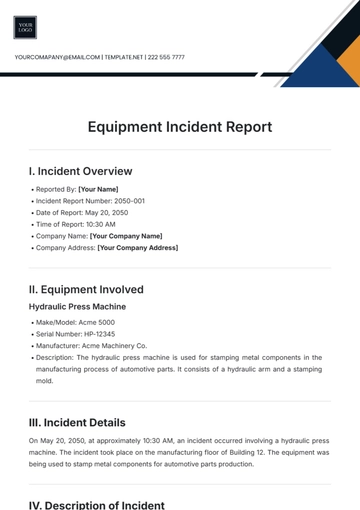
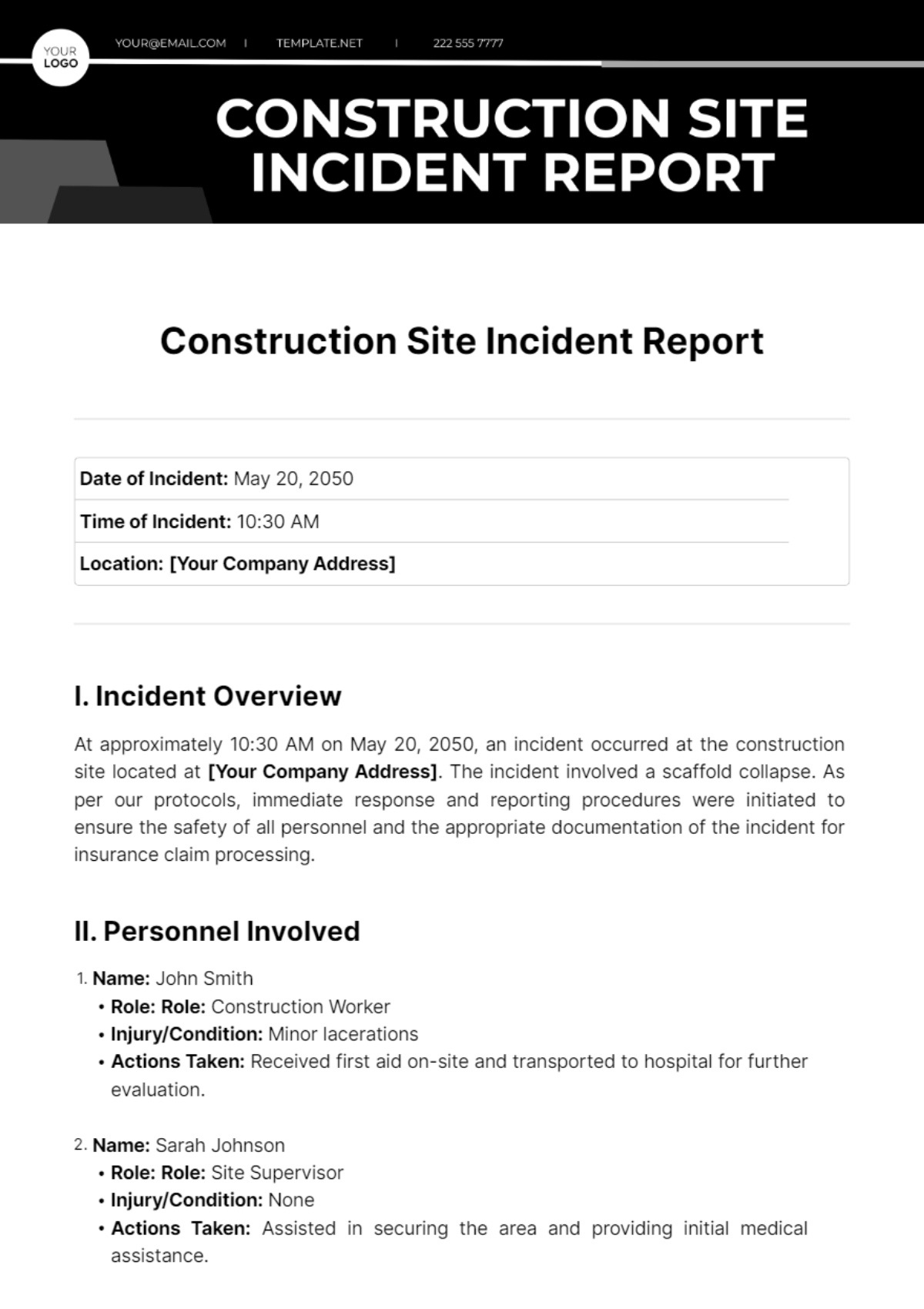
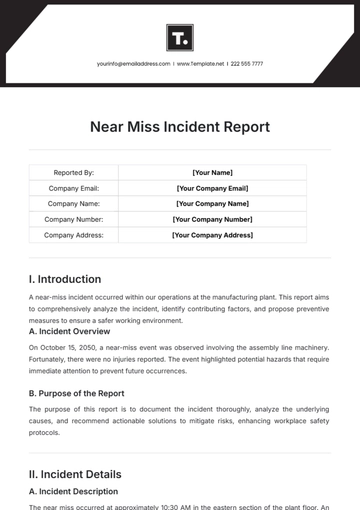
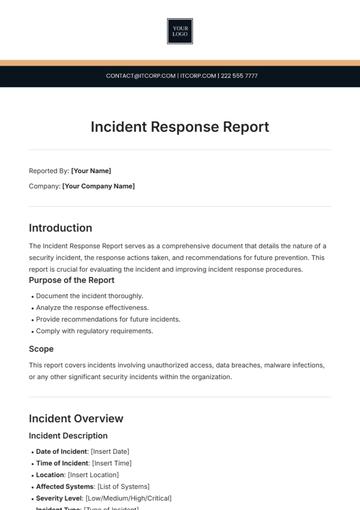
A construction security incident Template is easiest to evaluate when readers can compare real document structures rather than rely on a generic description. Useful examples show how forms organize incident dates, precise locations, event classifications, narratives, witnesses, evidence, immediate actions, and follow-up. They also show that there is no single universal layout: a short initial report may emphasize speed, while a detailed investigation record may include root-cause analysis, corrective actions, and authorization fields. The examples below are visual references for structure and content, not claims that every project should copy the same form.
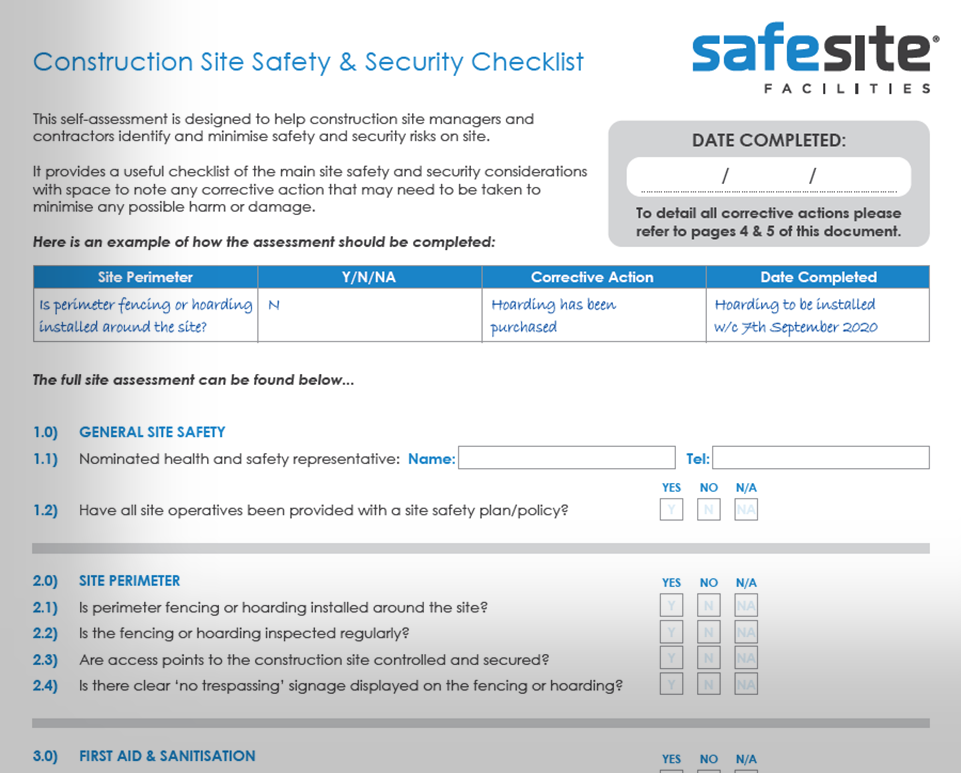
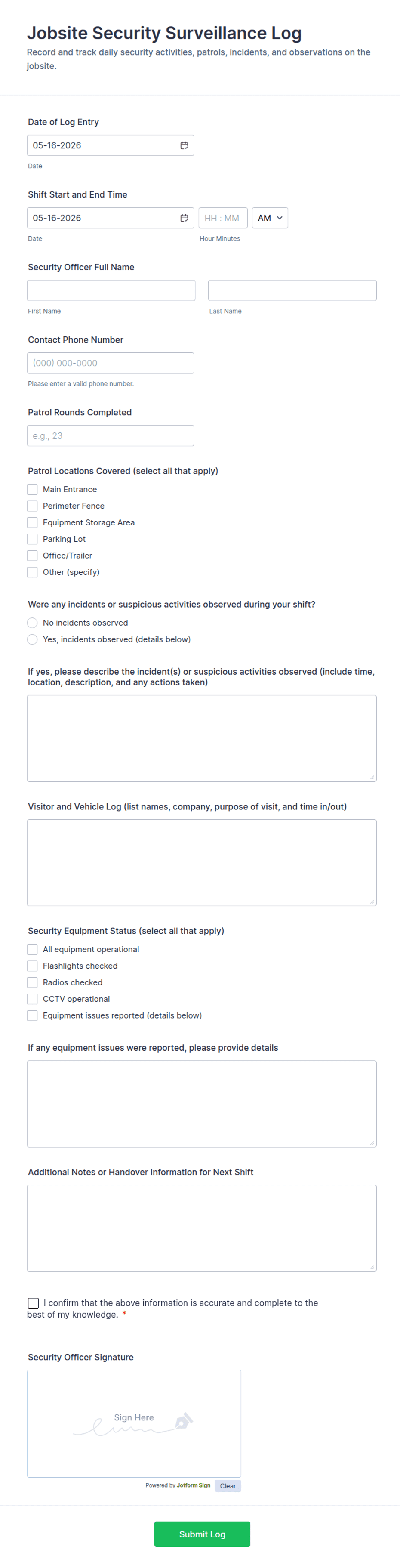
The following references also illustrate how a security-oriented construction record can connect the initial event with site controls. A perimeter checklist, incident register, patrol log, or property-damage form can complement the main incident report when the project’s procedure calls for those records. Comparing these formats helps a project team decide which fields belong in the initial report, which belong in a separate register, and which should remain part of the investigation record.
Construction Site Safety & Security Checklist
Source: SafeSite Facilities

Work Zone Incident and Property Damage Report Form
Source: Template.net
Incident & Accident Register
Source: SiteReady
Jobsite Security Surveillance Log Form
Source: Jotform

Construction Site Security Checklist
Source: SlideShare
