A strong commercial line account manager resume Template should do more than list insurance duties. It should show how you manage a book of business, support renewals, communicate with clients and carriers, review coverage, coordinate policy transactions, and contribute to retention and growth. Current commercial lines role descriptions commonly emphasize account servicing, renewal management, policy and coverage review, proposal preparation, carrier communication, documentation, and strong knowledge of commercial insurance.
The most useful template is therefore a structure rather than a decorative page. It gives recruiters a quick way to understand your insurance background while giving you enough space to show measurable accomplishments. Commercial lines account managers may work with producers, underwriters, claims teams, marketing staff, and clients, so the strongest resumes connect technical insurance knowledge with communication, organization, negotiation, and relationship management.
This guide explains what to put in each section, how to describe commercial insurance experience, which skills deserve emphasis, how to handle different document formats, and how to tailor the same core resume for different markets. The examples are illustrative; replace every hypothetical achievement, metric, employer name, license, and certification with information that is accurate for your own career.
What a Commercial Lines Account Manager Resume Needs to Communicate
A commercial lines account manager is typically responsible for the ongoing service and administration of commercial insurance accounts. Depending on the employer, that can include new business and renewal work, endorsements, certificates, claims support, billing questions, coverage analysis, policy checking, carrier submissions, account records, and client communication. Recent role descriptions from insurance employers also emphasize maintaining accurate documentation, coordinating with producers and marketing teams, and using agency management systems effectively. :contentReference[oaicite:1]{index=1}
Your resume should make those responsibilities visible without turning every job into a long list of routine tasks. A hiring manager needs to see not only that you processed endorsements or renewals, but also how you handled complexity, protected service quality, retained clients, improved workflows, supported producers, or solved difficult account issues.
For example, “managed commercial renewals” is accurate but weak on its own. A stronger version might explain that you coordinated renewal data, reviewed expiring coverage, prepared carrier submissions, compared quotations, identified coverage considerations, and supported renewal discussions. If you have a verified outcome, add it: improved retention, reduced turnaround time, expanded coverage, increased book revenue, or improved documentation accuracy.

Choose a Resume Structure That Makes Insurance Experience Easy to Scan
For an experienced commercial insurance professional, reverse chronological structure is usually the clearest starting point. It puts the latest position first and lets the reader see career progression, increasing responsibility, and relevant insurance experience quickly. A combination format can also work when you want to emphasize a specialized skill set while retaining a clear employment history.
A simple structure normally includes contact details, a professional headline, summary, core skills, professional experience, education, licenses or certifications, and optional additional information. The exact order can change according to your experience. Someone with extensive commercial lines experience should generally give more space to professional history and accomplishments than to older education.
A two-column design can look attractive, but a conventional single-column structure is often easier to scan and transfer into recruiting systems. The important principle is consistency: use clear section headings, predictable dates, readable typography, concise bullets, and enough white space to distinguish separate roles. The design should support the information rather than compete with it.

Write a Commercial Insurance Professional Summary
The summary is the opening argument for your candidacy. It should identify your commercial insurance experience, the type of accounts you manage, your strongest technical capabilities, and the business value you bring. Avoid generic statements such as “hard-working professional with excellent communication skills.” Those qualities become more persuasive when attached to actual insurance responsibilities.
A useful summary might mention commercial property and casualty experience, account servicing, renewals, risk review, policy administration, carrier negotiation, client retention, or agency management systems. Only mention licenses, designations, industries, account sizes, and software that you genuinely possess. Current job descriptions frequently identify commercial insurance knowledge, communication, organization, and familiarity with systems such as AMS or EPIC as valuable qualifications. :contentReference[oaicite:2]{index=2}
For example, a hypothetical summary could read: “Commercial Lines Account Manager with 7 years of experience servicing middle-market property and casualty accounts, coordinating renewals, preparing carrier submissions, reviewing coverage, and supporting client retention. Experienced in agency management systems, policy administration, proposal preparation, and carrier communication. Known for organized account stewardship and clear communication with clients, producers, and underwriting partners.” The wording should then be adjusted to match your real background.

Build a Skills Section Around Commercial Insurance Work
The skills section should reflect the role you are pursuing rather than becoming a collection of generic business terms. Common commercial lines capabilities include account management, renewal planning, policy administration, coverage analysis, risk assessment, proposal preparation, carrier marketing, claims coordination, endorsements, certificates, billing support, client relationship management, and negotiation. These themes recur across commercial lines job descriptions and resume examples.
Technical skills deserve particular attention when the employer names specific systems or tools. Examples may include Applied Epic, AMS360, ImageRight, Microsoft Excel, Word, Outlook, agency portals, CRM platforms, or document-management systems. Do not list every system you have ever encountered. Prioritize tools that you can actually use and that are relevant to the target position.
Soft skills are strongest when they are demonstrated through experience. Instead of simply listing “communication,” show that you communicated complex coverage issues to clients, coordinated renewal information across stakeholders, resolved billing questions, or negotiated with carriers. Instead of “organization,” show that you managed a large book, tracked expirations, maintained accurate files, or handled competing service deadlines.
- Insurance knowledge: commercial property, casualty, liability, workers compensation, commercial auto, umbrella, professional lines, or other areas you genuinely know.
- Account servicing: renewals, endorsements, certificates, audits, policy changes, billing coordination, claims support, and client correspondence.
- Market work: submissions, quotation review, carrier communication, renewal marketing, coverage comparison, and negotiation.
- Systems: agency management systems, document systems, CRM tools, spreadsheets, and relevant insurance portals.
- Professional strengths: prioritization, attention to detail, problem solving, negotiation, client communication, and cross-functional coordination.

Turn Daily Duties Into Strong Experience Bullets
The professional experience section is usually where the resume becomes persuasive. Begin with the most recent relevant position and identify the employer, location if useful, job title, and employment dates. Then use concise bullets to explain responsibilities and outcomes. A good bullet usually combines an action, a commercial insurance activity, and a result or purpose.
Consider the difference between “Responsible for renewals” and “Coordinated renewal timelines, gathered updated exposure information, prepared carrier submissions, reviewed quotations, and supported renewal recommendations for assigned commercial accounts.” The second version communicates a workflow and shows that the candidate understands the full renewal cycle.
Achievements should be specific when accurate. A candidate might have reduced policy-processing delays, improved documentation quality, retained a challenging account, identified additional coverage needs, supported new-business growth, or helped standardize renewal procedures. If a number is confidential or unavailable, describe the outcome without inventing one.

Examples of Stronger Experience Statements
Hypothetical examples can help demonstrate the difference between task-focused and value-focused writing. “Processed endorsements” could become “Reviewed endorsement requests for completeness, coordinated carrier processing, verified issued documents, and ensured updated records were delivered to clients.” “Handled client questions” could become “Served as a primary service contact for coverage, billing, policy, and certificate inquiries, coordinating complex issues with producers and carriers.”
For renewal work, a stronger statement might be: “Managed renewal workflows for a portfolio of commercial accounts, coordinating exposure information, loss data, carrier submissions, quotations, proposal materials, and binding instructions.” For claims support, you might write: “Collected claim information from insureds, coordinated documentation with carriers, and maintained timely follow-up through resolution.” These are templates for phrasing, not claims to copy as facts.
For leadership, emphasize the work you actually led. Examples include mentoring junior account staff, improving workflow procedures, coordinating a team project, creating account-service checklists, or helping colleagues interpret coverage information. Leadership does not require a formal manager title; evidence of ownership can demonstrate it.

Show Knowledge of Renewals, Policies, and Coverage
Renewal management is central to many commercial lines account management roles. Employers may expect an account manager to collect renewal information, coordinate timelines, communicate with clients and producers, prepare submissions, compare quotations, review expiring and proposed coverage, and ensure the final transaction is accurately documented.
Your resume should therefore use specific renewal terminology where it truthfully reflects your experience. Useful terms include renewal review, exposure information, loss runs, carrier submissions, quotations, coverage comparison, renewal proposal, binding instructions, endorsements, certificates, policy checking, and account documentation.
Coverage knowledge is another important differentiator. If you have worked with property, general liability, commercial auto, workers compensation, umbrella, professional liability, builders risk, inland marine, or other commercial products, identify the areas relevant to your target role. Avoid listing coverage types simply because they are common in the industry; credibility comes from demonstrated experience.

Make Client Relationship Management Concrete
Commercial account management combines technical insurance knowledge with relationship management. The account manager may be the person a client contacts when a policy changes, a certificate is needed, a billing issue appears, a claim arises, or renewal terms need clarification. Current employer descriptions emphasize serving as a client contact, advising clients, managing day-to-day issues, and maintaining long-term relationships.
Rather than writing “excellent customer service,” explain what that service involved. You might have translated insurance terminology into clear business language, coordinated urgent requests, prepared coverage summaries, handled escalations, or maintained communication during a renewal. Those details make the skill credible.
Relationship management can also connect to retention and growth. If you genuinely identified additional coverage needs, supported cross-selling, expanded an account, improved retention, or contributed to new business, explain the contribution. Keep the wording accurate about your role; do not claim that you personally generated revenue when the result came from a broader team.

Include Insurance Licenses and Professional Designations Carefully
Licensing can be important in commercial insurance, but requirements vary by employer and jurisdiction. Some current commercial lines postings explicitly require an active Property and Casualty license, while others specify a period in which a new hire must obtain one.
List licenses exactly and honestly. Include the license name, jurisdiction where relevant, and current status if useful. Do not imply that a license is transferable between jurisdictions when it is not. If a target employer specifies a licensing requirement, use the employer’s wording as a reference point while keeping your resume factually accurate.
Professional designations can also strengthen a commercial insurance resume when they are genuinely held. Depending on your background, relevant credentials may include CPCU, CIC, ARM, or other recognized insurance education. If a credential is in progress, label it as in progress rather than presenting it as completed.

Use Metrics Without Inventing Results
Quantification can make an account manager resume more persuasive because it gives scale to otherwise familiar responsibilities. Useful measurements may include the number of accounts managed, approximate premium volume, retention performance, renewal volume, turnaround improvements, number of transactions processed, size of a book, or number of team members supported.
Metrics must come from your actual work. If you managed approximately 80 accounts, say so if that figure is accurate. If you do not know the exact number, use a defensible description such as “a diverse commercial account portfolio” rather than inventing a figure. The same principle applies to revenue, retention percentages, processing times, and client satisfaction.
A strong accomplishment connects the measurement to an action. For example, a hypothetical statement could be “Managed a portfolio of approximately 75 commercial accounts while coordinating renewal submissions, endorsements, certificates, billing inquiries, and carrier follow-up.” Another could be “Standardized renewal tracking procedures across the team, improving visibility into outstanding items.” Add a verified numerical result only when you can support it.

Tailor the Resume to the Employer
Tailoring is not about rewriting the entire document for every vacancy. Start with a strong core resume and adjust the summary, skills, and several experience bullets to reflect the position. If a role emphasizes middle-market accounts, make relevant middle-market experience prominent. If it emphasizes transportation, highlight commercial auto and related account knowledge when accurate.
Job descriptions can also reveal which terminology matters. Current postings reference activities such as quoting and issuing policies, certificates, claims, renewals, follow-up, correspondence, coverage strategies, account documentation, and agency management systems. Use the terminology that accurately describes your background rather than copying requirements you do not meet.
For international searches, terminology may vary. A candidate researching a commercial line account manager resume template UK should check the target employer’s terminology, qualifications, licensing expectations, and document conventions. The same principle applies when researching a commercial line account manager resume template australia: compare the wording used by Australian insurance employers and recruitment listings before making regional adjustments. Current Australian listings show demand for commercial insurance account management and related account executive roles across several markets.

Choosing Between Word, PDF, and Other Resume Formats
Different employers may request different file formats, so it is useful to maintain an editable master version and a stable final version. A commercial line account manager resume template word can be useful when you need to make frequent content changes or adapt the document to a specific role. The important consideration is not the brand of software but whether the final document remains clean, readable, and consistent.
A commercial line account manager resume template pdf is useful when you need the recipient to see a consistent visual layout across devices. Before sending a PDF, inspect the final file carefully: confirm that dates, page breaks, section headings, contact information, and bullet points display correctly. Do not assume that a conversion preserved every formatting detail.
Searches for a commercial line account manager resume template doc often reflect a preference for an editable document, while a commercial line account manager resume template google docs search may indicate a preference for browser-based editing and collaboration. Either approach can work if the resulting resume remains professional, accurate, easy to read, and compatible with the employer’s submission instructions.

How to Handle Online Communities and Shared Resume Advice
A search for commercial line account manager resume template reddit may lead to discussions where insurance professionals share personal experiences, formatting preferences, or opinions about recruiting. Such discussions can be useful for generating ideas, but personal anecdotes should not be treated as universal hiring rules. A resume should ultimately reflect the requirements of the specific employer and the candidate’s actual experience.
Community discussions can be especially helpful for identifying practical questions that formal guides sometimes overlook: whether a particular system is widely recognized, how much technical insurance detail to include, or how experienced account managers describe renewal responsibilities. Treat those observations as informal perspective rather than verified policy.
The same caution applies to template collections. A visually attractive sample can inspire layout ideas, but the content may contain fictional employers, hypothetical metrics, outdated terminology, or qualifications that do not match your market. Use samples to understand structure, then replace the content with evidence from your own career.

Practical Solution
The practical solution is to build one evidence-based master resume and then create targeted versions from it. Start by collecting your real job titles, employment dates, account types, insurance lines, systems, licenses, designations, major responsibilities, projects, and measurable achievements. This evidence becomes your content bank. You can then select the most relevant material for each commercial account management role rather than rewriting your career history from memory.
Next, compare your evidence with the target job description. Mark requirements that you genuinely meet and bring the strongest matching evidence into the summary, skills section, and first several experience bullets. For example, if the employer emphasizes renewal management, coverage analysis, carrier negotiation, and EPIC, those subjects should be visible where they are supported by your background. If the employer emphasizes client advisory work, bring forward examples of needs analysis, coverage discussions, and relationship management.
Finally, perform a factual and presentation audit before submitting the resume. Confirm every date, title, license, credential, software name, metric, and achievement. Remove unsupported claims. Check that the most relevant information appears early on the page. Review the document at normal viewing size rather than only zoomed in. Then compare the final version against the employer’s stated formatting and submission instructions.

A Practical Five-Step Workflow
- Step 1: Gather evidence from your real career history, including account types, insurance lines, systems, licenses, projects, and outcomes.
- Step 2: Build the core resume using a clear chronological structure and concise commercial insurance language.
- Step 3: Match the summary and skills to the target position without claiming qualifications you do not have.
- Step 4: Rewrite routine duties as evidence of ownership, technical knowledge, client service, problem solving, or measurable impact.
- Step 5: Proofread the final document and verify every factual detail before submitting it.

Common Mistakes to Avoid
One of the most common problems is writing a resume that describes the insurance department rather than the candidate’s contribution. A long list of generic responsibilities may show familiarity with the job but does not explain why the candidate performed well. Focus on responsibilities you personally handled and outcomes you personally influenced.
Another problem is excessive jargon. Commercial insurance has specialized terminology, and appropriate terminology can demonstrate technical knowledge, but every phrase should remain understandable. A recruiter should be able to see the practical meaning of your work without decoding unnecessary abbreviations.
Over-designed resumes can create another issue. Multiple columns, graphics, rating bars, decorative icons, and unusual section structures may make a document harder to scan. A clean professional layout is usually a safer choice when the priority is communicating experience accurately and efficiently.

Example Resume Content for Different Career Levels
An entry-level or early-career candidate may need to emphasize transferable insurance experience, customer service, administrative accuracy, coursework, training, or related support work. If commercial lines experience is limited, do not disguise that fact. Instead, show evidence of learning speed, attention to detail, client communication, document handling, and exposure to insurance processes.
A mid-career account manager can emphasize independent account ownership, renewal management, carrier relationships, coverage analysis, client retention, and workflow coordination. The strongest bullets should show increasing responsibility rather than repeating the same duties under every employer.
A senior account manager can go further by demonstrating complex account management, mentoring, process improvement, strategic client relationships, retention, revenue contribution, team leadership, and technical expertise. Senior candidates should also consider whether the summary and first experience section clearly establish the scale and complexity of the accounts they manage.


How to Use Exact-Format Searches Without Letting Format Drive the Content
People searching for a commercial line account manager resume template free may primarily want a starting structure rather than a finished career history. A commercial line account manager resume template free download search can similarly signal a desire for a ready-made document, but the real value comes from adapting the structure to verified professional experience.
If you specifically need a commercial line account manager resume template word free, focus first on whether the document has sensible headings, readable spacing, consistent dates, and enough room for commercial insurance accomplishments. A polished layout cannot compensate for vague experience statements or missing technical qualifications.
Likewise, a commercial line account manager resume template download search should not encourage you to use the same resume for every vacancy. Templates work best as frameworks. The wording, skills, insurance lines, achievements, and emphasis should change according to the role, employer, seniority, account type, and market.

How to Think About CV Terminology
A commercial line account manager resume template cv search can reflect differences in terminology across regions and employers. In some markets, “CV” is used broadly for professional career documents, while “resume” is more common in others. The document should ultimately follow the convention expected by the target employer rather than relying on the label alone.
For an international search, pay attention to page length, contact information conventions, regional terminology, licensing references, and whether the employer requests a resume or CV. Avoid adding personal information simply because you see it in an older sample. Use current employer instructions and accepted professional practice in the relevant market.
The visual examples below illustrate how resume structure can vary while the fundamental information remains similar: professional identity, experience, education, skills, and evidence of value. The examples are references for layout and information hierarchy, not commercial lines insurance resumes.

Final Resume Quality Checklist
Before using your finished commercial lines account manager resume, read it as if you were a recruiter seeing it for the first time. Within a few seconds, it should be clear what kind of insurance professional you are, how much relevant experience you have, what types of commercial accounts you understand, and what value you can bring to the team.
Check that the summary is specific, the skills are relevant, and the experience section demonstrates both technical competence and business impact. Look for repeated bullets, vague phrases, unsupported metrics, unexplained career gaps, inconsistent dates, and outdated contact information. Every line should earn its space.
Finally, keep the underlying content current. Commercial insurance changes with market conditions, products, systems, regulations, and client expectations. When you gain a new license, designation, system skill, major account responsibility, leadership experience, or measurable achievement, update your master resume so the next targeted version can be built quickly and accurately.
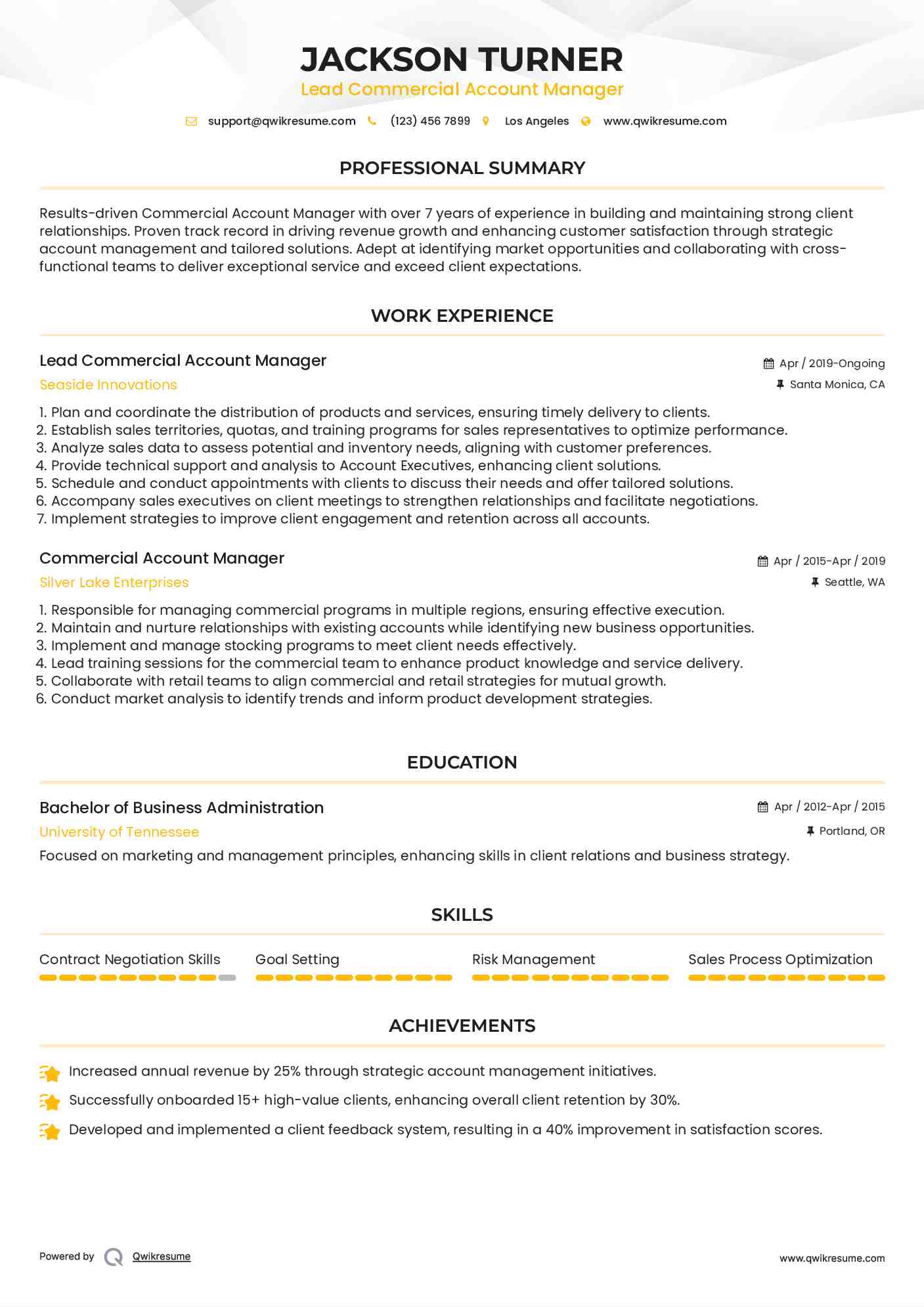


Reference Examples
A commercial line account manager resume Template works best when its structure makes professional evidence easy to recognize. The most useful reference points are the placement of the professional summary, work history, education, skills, and supporting qualifications. Commercial insurance candidates can borrow the information hierarchy from a strong general resume while replacing generic experience with account-specific evidence such as renewals, coverage analysis, carrier communication, policy administration, client service, and risk-related responsibilities. The following examples come from publicly accessible document references and are presented as visual references for structure rather than as commercial insurance content.
These visuals also demonstrate why there is no single correct appearance for a commercial line account manager resume Template . Some examples use traditional chronological formatting, while others use more modern spacing, color, section placement, or typography. The best choice is the one that keeps your experience clear, credible, and easy to review. When adapting a visual example, preserve the useful hierarchy but replace every personal detail, career claim, qualification, and achievement with information that accurately describes your own professional history.

Resume Outline
Source: Wikimedia Commons

Example Resume
Source: Wikimedia Commons

Example Resume
Source: Wikimedia Commons

Resume Example
Source: Wikimedia Commons

Hoja de Vida 2021
Source: Wikimedia Commons

Japanese style resume
Source: Wikimedia Commons

CV example with centered title
Source: Wikimedia Commons

Example Resume of a Senior Sales Director
Source: Wikimedia Commons

Resume logo
Source: Wikimedia Commons

Shevach Eden Curriculum Vitae
Source: Wikimedia Commons
