An employee retention legal compliance review hr Template is most useful when it does more than list retention ideas. A strong review framework connects employee experience, HR policy, employment records, compensation practices, performance management, leave administration, privacy controls, and separation procedures so that an organization can identify gaps before they become operational or legal problems. The document should also make clear which findings are confirmed requirements, which are internal policy decisions, and which need specialist legal review.
Searches for an employee retention legal compliance review hr Template often reflect several needs at once: a structured HR review form, a retention assessment, a compliance checklist, a records-retention schedule, and a practical action plan. That means the best template is not simply a generic employee retention worksheet. It should provide a repeatable method for documenting scope, evidence, findings, owners, deadlines, and follow-up while allowing the organization to adapt the review to its workforce and jurisdictions.
The legal component is especially important because retention practices can touch many regulated areas. For example, U.S. federal recordkeeping rules administered by the Equal Employment Opportunity Commission require covered employers to retain certain personnel and employment records for specified periods, while other requirements apply to payroll, benefits, safety, immigration documentation, or particular types of employee information. California and the UK can impose additional or different obligations. A review template therefore should never assume that one retention period applies to every record or every location.

What an employee retention legal compliance review should accomplish
The central purpose of the review is to determine whether retention practices are both effective and appropriately controlled. Retention is not merely a matter of increasing tenure. HR should be able to explain how it identifies turnover patterns, gathers employee feedback, evaluates retention risks, communicates policies, manages development opportunities, administers compensation consistently, and records significant decisions.
A useful review also separates retention outcomes from retention activities. A retention rate or voluntary turnover measure describes an outcome, while stay interviews, career development, manager training, compensation reviews, recognition practices, and flexible-work arrangements are activities that may influence that outcome. This distinction matters because a high retention rate by itself does not prove that every HR practice is compliant or fair.
The review should also establish evidence standards. A reviewer should be able to identify the policy being assessed, the relevant records or process evidence, the jurisdiction involved, the person responsible, the date reviewed, and the corrective action if a gap is identified. This turns a template into a governance instrument rather than a document that is completed once and then forgotten.

Core sections to include in the HR review template
Scope, ownership, and review period
Start with basic document control. Record the organization, business units included, workforce locations, employee population, review period, reviewer, HR owner, and date of the next review. If the organization operates across multiple jurisdictions, identify each relevant location rather than treating the workforce as a single legal population.
Ownership should be explicit. HR may coordinate the review, but legal counsel, payroll, benefits, information security, privacy specialists, safety personnel, or local HR leaders may own individual controls. A finding without an accountable owner is much less likely to be resolved. The template should therefore include fields for finding owner, target date, status, evidence, and escalation.
It is also useful to record the reason for the review. A routine annual review has a different context from a review triggered by expansion into a new state, acquisition, restructuring, employee complaints, a regulator inquiry, or a significant change in HR systems. Recording that context helps later reviewers understand why certain controls received greater attention.

Retention strategy and employee experience
The retention section should examine whether the organization has a documented strategy and whether that strategy is connected to actual employee experience. Relevant areas include onboarding, career progression, manager effectiveness, recognition, compensation, benefits, workload, flexibility, internal mobility, learning opportunities, and communication.
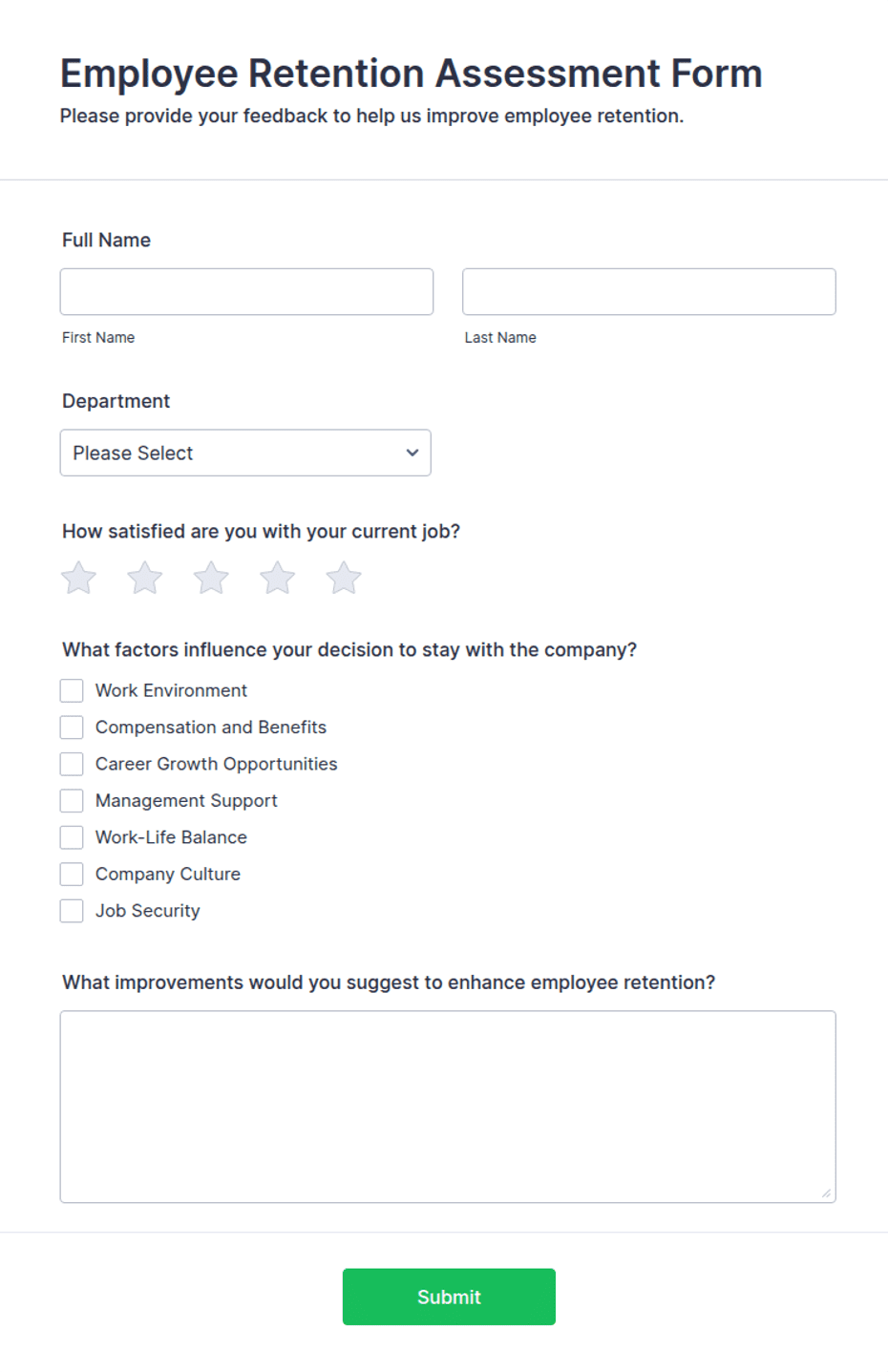
Employee feedback is valuable, but it needs careful handling. Surveys, stay interviews, exit interviews, grievance records, and other feedback mechanisms can reveal themes that quantitative turnover data cannot explain. At the same time, sensitive employee information should not be collected merely because it might be interesting. The review should ask whether the organization has a defined purpose for collecting the information, appropriate access controls, and a documented approach to retention and disposal.
A practical template can ask whether feedback is analyzed consistently, whether managers receive appropriate guidance, and whether identified issues result in documented actions. This creates a closed loop: collect evidence, analyze it, assign an intervention, measure the result, and revisit the issue. A retention review becomes much more useful when it can demonstrate that the organization acts on evidence rather than simply accumulating surveys.
Employee records and retention schedules
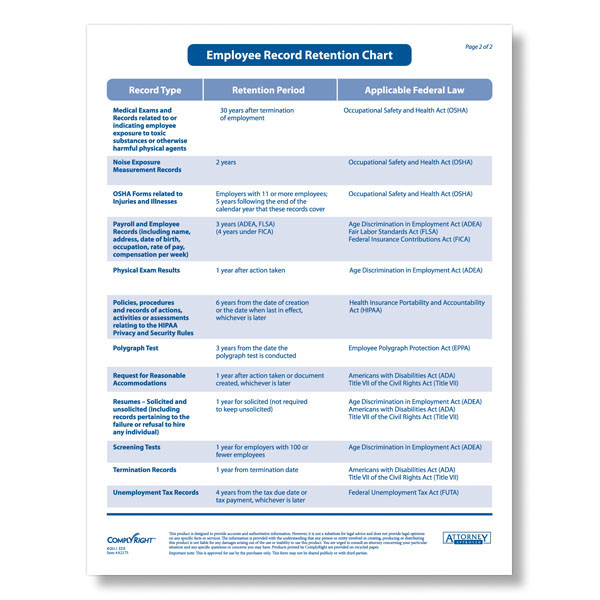
Recordkeeping is one of the most important compliance components. A retention schedule should classify records by type rather than applying one universal period. Personnel files, payroll records, wage information, benefits records, medical information, safety records, work authorization records, performance records, and investigation materials may have different legal or business requirements.
The EEOC states that covered employers generally must retain personnel or employment records for one year, with particular rules applying to involuntary termination and other records. It also identifies longer periods for certain payroll and benefit-related records. OSHA has separate requirements for certain injury and illness records and for employee medical and exposure records. These examples demonstrate why a review template should contain a field for the applicable authority and not merely a blank box labeled “retention period.”
California provides an important example of jurisdiction-specific requirements. The California Department of Industrial Relations states that employers must maintain copies of personnel records for at least three years after termination for purposes connected with employee inspection rights. California also has specific wage and personnel-record rules. These requirements should be assessed alongside federal rules rather than substituted for them.

In the UK, the Information Commissioner’s Office emphasizes storage limitation: personal information should not be kept longer than necessary, and organizations should establish and document standard retention periods wherever possible. The review therefore needs to address both sides of records management: retaining information when law or business need requires it, and avoiding unnecessary retention when it no longer serves a legitimate purpose.
How legal compliance connects to employee retention
Legal compliance is not separate from retention strategy. Employees are more likely to encounter HR policies through everyday events such as hiring, pay decisions, performance reviews, leave requests, accommodations, promotions, disciplinary action, and separation. If these processes are inconsistent or poorly documented, the resulting uncertainty can affect employee trust as well as legal risk.
Consistency should therefore be a central review criterion. If two employees in similar circumstances receive materially different treatment, the organization should be able to explain the legitimate business reason. A template can ask whether decision criteria are documented, whether managers receive consistent guidance, whether exceptions are approved, and whether records support the decision actually made.
Fairness does not mean that every employee receives identical treatment. Legitimate differences can arise from role, location, seniority, contract terms, performance, eligibility, or applicable law. The review should instead test whether differences are based on documented and defensible criteria rather than informal preferences or inconsistent manager judgment.

Compensation, benefits, and retention incentives
Retention programs frequently involve compensation or benefits, which means the review should examine more than whether employees consider the package attractive. HR should assess eligibility rules, approval procedures, communication, payroll treatment, documentation, and consistency. A retention bonus, salary adjustment, promotion, or special benefit can create additional legal and administrative considerations depending on the jurisdiction and circumstances.
The review should identify who approves compensation changes and what evidence supports them. If managers can request exceptions, the process should record the rationale and approval. This helps distinguish a controlled retention intervention from an informal promise that may later conflict with written policy, employment terms, payroll rules, or local requirements.
Benefits should also be assessed for communication and eligibility accuracy. A template can include checks for enrollment records, notices, eligibility decisions, changes in status, and the handling of departing employees. Where specialist rules apply, the template should provide a place to identify the responsible benefits or legal reviewer rather than attempting to encode every possible regulation into a generic checklist.
Performance management and career development
Performance management has a direct relationship with retention because employees need clear expectations, useful feedback, and credible development opportunities. A compliance review should check whether performance criteria are documented, whether reviews occur according to policy, whether managers are trained, and whether employees receive consistent opportunities to understand their progress.
Career development deserves its own review category. A development plan can identify skills, target roles, development actions, ownership, review dates, and evidence of progress. This makes career growth measurable without promising promotion or advancement that the organization cannot guarantee.
The review should also look for potential inconsistency in access to development. If certain groups or locations receive substantially different opportunities, HR should understand why. The objective is not to force identical development plans but to make the decision process transparent, job-related, and consistent with applicable equal-employment principles.


Using surveys, stay interviews, and exit information
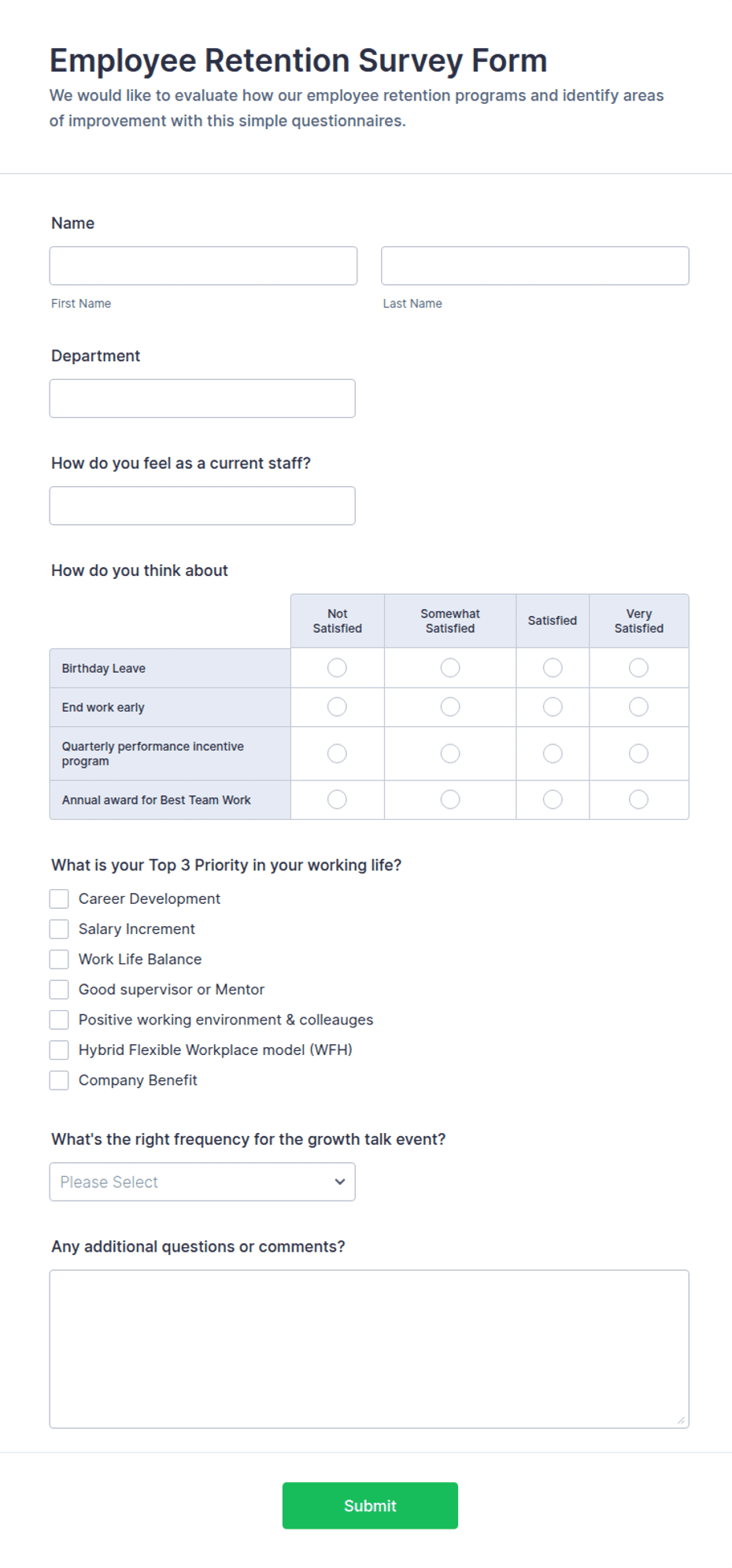
A strong employee retention legal compliance review hr Template should include a controlled method for collecting employee feedback. Stay interviews can ask what employees value, what obstacles they face, what skills they want to use, and what changes might improve their experience. Exit interviews can identify recurring reasons for departure and reveal process weaknesses that are not visible in routine engagement data.
Survey design matters. Questions should be understandable, relevant to the decision being made, and proportionate to the purpose of the exercise. If an organization asks for sensitive information, it should understand why that information is needed, who will access it, how long it will be kept, and how results will be communicated.
The review should also assess what happens after data collection. If employees repeatedly identify career growth as a concern but no action is assigned, the feedback process becomes performative. A better framework records the theme, evidence, responsible owner, proposed intervention, target date, and later outcome.


Jurisdiction-specific considerations
California
Organizations searching for an employee retention legal compliance review hr template california should treat California as a jurisdiction-specific review rather than simply adding “California” to a national checklist. The state has its own wage, personnel-record, leave, privacy, workplace safety, and other employment requirements. A good template should therefore include fields for the specific California rule being assessed, the evidence reviewed, the responsible owner, and the date the requirement was last confirmed.
California personnel-file rules illustrate the importance of precise record management. The California Department of Industrial Relations explains that current and former employees can have rights to inspect and receive copies of qualifying personnel records and that employers must maintain personnel records for at least three years after termination for this purpose. A retention review should therefore examine not only how long records are kept but also whether they can be located and produced within the applicable process.
California wage and pay-equity recordkeeping can create additional retention considerations. The state identifies several categories of records with specified periods, including wage statements, wage-rate histories, hours worked, and certain personnel records. The correct approach is to map each record category to its governing rule rather than copying one generalized retention period across the HR system.

United Kingdom
An employee retention legal compliance review hr template uk should incorporate UK employment and data-protection considerations while avoiding the assumption that every record has a single statutory period. The ICO explains that organizations need to consider how long worker information is needed, document retention schedules where appropriate, and periodically review information so that unnecessary personal data can be erased or anonymised.
That principle changes how HR should think about retention. A record may be valuable for one purpose but unnecessary for another. For example, an organization might need evidence of a particular employment decision while no longer needing unrelated personal details collected during an earlier process. A review should therefore distinguish the purpose of the record, the applicable retention requirement, the access group, and the planned disposal or anonymisation process.
Security should also be part of the review. The ICO identifies appropriate security measures as part of the protection of worker health information and other personal data. The template can therefore ask whether access is restricted, whether sensitive records are segregated where appropriate, whether permissions are reviewed, and whether the organization has a documented process for correcting or deleting information when required.
Choosing the right template format
The phrase employee retention legal compliance review hr template free commonly indicates that readers want a practical starting point without a complicated procurement process. The important consideration is not the price of the document but whether its structure supports the review. A useful template should allow fields to be edited, responsibilities to be assigned, evidence to be referenced, and findings to be tracked.
For teams that prefer a document-based workflow, an employee retention legal compliance review hr template word can work well when the review is narrative-heavy. A document format is useful for executive summaries, findings, policy assessments, legal-review notes, and corrective-action narratives. It becomes less effective when hundreds of individual records or recurring compliance dates must be tracked.
Organizations seeking an employee retention legal compliance review hr template pdf may prefer a stable review form for circulation, sign-off, or archival purposes. A PDF-style layout is particularly useful when the organization wants to preserve the appearance of a completed review. It should not, however, be treated as evidence that the underlying process is legally compliant; the substance of the review still depends on accurate jurisdictional analysis and evidence.

An employee retention legal compliance review hr template excel is better suited to structured data, recurring reviews, evidence logs, deadlines, and trend analysis. A spreadsheet can separate record categories, retention periods, review status, owners, and due dates into distinct fields. It can also support filters that help HR locate overdue reviews or recurring issues.
For collaborative teams, an employee retention legal compliance review hr template google docs can be useful for narrative drafting and shared review, while structured spreadsheet work may be better handled separately. The key is to preserve version control and clearly identify which document is authoritative. Multiple uncontrolled copies can create uncertainty about which retention schedule or policy version is current.
Searchers also use phrases such as employee retention legal compliance review hr template download and employee retention legal compliance review hr template kit when looking for a broader package rather than one form. A sensible kit would contain a review scope sheet, compliance checklist, records schedule, findings log, action plan, employee feedback instrument, and sign-off page. Each component should have a defined purpose rather than duplicating information across several documents.
Some readers search for employee retention legal compliance review hr template reddit because community discussions can reveal practical experiences with HR workflows. Such discussions can be useful for discovering common implementation problems, but they should not be treated as authoritative evidence of legal requirements. The review should always trace legal conclusions to current primary or professionally authoritative sources.
Organizations may also search for employee retention legal compliance review hr template letters when they need communication materials connected to the review. Letters can support policy updates, review notices, employee communications, corrective-action acknowledgments, or separation processes. Each letter should be reviewed against the applicable jurisdiction and actual circumstances rather than copied as a universal legal form.
Building the findings and risk-rating section
A good findings section should distinguish between a confirmed compliance gap, a policy inconsistency, an operational weakness, and a recommended improvement. These categories should not be treated as interchangeable. For example, missing evidence may be an operational weakness, while a failure to meet a specific statutory retention requirement may represent a legal compliance issue.
Risk ratings should be understandable and consistently applied. A simple model can consider legal exposure, employee impact, likelihood, scope, and urgency. The template should require an explanation for a high-risk rating rather than allowing reviewers to select a color or label without supporting reasoning.
Every finding should produce an action. Useful fields include issue description, evidence, applicable rule or policy, risk level, corrective action, owner, due date, status, verification method, and closure date. This creates an audit trail showing not only what was wrong but how the organization responded.

Metrics that belong in a retention compliance review
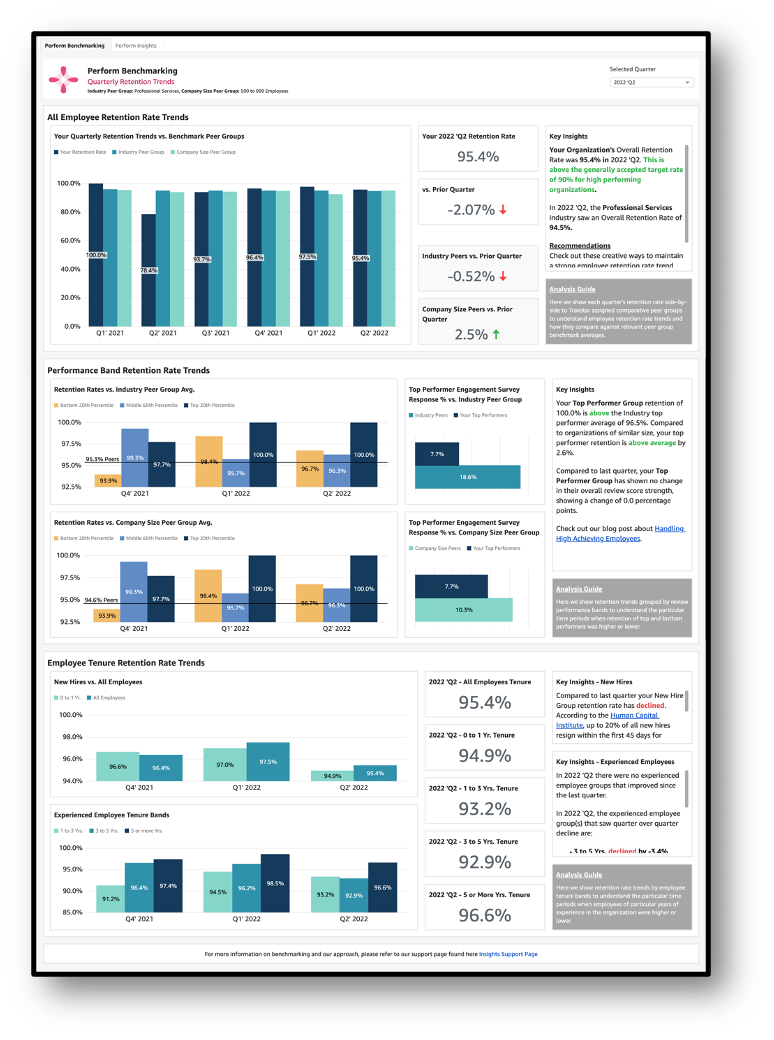
Metrics should be selected because they answer a management question. Useful measures may include voluntary turnover, involuntary turnover, retention by tenure group, retention in critical roles, average tenure, internal mobility, stay-interview completion, exit-interview themes, development-plan completion, and employee feedback scores.
Metrics should be segmented carefully. An overall retention rate can hide substantial differences between departments, locations, job families, managers, or tenure groups. However, segmentation must be handled responsibly because small groups can create privacy concerns and misleading conclusions. The template should specify minimum reporting thresholds or appropriate aggregation practices where needed.
Numbers should also be interpreted rather than simply displayed. A change in turnover might result from workforce restructuring, seasonal hiring, a change in reporting definitions, a new business acquisition, or an actual change in employee experience. A compliance review should document the definition used, data source, reporting period, and interpretation so that future comparisons remain meaningful.


Practical Solution
The most practical way to implement an employee retention legal compliance review hr Template is to build one master review with linked supporting records. Begin by defining the workforce scope and jurisdictions. Then list the retention-related processes that will be assessed: hiring, onboarding, compensation, benefits, performance, development, employee feedback, records management, leave, accommodations, grievances, investigations, and offboarding. For each area, identify the governing policy, responsible owner, evidence source, review date, and escalation route.
Next, separate legal requirements from organizational choices. Mark each review item as a legal requirement, internal policy, contractual obligation, business practice, or recommended control. This prevents a common mistake in HR templates: presenting a suggested practice as if it were mandatory law. Where the requirement is jurisdiction-specific or technically complex, record the source and send the issue to qualified employment counsel or another appropriate specialist.
Finally, turn every unresolved issue into an action with a named owner and deadline. Do not close a finding simply because someone has promised to fix it. Define the evidence required for closure, such as an updated policy, corrected record, completed training, revised retention schedule, documented approval, or verified system control. Schedule a later validation review so that the organization can confirm that the corrective action actually changed the process.
For a small HR team, a quarterly review of high-risk controls plus a broader annual review can provide a practical rhythm, although the appropriate frequency depends on the organization’s workforce, jurisdictions, regulatory exposure, and internal governance. Reviews should also be triggered when there is a significant change in law, workforce location, HR system, acquisition, restructuring, or records-management process.
A useful implementation sequence is:
- Define scope: identify workforce groups, locations, business units, and review objectives.
- Map obligations: connect each process to the applicable law, regulation, contract, policy, or documented business requirement.
- Inventory evidence: identify policies, records, reports, system controls, survey results, and approvals that support each review item.
- Assess gaps: distinguish legal gaps from policy inconsistencies and operational improvements.
- Assign ownership: give each material finding one accountable owner and a target date.
- Escalate appropriately: involve qualified legal or specialist reviewers when the issue requires jurisdiction-specific interpretation.
- Verify closure: require objective evidence before marking a finding complete.
- Refresh the template: update the review framework when laws, policies, systems, or workforce conditions change.


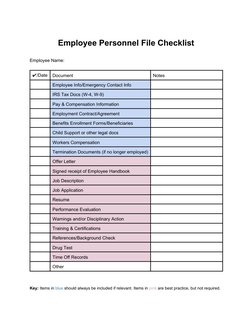
Common mistakes to avoid
One common mistake is treating retention as a purely cultural issue. Culture matters, but an organization can have a strong employee experience and still have weak recordkeeping, inconsistent compensation controls, or unclear retention schedules. The review needs both people-focused and compliance-focused evidence.
Another mistake is using one retention period for every record. Employment information is not one homogeneous category. Different laws can apply to different records, and some records may need to be retained for longer than ordinary personnel information. A defensible schedule should identify record type, purpose, governing requirement, start point, end point, owner, storage location, and disposition method.
A third mistake is allowing the checklist to become a static document. A completed review has limited value if findings are not tracked through resolution. The strongest process treats the template as part of an ongoing control cycle in which HR reviews, acts, verifies, and updates.


How to evaluate a template before adopting it
Before adopting any employee retention legal compliance review hr Template, check whether it has enough space for jurisdiction, evidence, ownership, and review dates. A visually attractive checklist may still be inadequate if it does not distinguish between legal requirements and internal practices.
Look for flexibility. The template should allow organizations to add new jurisdictions, record types, policy changes, and emerging risks without rebuilding the entire framework. It should also allow reviewers to document “not applicable” decisions and explain why an item does not apply.
Finally, assess whether the template supports defensible decision-making. It should encourage source verification, evidence collection, consistent scoring, documented remediation, and periodic reassessment. The best design is not necessarily the longest one. It is the one that makes important HR controls easier to review consistently and easier to explain later.


Reference Examples
An employee retention legal compliance review hr Template works best when its visual structure mirrors the actual HR control process. The examples below illustrate several useful document patterns: a review cover sheet, a retention schedule, a tracker, a retention plan, a compliance checklist, an employee survey, a stay-interview form, and analytical dashboards. Together, these formats show how a review can move from scope and evidence collection to risk assessment, retention planning, measurement, and follow-up. They are references for structure and visual organization rather than universal legal forms, because the applicable rules and retention periods depend on the organization, record category, workforce location, and circumstances.
These visuals can also help teams compare different working formats before building their own employee retention legal compliance review hr Template. A document-oriented layout may work well for narrative findings and approvals, while a spreadsheet-style tracker is better suited to record inventories and deadlines. Survey and interview forms help organize employee feedback, whereas dashboards help interpret retention trends. The most useful design combines these elements without duplicating information and keeps a clear distinction between employee experience evidence, operational controls, and legal requirements.

HR Record Retention Schedule and Tracker Template
Source: Template.net

HR Record Retention Schedule and Tracker Features
Source: Template.net
HR Retention Plan Template
Source: Lumin

Performance Appraisal Checklist
Source: Venngage

Employee Termination Checklist
Source: Venngage

New Employee Training Checklist Template
Source: Venngage

New Employee Mentorship Onboarding Checklist
Source: Venngage

New Hire Onboarding Checklist
Source: Venngage

New Hire Preboarding Checklist
Source: Venngage

New Hire Pre-boarding HR Checklist
Source: Venngage
