A strong business operations specialist resume Template should make it easy for a recruiter to understand what you manage, how you improve processes, which tools you use, and what measurable results you have produced. Business operations roles can span reporting, process improvement, budgeting, project coordination, vendor management, compliance, customer operations, data analysis, and cross-functional support, so a useful resume must be specific rather than generic.
The role also sits within a broad occupational family. The U.S. Bureau of Labor Statistics classifies business operations specialists, all other, under occupational code 13-1199 and describes the group as covering business operations work that is not classified elsewhere. Current BLS occupational information also lists a bachelor’s degree as the typical education level for business operations specialists in this category. These facts are useful context, but the exact requirements of an individual vacancy should always take priority over a generic template.
Current resume guidance from major career resources consistently emphasizes relevance, measurable achievements, clear sections, strong action verbs, and alignment with the target job description. Indeed’s current operations specialist guidance, for example, recommends clearly organized sections for experience, skills, education, and a professional summary, while recent specialist examples emphasize process improvement, reporting, operational analysis, and cross-functional work. :contentReference[oaicite:0]{index=0}

What a Business Operations Specialist Resume Needs to Communicate
The central purpose of the resume is to connect your previous work with the employer’s operational problems. A hiring manager should quickly see evidence that you can organize information, coordinate activities, analyze performance, improve workflows, maintain accurate records, and support business decisions. Simply describing yourself as organized, analytical, or detail-oriented is much weaker than showing where those qualities produced a useful outcome.
Business operations specialists often work between several functions rather than inside one narrow department. A role may involve finance, sales, customer success, procurement, technology, human resources, logistics, or executive reporting. That makes cross-functional coordination particularly valuable to show. Instead of writing that you “worked with other teams,” explain which teams you coordinated, what problem they were solving, and what changed as a result.
Your resume should also show the scale and complexity of your work whenever the information is genuine. Examples include the number of processes supported, reporting frequency, size of a budget you monitored, number of stakeholders coordinated, volume of transactions handled, geographic scope, or time saved through a process improvement. Numbers should describe real achievements rather than invented claims.

Choose the Right Resume Structure
For most business operations specialists, a reverse-chronological structure is a practical starting point because it lets the reader see career progression quickly. A hybrid format can also work when you have transferable skills from several functions, a career transition, or a mixture of operational, analytical, and project-based experience. The most important consideration is that the format should make relevant evidence easy to find rather than hiding experience behind a large skills block.
A clean structure normally begins with contact details and a professional headline, followed by a concise summary, key skills, professional experience, education, and relevant certifications. Additional sections such as selected projects, technical tools, languages, or professional development can be included when they strengthen your candidacy. Every section should earn its space by helping the reader understand your suitability for business operations work.
Current resume guidance commonly favors concise documents that prioritize recent and relevant experience. Indeed’s operations specialist guidance states that one to two pages is generally appropriate, while other resume resources similarly recommend tailoring length to experience rather than adding material simply to fill space. :contentReference[oaicite:1]{index=1}
Recommended Section Order
- Name and professional contact details: Use a professional email address, phone number, location, and an optional professional profile link.
- Professional headline: State the target role clearly, especially when your current job title differs from the vacancy title.
- Professional summary: Present experience, operational strengths, and one or two credible results.
- Core skills: Include relevant operational, analytical, financial, project, and technical skills.
- Professional experience: Focus on achievements, scope, responsibilities, and measurable outcomes.
- Education: List the most relevant degree, institution, and completion details.
- Certifications and additional skills: Add credentials or tools that are genuinely relevant to the role.
Write a Business Operations Specialist Resume Summary
The summary should answer three questions quickly: what level of professional are you, what operational capabilities do you bring, and what kind of impact have you delivered? A strong summary is not a personal biography. It is a compact positioning statement that makes the rest of the resume easier to interpret.
For an experienced specialist, a useful pattern is to begin with years of relevant experience, identify two or three areas of strength, and finish with a credible achievement. For example, a hypothetical candidate could write: “Business Operations Specialist with six years of experience improving reporting workflows, coordinating cross-functional projects, and supporting operational planning. Experienced with Excel, dashboard reporting, process documentation, and stakeholder coordination, with a record of reducing manual reporting effort through workflow redesign.” The example is intentionally generic and should be replaced with the candidate’s actual evidence.
For an entry-level candidate, the summary can focus more on transferable evidence. Coursework, internships, project coordination, analytical work, customer operations, finance support, or process documentation can demonstrate relevance. Do not compensate for limited experience by filling the summary with vague adjectives. Show what you have actually done and connect it to the target role.

Build a Strong Skills Section
A business operations specialist may need a broad combination of hard and soft skills. The strongest skills section reflects the actual vacancy instead of copying a long collection of popular terms. If the position emphasizes operational reporting, prioritize reporting and data skills. If it focuses on project coordination, emphasize project planning, stakeholder communication, documentation, and tracking.
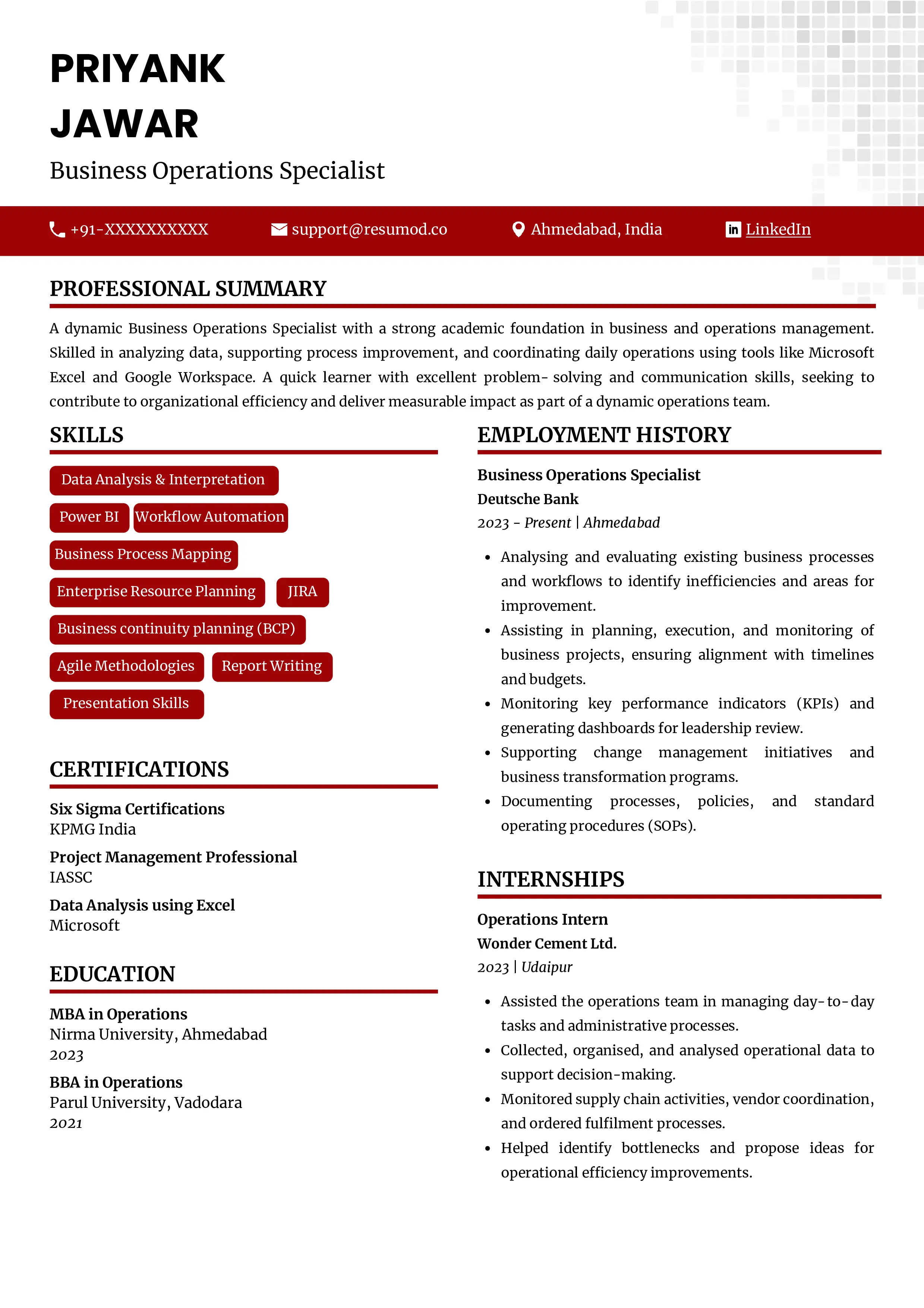
Relevant technical skills can include Microsoft Excel, SQL, Power BI, Tableau, enterprise resource planning systems, customer relationship management systems, workflow platforms, reporting systems, and project management tools. Resumod’s current business operations specialist example highlights data interpretation, Power BI, workflow automation, business process mapping, enterprise resource planning, Jira, business continuity planning, reporting, and presentation skills. :contentReference[oaicite:2]{index=2}
Soft skills should be supported by experience whenever possible. Communication, prioritization, analytical thinking, problem solving, organization, adaptability, and stakeholder management are more convincing when demonstrated through an achievement bullet. Rather than listing “problem solving” alone, show the operational issue you identified, the action you took, and the result that followed.

Turn Work Experience Into Evidence of Impact
The experience section is usually the most important part of a business operations specialist resume because it demonstrates how you have applied your skills. Each role should make the reader understand the operating environment, your responsibilities, and the outcomes you influenced. Begin with the most relevant achievements rather than a long list of routine duties.
A useful bullet often follows an action, task, and result pattern. For example, instead of writing “Responsible for monthly reports,” a stronger hypothetical version would be “Redesigned the monthly operations reporting workflow, consolidating recurring data sources and reducing preparation time by 30%.” The percentage in this example is hypothetical; a real resume should use the candidate’s verified result.
Operations work often involves improvements that are difficult to describe because they happen behind the scenes. Think about reduced processing time, fewer errors, clearer documentation, better data visibility, faster approvals, improved vendor coordination, stronger controls, smoother onboarding, better resource allocation, or more reliable reporting. These are all potential sources of resume evidence when they accurately reflect your work.

Use Strong Operations Action Verbs
- Analyzed operational performance and identified process bottlenecks.
- Streamlined recurring reporting workflows and documentation.
- Coordinated cross-functional initiatives involving finance, sales, and operations.
- Monitored key performance indicators and prepared leadership reports.
- Implemented process controls to improve consistency and accuracy.
- Developed standard operating procedures for recurring operational activities.
- Reconciled operational and financial records to support accurate reporting.
- Optimized resource allocation based on operational data.
- Audited workflows and recommended corrective actions.
- Facilitated stakeholder communication during operational projects.
Show Operational Metrics Without Inventing Results
Metrics make operational experience easier to understand, but they should be used responsibly. The best numbers come directly from business records, project documentation, reporting systems, financial summaries, or other evidence you can substantiate. Useful measures may include processing volume, cycle time, error rate, cost variance, reporting time, service levels, turnaround time, completion rates, budget scope, or project duration.
When an achievement does not have a precise number, you can still describe its scope accurately. “Coordinated weekly reporting across finance, sales, and customer operations” provides useful context without inventing a percentage. “Maintained operational documentation for a multi-site team” is also meaningful when the number of sites is known and can be stated honestly.
Do not turn every bullet into a numerical claim. A resume filled with percentages can look artificial if the numbers lack context. Balance measurable outcomes with clear descriptions of the operational problem, your contribution, the tools involved, and the business consequence.

Make the Resume ATS-Friendly Without Making It Generic
An applicant tracking system can influence how a resume is processed, so clear headings, conventional terminology, and readable formatting are sensible choices. However, there is no universal keyword formula that guarantees a successful result. The strongest strategy is to use terminology that genuinely describes your experience and corresponds with the language used in the target job description.
For example, if a vacancy repeatedly refers to “process improvement,” “KPI reporting,” “stakeholder management,” and “operational planning,” those concepts should appear naturally in your experience if you have actually performed them. Do not insert unrelated terms merely because they are popular. Recruiters still need to understand the document after it passes any automated screening.
Complex graphics, excessive columns, decorative icons, unusual headings, and text embedded inside images can make information harder to process. A restrained layout with clear section headings, consistent spacing, readable typography, and straightforward bullet points is usually a safer choice for business operations positions.
Choosing Between Word, Google Docs, PDF, and Other Formats
People searching for a business operations specialist resume template free are often looking for a starting structure rather than a particular visual design. The important question is whether the format lets you edit sections cleanly and preserve consistent spacing. A simple Word-based structure can be useful when you expect to make substantial changes, while a Google Docs version can be convenient when you need browser-based editing or collaboration.
A search for a business operations specialist resume template word usually reflects a preference for a familiar document-editing workflow. Word is particularly useful when you need control over page breaks, section spacing, bullets, and document formatting. Before sending a Word-based resume, inspect the final pages carefully because small edits can sometimes change line breaks or create unwanted blank space.
People seeking a business operations specialist resume template google docs may value collaborative editing, access across devices, and straightforward version management. Regardless of the editor, the underlying content matters more than the platform. A strong Google Docs layout and a strong Word layout should contain the same core evidence: relevant experience, targeted skills, measurable accomplishments, education, and accurate contact details.

When PDF Is the Better Final Format
A business operations specialist resume template pdf can be useful when the final visual appearance needs to remain consistent across devices. PDF preserves page structure, spacing, fonts, and section placement more reliably than editable formats in many situations. It is especially useful for reviewing the final presentation before submission.
However, the exact submission instructions of the employer should always control. If a vacancy specifically requests another format, follow those instructions. When no format is specified, a clean PDF is often a practical final version, provided the text remains selectable and readable rather than being flattened into a single image.
Readers searching for a business operations specialist resume template download or a business operations specialist resume template pdf should distinguish between a visual example and a genuinely editable document. An image that looks like a resume may be useful for studying layout, but it is not equivalent to an editable template. Verify the nature of any resource before relying on it.

Regional Considerations for UK and Australia
A business operations specialist resume template uk search often reflects differences in terminology and local hiring conventions. UK employers may use “CV” more frequently than “resume,” and job descriptions can differ in wording from those used by U.S. employers. The safest approach is to mirror the terminology used in the vacancy while keeping the document focused on professional evidence.
For someone researching a business operations specialist resume template australia, the same principle applies: use the language, spelling conventions, location details, and professional terminology expected by the Australian employer. Avoid assuming that one country’s resume conventions automatically apply everywhere. Research the target vacancy and employer rather than relying solely on a generic regional template.
Regional adaptation should not change the substance of your achievements. The goal is to present the same truthful experience in a format and vocabulary that makes sense to the intended audience. Location, work authorization, professional memberships, and other details should only be included when they are relevant or requested.
How to Use Word and Document-Based Templates
A business operations specialist resume template word free search can be useful when you want a conventional document that can be heavily customized. The key is to remove placeholder language completely and replace it with evidence from your own career. A template should provide structure, not dictate your professional story.
A business operations specialist resume template doc can serve the same purpose when the resource is supplied in an editable document format. Check every section after editing. Look for inconsistent dates, different bullet styles, accidental duplicate headings, uneven spacing, and leftover sample content. These small issues can make an otherwise strong resume appear unfinished.
If you are working from a business operations specialist resume template from resume material you already have, treat the existing document as source material rather than as a final version. Extract the strongest achievements, identify the capabilities most relevant to the target role, remove outdated material, and rebuild the hierarchy around the vacancy. This is usually more effective than changing fonts and colors without revising the content.

How to Handle Online Discussions and Community Advice
A search for a business operations specialist resume template reddit can reveal practical experiences from job seekers, recruiters, and career communities. Such discussions can be useful for discovering common concerns, but they should not be treated as authoritative requirements. Individual experiences vary by employer, industry, geography, seniority, and hiring process.
Community advice is most useful when it helps you identify questions to investigate. For example, discussions may raise concerns about overly designed resumes, excessive length, weak achievement bullets, or unclear technical skills. Use those observations as prompts to evaluate your own document rather than assuming that every comment represents a universal hiring rule.
The same principle applies to any template or example found online. A visually attractive resume may have been designed for a different profession or market. A plain document may contain much stronger evidence. Evaluate the information hierarchy, relevance, clarity, and credibility of the content rather than copying appearance alone.

Tailor the Resume to the Actual Job Description
Tailoring is particularly important for business operations positions because job scopes vary substantially between employers. One specialist may focus on financial operations, another on customer operations, another on supply chain processes, and another on business planning or technology-enabled workflow improvement. Your resume should make the relevant version of your experience visible.
Start by separating the vacancy into categories: core responsibilities, required tools, business outcomes, stakeholder groups, and preferred qualifications. Then identify where your own experience provides credible evidence. Prioritize those matches in the summary, skills section, and first few bullets under the most relevant roles.
Do not copy the employer’s job description into your resume. Translate its requirements into evidence from your own work. If the vacancy asks for KPI reporting, explain which metrics you monitored and how the information was used. If it asks for process improvement, identify the workflow, your intervention, and the resulting improvement.
Education, Certifications, and Technical Tools
Education should be presented clearly and proportionately. Business administration, operations management, finance, accounting, supply chain, analytics, economics, and related degrees can be relevant depending on the position. BLS current occupational information lists a bachelor’s degree as the typical education level for business operations specialists, all other, but individual employers can set different requirements. :contentReference[oaicite:3]{index=3}
Certifications should support the story rather than dominate it. Project management, process improvement, supply chain, analytics, or quality credentials can be useful when they correspond with the target role. If you list a certification, include the official name and issuing organization, and avoid listing credentials that you cannot verify.
Technical tools should also be connected to outcomes. Instead of creating a long software inventory, show how you used Excel to reconcile records, Power BI to present operational metrics, SQL to retrieve data, a CRM to manage operational information, or a project platform to track delivery. Tool names are more persuasive when the reader can see what you accomplished with them.

Common Mistakes to Avoid
One common problem is describing responsibilities without showing value. “Managed reports” tells the reader very little. “Prepared weekly operational reports used by finance and leadership to monitor service levels and unresolved issues” provides more context. The second version explains what the work supported and who relied on it.
Another mistake is creating an oversized skills section while giving too little detail about professional experience. Skills matter, but experience demonstrates whether you can actually apply those skills. Keep the skills section focused and use the experience section to prove the most important capabilities.
A third problem is excessive design. Business operations hiring generally rewards clarity because the reader needs to understand processes, metrics, systems, and responsibilities quickly. A clean hierarchy, consistent typography, and restrained formatting can make operational achievements easier to evaluate than a highly decorative layout.

Practical Solution
Start by creating a master career inventory before editing the template. List every relevant role, project, recurring responsibility, operational system, reporting activity, process improvement, stakeholder group, certification, and measurable result you can substantiate. Do not worry about length at this stage. The purpose is to create a reliable evidence bank from which the final resume can be tailored.
Next, study the target vacancy and highlight its recurring requirements. Group them into operational responsibilities, technical capabilities, business outcomes, and interpersonal expectations. Compare those requirements with your evidence bank. Select the strongest matches and place them near the top of the resume. This creates a document that is both readable and specifically relevant to the role rather than merely containing popular operations terminology.
Then rewrite each selected experience bullet around contribution and consequence. Ask: What problem existed? What did I do? Which tools or methods did I use? Who did I coordinate with? What changed afterward? If there is a verified metric, include it. If there is no reliable metric, describe the scope or operational consequence accurately without inventing a number.
Finally, conduct a quality review before sending the document. Check dates, job titles, spelling, contact details, tense consistency, formatting, page breaks, duplicated phrases, and alignment with the target vacancy. Read the document once as a recruiter would: can the most important evidence be understood quickly? Then read it again as a fact checker: can every claim be supported by your actual experience?

Practical Resume Content Blueprint
A useful blueprint for this role can be built around a short professional identity statement, a focused skills block, and achievement-led experience. The summary should position the candidate; the skills section should provide searchable terminology; the experience section should supply proof. Education and certifications then reinforce the professional story rather than carrying it.
For a mid-career candidate, the experience section might contain four to six strong bullets for the current position and fewer for older roles. For an early-career candidate, internships, projects, academic operations work, customer service, finance support, and administrative coordination can provide relevant evidence. The wording should change according to experience level, but the underlying principle remains the same: show operational contribution.
Keep personal details limited to information that is professionally relevant or expected in the target market. Avoid unnecessary claims about personality. A resume has limited space, so evidence of process improvement, reporting, analysis, coordination, financial awareness, systems knowledge, and stakeholder management usually has more value than generic statements about being hardworking or passionate.

Examples of Stronger Experience Bullets
Consider a hypothetical candidate whose work involved recurring reporting. A weak bullet might say, “Created reports for management.” A stronger version could say, “Consolidated recurring operational data into a standardized weekly reporting pack, improving consistency across leadership updates.” If the candidate has a verified time-saving measure, that number can be added. If not, the bullet should remain qualitative.
For process improvement, a stronger pattern could be: “Mapped the customer onboarding workflow, identified duplicated approval steps, and coordinated revisions with sales and operations.” This communicates analysis, process mapping, cross-functional coordination, and implementation without claiming an unsupported business result.
For financial operations, a useful pattern could be: “Reconciled monthly operational expenses against budget records, investigated variances, and prepared findings for the operations manager.” This shows financial awareness and analytical responsibility without exaggerating ownership of the wider finance function.

Design Choices That Support Readability
Use a consistent visual hierarchy. Your name should be prominent, section headings should be easy to locate, dates should follow one consistent pattern, and bullet points should align cleanly. Avoid mixing several font families or using decorative graphics that compete with the content. Business operations resumes benefit from a document-like appearance because the subject itself is structured and process-oriented.
Color can be used sparingly, but it should not replace hierarchy. A subtle accent for headings can work when the target employer accepts a modern style, while a monochrome structure is often appropriate for traditional corporate environments. If you are uncertain, prioritize readability and conventional structure over visual novelty.
Review the final document at normal viewing size rather than judging it only while zoomed in. Make sure important information does not sit too close to page edges, that headings are not stranded at the bottom of a page, and that bullets do not become awkwardly split. The final presentation should look intentional from the first page to the last.

Entry-Level and Career-Change Approaches
An entry-level candidate does not need to pretend to have senior operations experience. Instead, identify situations where you analyzed information, coordinated tasks, supported a process, handled records, prepared reports, improved a workflow, or worked across groups. Academic projects can be relevant when they demonstrate these capabilities and are presented honestly.
Career changers should emphasize transferable operations evidence. Someone moving from customer service may highlight workflow coordination, issue resolution, service metrics, documentation, and escalation management. Someone moving from finance may emphasize reconciliation, reporting, budgeting, controls, and data analysis. Someone moving from project coordination may emphasize schedules, stakeholders, documentation, risk tracking, and delivery management.
The goal is to create a credible bridge between what you have already done and what the employer needs. A template cannot create that bridge by itself. The content must explain why your existing experience is relevant to business operations.

Senior-Level Positioning
Senior business operations candidates should emphasize ownership, scale, decision support, and strategic influence rather than listing every routine responsibility. Leadership can be demonstrated without formal people management. For example, owning a cross-functional process redesign, coordinating multiple departments, establishing reporting standards, or advising leadership on operational risks can all demonstrate senior-level responsibility.
Senior candidates should also show progression where it exists. Promotions, expanded scope, larger budgets, broader geographic responsibility, additional stakeholders, or increasing responsibility for strategic initiatives can demonstrate professional growth. Do not simply state that your responsibilities increased; explain how the scope changed.
At senior levels, the resume should also connect operational work with business outcomes. Cost control, service quality, revenue support, risk reduction, productivity, scalability, customer experience, and decision quality can all be relevant depending on the role. The best emphasis should be determined by the target vacancy.

Final Editing Checklist
- Does the headline clearly match the target business operations role?
- Does the summary explain your strongest relevant capabilities?
- Does each major experience entry contain evidence rather than only duties?
- Are important operational achievements quantified where reliable figures exist?
- Are the listed tools ones you can genuinely use?
- Does the skills section reflect the target vacancy?
- Are dates, job titles, and company names accurate?
- Is the document easy to scan from top to bottom?
- Are unnecessary personal details removed?
- Have placeholder phrases and sample content been completely replaced?
- Have spelling, grammar, spacing, and page breaks been checked?
- Does the final version accurately represent your real experience?

Reference Examples
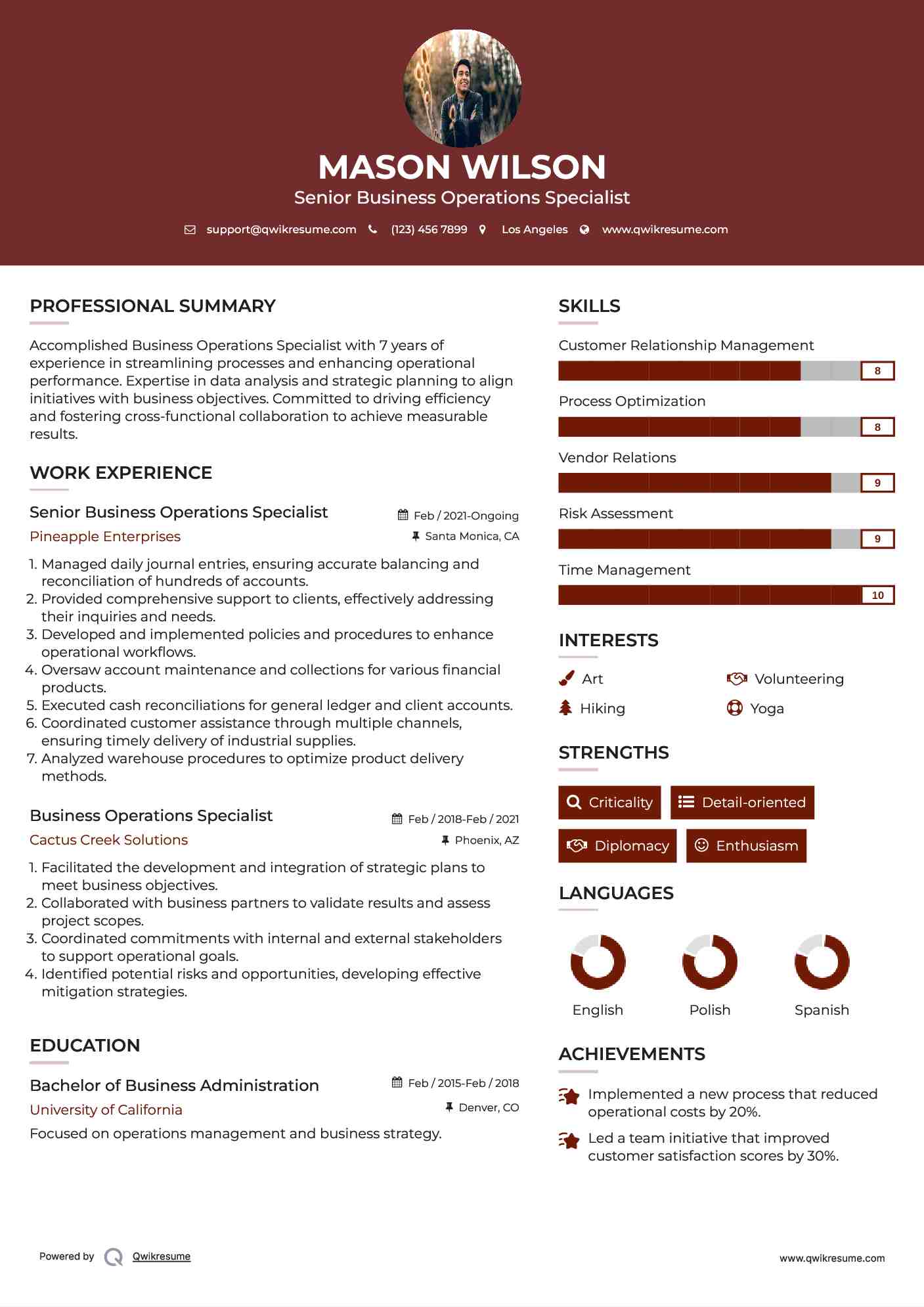
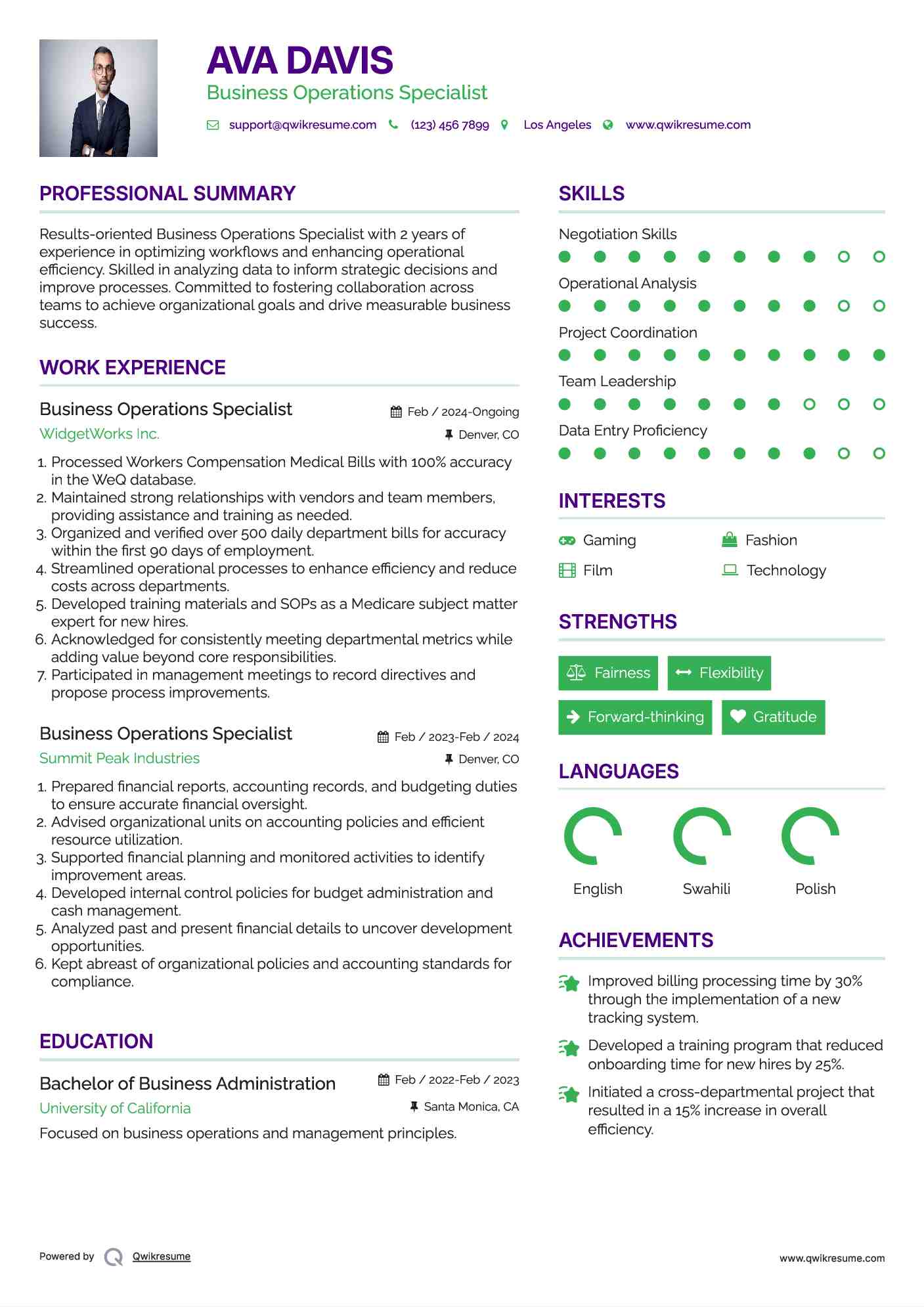
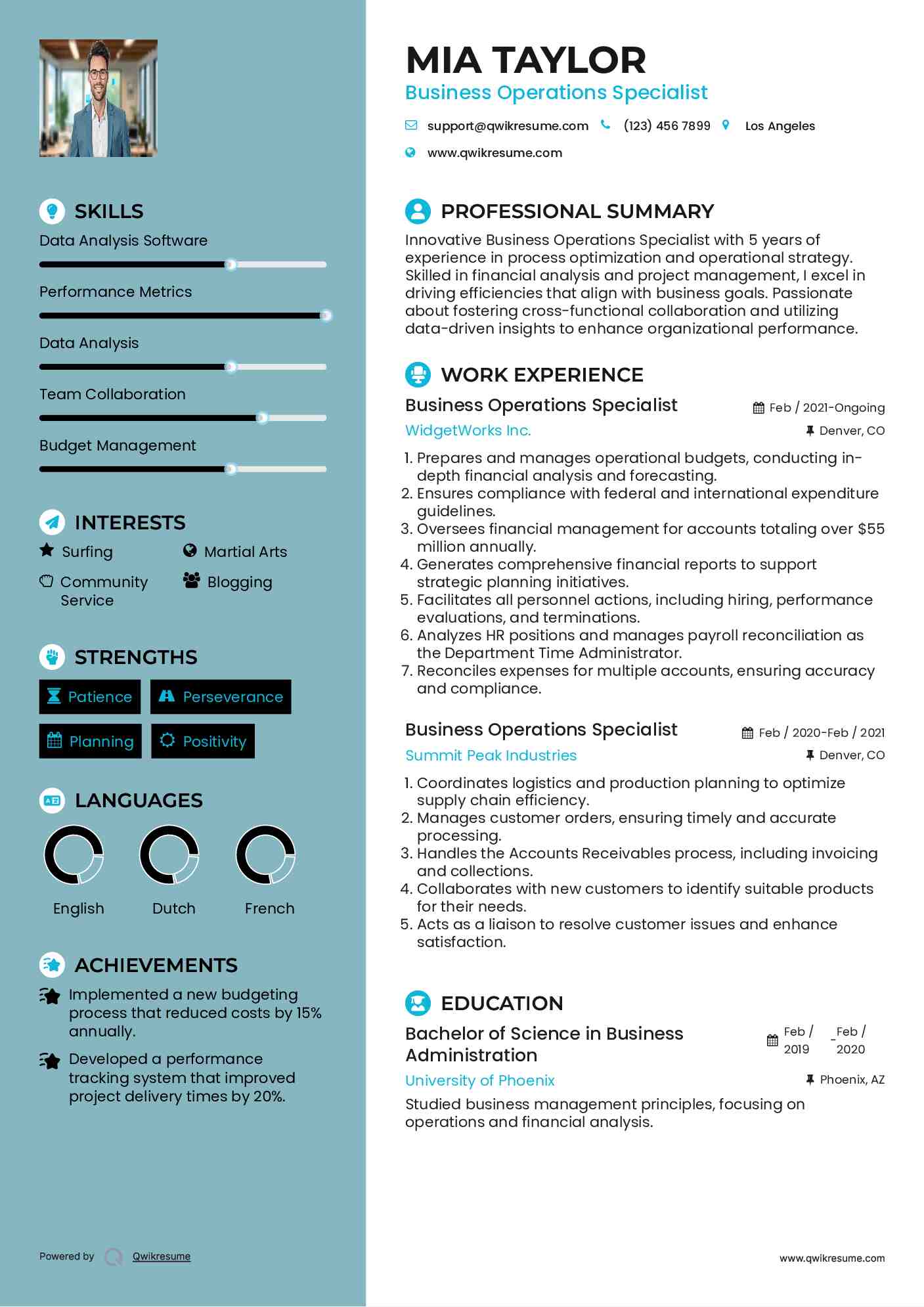
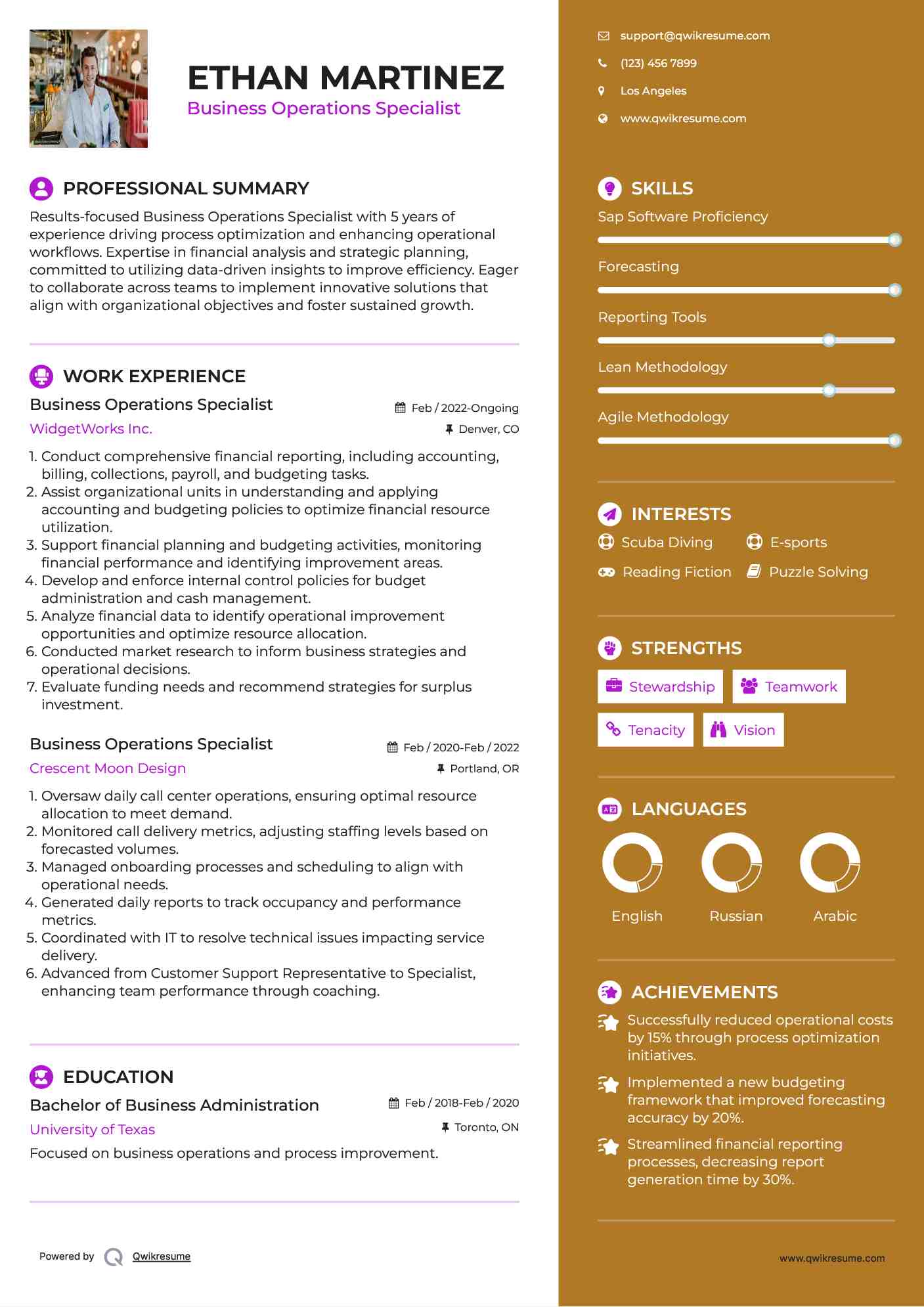
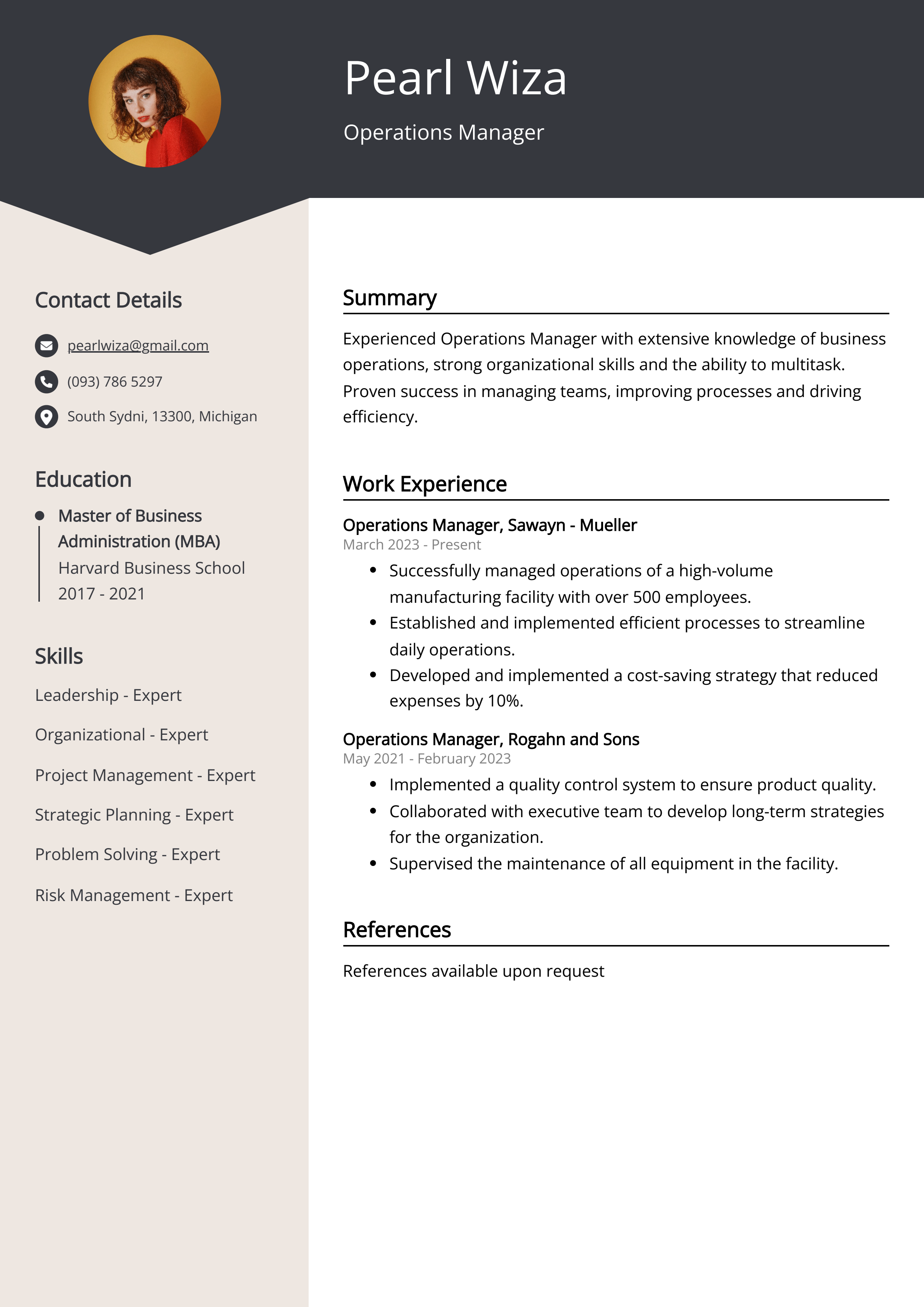
A business operations specialist resume template is most useful when treated as a structural reference rather than a document to copy. The strongest examples typically make the candidate’s professional identity clear at the top, organize experience in a logical sequence, and use skills that correspond with actual operational work. Looking at several examples can reveal how different layouts handle summaries, achievement bullets, technical tools, education, and career progression. The visual references below come from identifiable resume publishers and illustrate different approaches to presenting business operations experience, including traditional single-column structures and more modern layouts.
These reference examples can help you compare hierarchy, density, section order, use of metrics, and the balance between skills and experience when evaluating a business operations specialist resume template. They should not be treated as universal hiring requirements because employers and regions differ. Instead, use them to recognize patterns that make operational evidence easier to understand. The most effective design for your own resume is the one that presents your genuine experience clearly, keeps relevant achievements prominent, and adapts naturally to the specific vacancy you are targeting.
Business Operations Manager Resume Example
Source: Resumaker.ai

Business Operations Specialist Resume Sample
Source: VelvetJobs

Business Operations Specialist Resume Sample
Source: VelvetJobs

Business Operations Specialist Resume Sample
Source: VelvetJobs
Step-by-Step Resume Visual Guide
Source: VelvetJobs
