A strong medical cover letter gives a hiring manager, clinical supervisor, practice administrator, or program director a concise explanation of who you are, what you bring, and why the specific opportunity fits your professional direction. Unlike a curriculum vitae, which records education, training, experience, publications, certifications, and achievements, the letter creates a narrative connection between those facts and the role. A useful medical cover letter template provides the framework for that narrative without forcing every candidate into identical wording.
Searches for a medical cover letter Template usually reflect a practical need: the reader wants to see a professional structure, understand what belongs in each paragraph, choose an appropriate file format, and adapt the content to a particular medical role. That need can vary considerably between an attending physician, resident, medical student, registered nurse, medical assistant, laboratory professional, or healthcare administrator. The strongest approach is therefore to use a clear framework while tailoring evidence, terminology, and emphasis to the position.
Current medical career guidance supports this distinction between factual career records and narrative communication. The American Medical Association notes that a physician CV documents the career chronologically, while a cover letter can provide context and explain where the candidate’s career is going. AAMC guidance likewise emphasizes accuracy, specificity, and relevance when medical candidates communicate their qualifications. The result should be a letter that complements the CV rather than repeating it line by line.

What a medical cover letter Template should accomplish
The primary purpose of a medical cover letter is to connect professional evidence with the needs of a particular opportunity. A physician may need to explain clinical specialization, leadership, quality improvement, teaching, research, or practice interests. A nurse may need to emphasize patient-care experience, clinical judgment, communication, care coordination, and relevant certifications. A student or trainee may have fewer years of employment history, so clinical rotations, research, academic work, service, and professional development can carry more weight.
A useful template should also help the reader find information quickly. The opening should identify the role and establish a clear reason for writing. The middle should provide two or three focused examples that demonstrate relevant qualifications. The closing should communicate professional interest and make it easy for the recipient to identify the candidate. Excessive decoration, long blocks of generic claims, and broad statements about being a hard worker usually provide less useful information than specific evidence connected to the position.
The visual examples commonly found online show several legitimate approaches: traditional single-page letters, modern layouts with restrained color, simple professional documents, and specialty-specific designs. These examples can help with structure, but visual style should remain secondary to readability. Medical employers and training programs need to process substantial amounts of information, so clear typography, logical spacing, consistent margins, and a conventional hierarchy generally matter more than elaborate graphics.

Core sections of an effective medical cover letter
Header and contact information
The top of the letter should make identification straightforward. Include your full professional name, preferred email address, telephone number, city or location when appropriate, and the date. For physicians and other licensed professionals, the professional name should be consistent with the name used on credentials and career records. A recipient’s name and professional title should be included when they can be verified.
For a hospital position, the recipient may be a physician recruiter, department chair, medical director, practice administrator, nursing manager, or human resources representative. For residency-related communication, the program director or another designated program contact may be appropriate when direct outreach is permitted and relevant. If a specific name cannot be confirmed, a neutral professional salutation is preferable to an incorrect name.
The header should not become a miniature biography. Degrees, board certifications, fellowship details, and other credentials belong primarily in the CV and should appear in the letter only when they support the central message. The goal is to establish identity and contact information before the reader reaches the substantive narrative.

Opening paragraph
The first paragraph should answer three questions: what position or opportunity is being addressed, how the candidate learned about it when relevant, and why the opportunity is professionally relevant. A physician applying for a cardiology position might mention a cardiology practice focus and a specific connection to the role. A nurse could identify the unit or specialty. A medical student could explain the academic or clinical opportunity being pursued.
Avoid beginning with a vague statement such as “I am a highly motivated healthcare professional.” Such language makes the letter interchangeable with thousands of other documents. A stronger opening establishes the role and immediately introduces one relevant qualification or area of professional interest.
For example, a hypothetical physician might write: “I am writing regarding the hospitalist physician position at North Valley Medical Center. My recent inpatient training, experience coordinating multidisciplinary care, and interest in quality improvement have prepared me to contribute to a hospital-based practice.” The example is intentionally generic; candidates should replace it with accurate information from their own records.

Evidence-focused middle paragraphs
The body of the letter should select evidence rather than reproduce the CV. One effective method is to identify three requirements from the position description and match each with a credible example from your background. If the role emphasizes clinical experience, describe the relevant setting and responsibility. If it emphasizes leadership, provide a concrete initiative. If it emphasizes research, identify the subject area, your contribution, and the resulting professional value.
Specificity is particularly important in medicine because many candidates share broad qualifications. Saying that you are “excellent at teamwork” is less informative than explaining how you coordinated with nurses, pharmacists, therapists, residents, or other clinicians during a particular clinical workflow. Likewise, saying that you are “committed to evidence-based care” becomes more meaningful when connected to a research project, quality initiative, educational activity, or documented clinical responsibility.
The body should also remain proportionate. A one-page letter normally cannot accommodate every rotation, publication, conference, certification, or clinical procedure. Select the evidence most closely connected to the role. If an accomplishment is already prominent in the CV, the letter can explain its relevance rather than repeat the same entry.

How to tailor the letter to different medical careers
Physicians and specialists
A physician-oriented letter should establish clinical identity quickly. State the specialty or practice area, relevant training level, and the type of position being considered. Depending on the role, useful evidence may include fellowship training, subspecialty experience, patient population, procedural experience, teaching, research, leadership, quality improvement, or administrative responsibilities.
The letter should not make unsupported claims about patient outcomes. If a documented achievement exists, describe it accurately. For example, a physician could explain that they led a chart-review project, developed a teaching session, participated in a multidisciplinary service, or contributed to a quality-improvement initiative. If a numerical result is used, it should come from a reliable record rather than an estimate created for the letter.
A physician seeking an employment position may find a medical cover letter template for doctors useful because the structure usually leaves room for clinical specialization and professional accomplishments. The template should still be modified for the employer’s specific needs. A family physician, emergency physician, hospitalist, surgeon, or specialist should not submit identical language simply because the page design is similar.

Nurses and nursing professionals
Nursing letters often benefit from a clear connection between clinical capability and the care environment. Relevant topics may include patient assessment, care planning, medication administration, documentation, patient education, communication, interdisciplinary coordination, specialty experience, leadership, or experience with particular populations. The correct emphasis depends on the job description.
For an experienced registered nurse, the letter can focus on the clinical setting and responsibilities that most closely match the target role. For a new graduate, clinical placements and supervised experience can provide credible evidence. For an advanced practice nurse, education, specialty certification, assessment responsibilities, treatment planning, and collaborative practice may be more relevant.
A medical cover letter template for nurses can therefore be useful as a structural starting point, but it should never substitute for professional judgment. A hospital nursing role, community health position, school nursing position, clinical research role, and specialist nursing position may require substantially different evidence even when the basic letter structure remains the same.

Students, interns, and early-career candidates
Students sometimes assume that a lack of extensive employment history makes a persuasive letter impossible. In practice, the letter can draw from clinical rotations, research, coursework, student leadership, service activities, presentations, academic projects, and supervised healthcare experience. The key is to describe what was actually done and connect it to the opportunity.
A medical cover letter template for students should therefore avoid inventing senior-level responsibilities. A student can demonstrate professionalism by describing a meaningful rotation, research contribution, patient-education project, student organization role, or academic achievement. The strongest examples show what the student learned, contributed, or developed rather than merely listing activities.
For a candidate moving from education into employment, the letter can also explain the transition. A nursing graduate might connect clinical rotations to the target unit. A medical student might explain an interest in a research opportunity. A recent graduate might connect academic training with a first professional role. These connections help the recipient understand the direction of the candidate’s career.

Residency-focused letters require special care
Residency communication is different from ordinary employment correspondence. The AAMC explains that residency programs establish individual document requirements, and the current ERAS process includes personal statements, letters of recommendation, transcripts, MSPE materials, and other supporting documents. Therefore, candidates should not assume that a conventional employment cover letter is automatically expected by every residency program.
A medical cover letter template for residency can still be useful when a program, institution, specialty, or communication context specifically calls for a letter. Before sending one, check the current program instructions and specialty guidance. The AAMC and AMA have also emphasized that communication practices can vary by specialty and by stage of the residency-selection process.
When a residency letter is appropriate, the content should be concise and specific. Explain the specialty interest, relevant clinical experiences, meaningful academic or research work, and the reason the particular program is relevant. Avoid repeating the personal statement or writing a generic declaration of enthusiasm that could be sent to every program.
The AAMC’s guidance for residency recommendation letters is also useful as a reminder about specificity. Although a recommendation letter is not the same document as a candidate’s cover letter, the broader principle applies: concrete observations and relevant evidence are more informative than unsupported general praise. Candidates should therefore favor precise examples over adjectives such as outstanding, exceptional, passionate, or dedicated unless those descriptions are supported by facts.

Choosing between PDF and Word formats
People searching for a medical cover letter template pdf often want a stable final presentation that preserves spacing, typography, and page structure. PDF can be appropriate when the recipient specifies it or when the final letter needs to retain its appearance across different devices. Before sending, inspect the final file to confirm that the recipient name, date, contact information, signature, and page breaks are correct.
A medical cover letter template word can be more convenient when the document needs continued editing. Word-based templates are useful for drafting several versions, changing recipient information, revising paragraphs, and maintaining a master document. However, editable convenience should not result in inconsistent formatting. After revisions, review the entire document rather than assuming that only the changed paragraph needs checking.
Format choice should ultimately follow the recipient’s instructions. If no format is specified, a professionally prepared PDF is often useful for preserving the intended visual layout, while a Word version can remain the working copy. Keep a clean master version separately so that each future letter can be tailored without accidentally changing the original.

Medical document cover letters and supporting materials
The phrase medical document cover letter template can refer to a letter accompanying a professional submission rather than a conventional job-search letter. The exact purpose matters. A cover note for a credentialing packet, professional record, research submission, or institutional document may require a different structure from a letter accompanying a CV for employment.
For a document-covering letter, identify the materials being submitted, the recipient, the purpose of the submission, and any relevant reference number or requested action. Do not include confidential patient information unless the recipient and transmission method are authorized for that information. A professional letter should never become a substitute for secure clinical-data procedures.
When multiple documents accompany the letter, a short descriptive list can help the recipient understand the packet. For example, the writer might identify a CV, certification record, transcript, publication list, or requested professional form. Only list documents that are genuinely included. Accuracy is more important than making the packet appear comprehensive.

Building the body around evidence
A reliable drafting method is to begin with the position description rather than the template. Mark the responsibilities, required qualifications, preferred qualifications, and recurring terminology. Then identify two or three experiences from your background that directly address those points. This creates a logical chain from employer need to candidate evidence.
Next, convert each selected experience into a short evidence statement. A useful pattern is context, action, and relevance. State the setting, explain what you personally did, and finish by showing why that experience matters to the target role. This approach avoids vague claims while keeping the letter readable.
For example, a hypothetical medical researcher might write that they supported a clinical research team by organizing study records, preparing materials for review, and maintaining accurate documentation. The candidate could then explain how that experience prepared them for a research-focused healthcare position. The example does not claim a specific study outcome because none has been verified.

Formatting principles that improve readability
A professional medical letter should normally be easy to scan. Use a consistent typeface, readable text size, conventional margins, and clear separation between paragraphs. Avoid dense blocks that force the recipient to search for the central point. A restrained accent color can work in some contexts, but a simple black-and-white structure is often entirely appropriate.
Keep the letter focused enough that the reader can understand the candidate’s central message quickly. The appropriate length depends on the context and instructions, but unnecessary detail rarely improves a professional letter. If a paragraph merely repeats the CV, replace it with an interpretation of why a particular achievement matters.
Visual examples can help candidates compare layouts, but they should be treated as references rather than instructions. A visually attractive document can still be ineffective if it contains excessive text, weak hierarchy, unsupported claims, or inconsistent spacing. The best template is the one that helps the reader understand the candidate efficiently.
Common mistakes to avoid
One frequent problem is sending the same letter to every employer. Even when qualifications remain constant, the emphasis should change according to the role. A physician applying to an outpatient practice may emphasize continuity of care and collaboration, while the same physician seeking an academic position may emphasize teaching, research, and scholarly activity.
Another problem is exaggeration. Medical careers involve credentials, licensure, supervised training, and professional accountability, so every statement should be defensible. Do not inflate the number of patients seen, claim responsibility for work performed by a team without explaining your role, or imply certifications that have not been awarded.
Errors in names, dates, specialty titles, institution names, and contact information are especially damaging because they can be prevented through careful review. The AMA has repeatedly emphasized accuracy and proofreading in medical career materials. A final review should compare the letter against the CV and the original position description rather than relying only on automated spelling tools.

Using a template without sounding generic
The most effective way to personalize a template is to change the content hierarchy, not simply replace bracketed placeholders. Start by identifying the recipient and exact position. Then select the two or three experiences that most clearly support the role. Rewrite the opening and closing specifically for that opportunity, and make sure the body contains evidence that would not appear in an unrelated letter.
Another useful technique is to remove sentences that could apply to almost anyone. Phrases such as “I am passionate about healthcare” can be retained only when followed by a specific professional reason. A better approach is to explain what aspect of medicine interests you and how that interest has been demonstrated through training, service, research, clinical experience, or professional development.
Templates should also be adjusted for career stage. An experienced physician may need more space for leadership and specialty experience, while a student may need more emphasis on clinical exposure and academic preparation. A nurse returning to a clinical role after a nonclinical period may need to explain relevant continuing education and current credentials without dwelling on unrelated history.

Practical Solution
Start by creating a master medical cover letter template with stable sections for your name, contact details, date, recipient, salutation, opening, evidence paragraphs, closing, and signature. Keep the master neutral. Do not insert employer-specific names or claims until you begin preparing a particular letter. This prevents outdated details from being carried into a later submission.
Next, create a short evidence bank from your CV. Group examples under headings such as clinical practice, patient care, leadership, research, teaching, service, quality improvement, communication, technology, and specialty training. Each example should contain only facts you can verify. When preparing a new letter, select the examples that correspond most closely with the opportunity instead of trying to mention everything.
Then tailor the first and last paragraphs. The opening should identify the exact role and establish professional relevance. The final paragraph should express interest in the next stage without making exaggerated promises. Review the entire document for accuracy, remove unsupported superlatives, verify the recipient information, and confirm that the selected format follows the recipient’s instructions.
For candidates who want a medical cover letter template free download, the safest approach is to treat any publicly available template as a structural reference rather than as finished content. Likewise, a medical cover letter template free should not be assumed to satisfy the requirements of a particular employer, specialty, hospital, or residency program. The value comes from adapting the framework to verified personal information and current instructions.
Before sending, compare the letter with the position description one final time. Confirm that the specialty, institution, role title, credentials, dates, and supporting documents are correct. Open the final file on a second device if possible and inspect page breaks, spacing, and readability. If the recipient requested a particular format, naming convention, or submission channel, follow those instructions exactly.

Examples of wording for different situations
A physician employment opening might begin with a direct statement of specialty and experience, followed by one carefully selected clinical example. A nurse could open by identifying the unit or care setting and then connect relevant patient-care experience to the role. A student could focus on clinical rotations, academic preparation, research, and demonstrated communication skills.
For an academic medical position, the middle paragraph may focus on teaching, scholarship, research methodology, publications, presentations, or mentorship. For a community health position, it may be more appropriate to emphasize population health, patient education, care coordination, and experience working with varied patient needs. The template remains similar, but the evidence changes.
For a medical document submission, the letter may be much more administrative. Identify what is being submitted, why it is being submitted, who should review it, and what action is expected. Keep sensitive information out of ordinary correspondence unless the transmission method and recipient are appropriate for that information.

How to review the finished letter
First, review factual accuracy. Check every professional title, degree, certification, institution, date, clinical role, and accomplishment. If the letter contains a numerical claim, verify the source. If a role is described as current, make sure that remains true. If the recipient or position has changed, update every reference rather than relying on a single search-and-replace pass.
Second, review relevance. Highlight every sentence that describes a qualification and ask whether it supports the target role. If a sentence could remain unchanged when the recipient, specialty, and employer were replaced with entirely different details, consider rewriting it with more specific evidence.
Third, review tone. Medical correspondence should be confident without becoming inflated. It should demonstrate professional interest without sounding desperate or overly familiar. The candidate should describe what they have actually done and what they hope to contribute, while allowing the recipient to make the final assessment.

When a Word, PDF, or printable version makes sense
The choice between formats depends on the workflow. A medical cover letter template word is useful during drafting because individual sections can be revised quickly. A medical cover letter template pdf is useful when the final layout needs to remain stable during transmission or review. If a recruiter or institution specifies a particular format, that instruction should take precedence over general preferences.
Keep the editable master separate from the final version. This allows you to maintain a reliable base structure while producing tailored letters for different positions. Before creating a final file, remove temporary notes, bracketed instructions, sample employer names, placeholder contact information, and unused sections.
For print-oriented use, inspect the page at actual size. Check that the header is not crowded, the closing is not separated awkwardly from the body, and the signature area remains visually balanced. For digital review, make sure the document is legible at normal screen size and that the file name identifies the candidate and purpose clearly.

Final preparation for different candidate groups
For experienced physicians, emphasize specialty alignment, clinical scope, leadership, research, teaching, or operational contributions that directly match the position. For nurses, prioritize the care setting, patient population, specialty competencies, teamwork, communication, and relevant credentials. For students, use clinical rotations, academic projects, research, service, and supervised experience as evidence rather than attempting to imitate the career history of an experienced clinician.
A medical cover letter template for doctors should therefore differ in emphasis from a medical cover letter template for nurses, even if both use the same basic one-page architecture. A medical cover letter template for residency also requires a separate check against current program and specialty instructions. A medical cover letter template for students should accurately represent the candidate’s stage of training rather than exaggerating responsibilities.
Similarly, a medical cover letter template pdf and a medical cover letter template word may be visually identical while serving different stages of the workflow. The format does not determine the quality of the letter. The quality comes from accurate facts, targeted evidence, readable structure, appropriate tone, and careful adaptation to the recipient.
Reference Examples
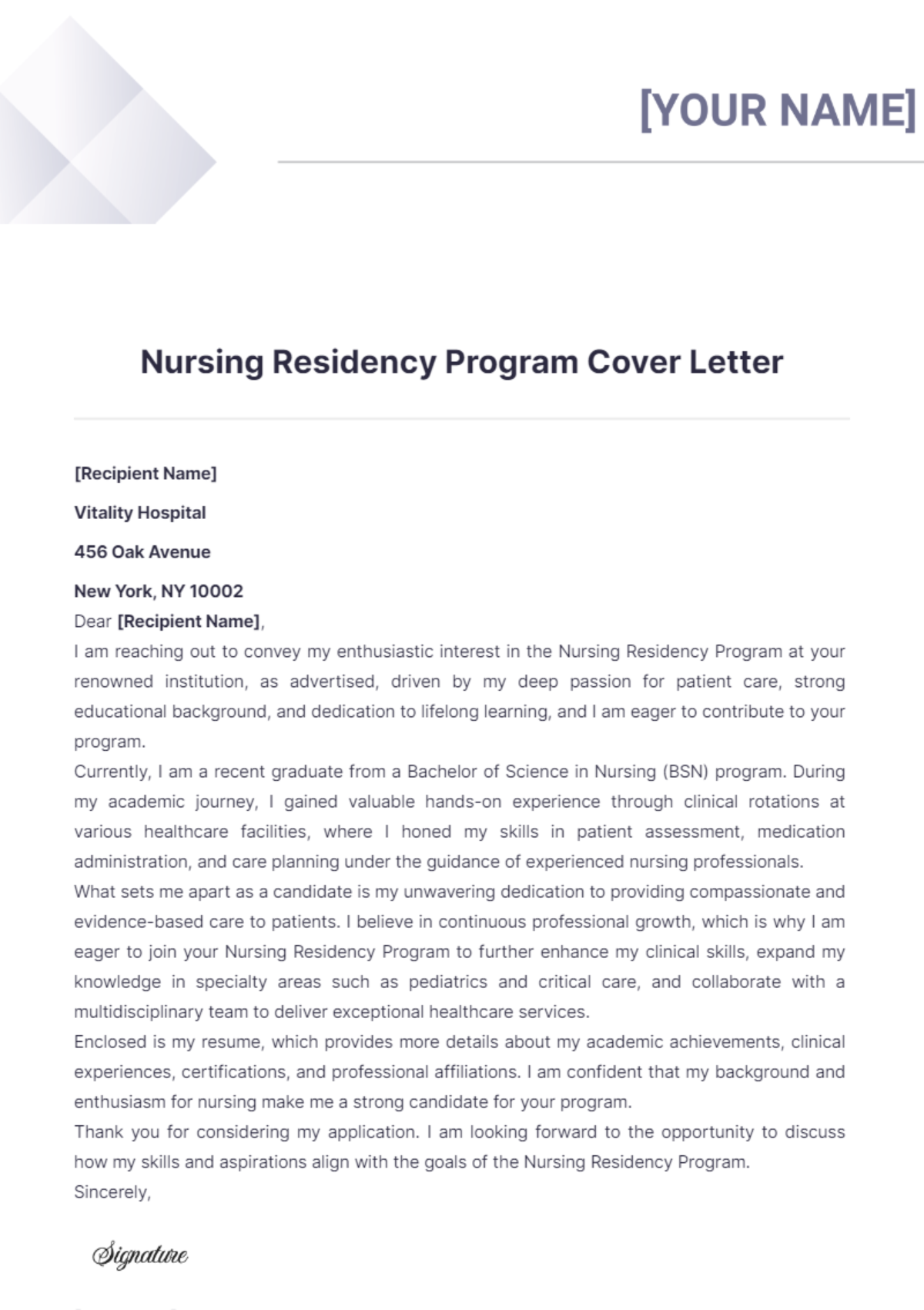
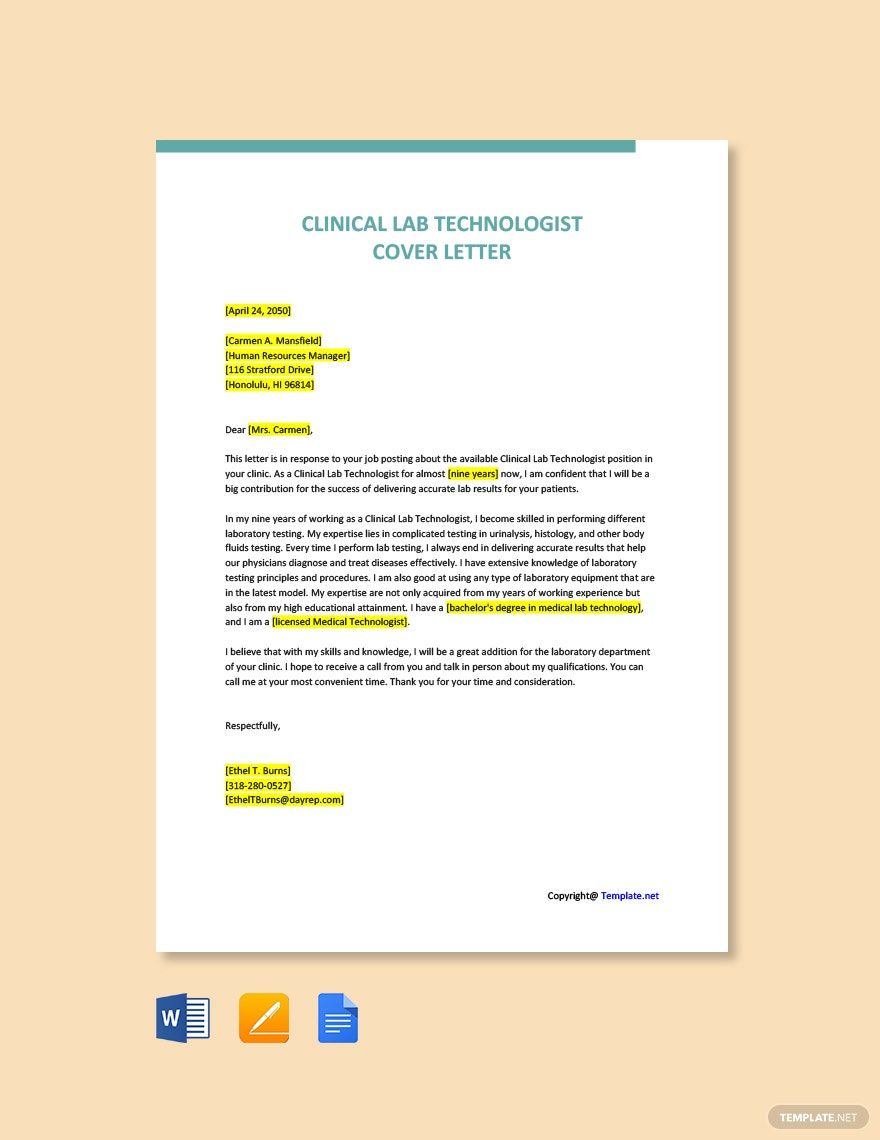
A medical cover letter Template is most useful when readers study how the document organizes information rather than copying its wording. The visual references below show several approaches, including traditional physician letters, specialty-oriented nursing layouts, highlighted recipient fields, feature-oriented template previews, and residency-focused correspondence. Comparing these structures can help identify the practical differences between a simple one-page letter and a more visually presented template. The examples also demonstrate how headings, spacing, address blocks, body paragraphs, and closing areas can be arranged while keeping the medical cover letter itself as the central document.
These references can also help readers evaluate which elements should be retained and which should be changed. A candidate can compare how different medical cover letter Template examples introduce the position, organize evidence, present contact details, and separate the closing from the main narrative. Residency-oriented examples are particularly useful for seeing how specialty interest and training information may be framed, while physician and nursing examples illustrate how the same broad letter architecture can accommodate different professional backgrounds. The goal is not to reproduce a sample word for word, but to understand the structural choices that make a professional medical letter easier to read and customize.

Doctor Cover Letter Template Features
Source: Template.net

Doctor Cover Letter Template Overview
Source: Template.net

Doctor Cover Letter Template Instructions
Source: Template.net

Medical Professional Cover Letter Template
Source: Template.net

HCA Physician Cover Letter Template
Source: Template.net

Professional Nurse Cover Letter
Source: Template.net
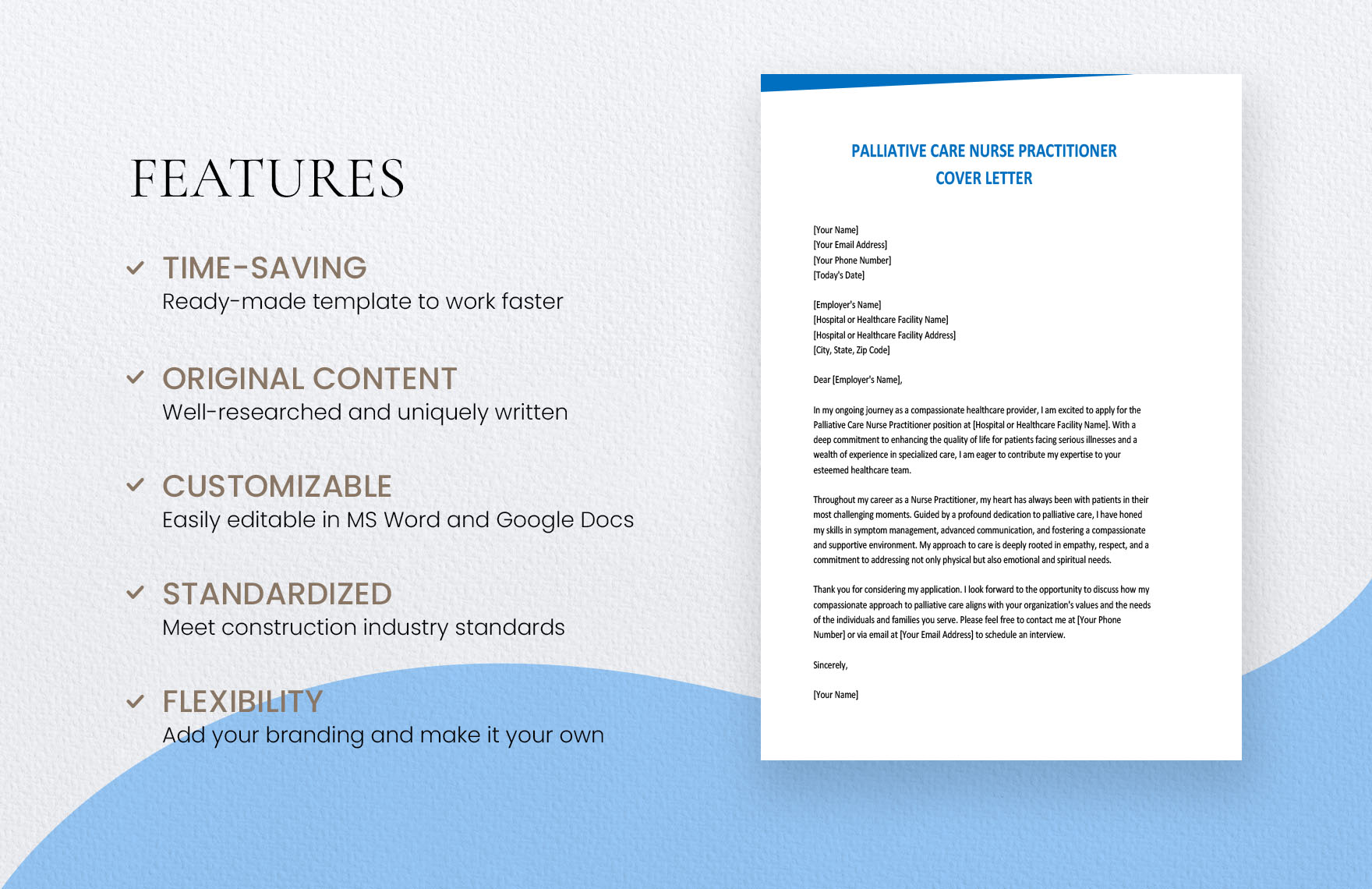
Palliative Care Nurse Practitioner Cover Letter Features
Source: Template.net
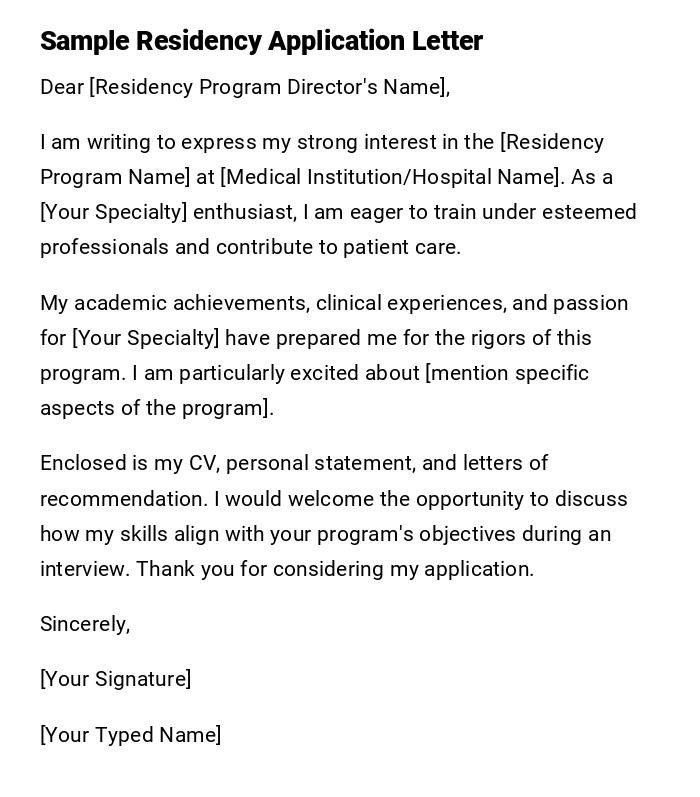
Sample Residency Application Letter Template
Source: LettersAndTemplates.com
Nursing Residency Program Cover Letter
Source: Template.net
