A strong senior tax accountant cv Template should do more than present a list of duties. It should quickly communicate technical tax expertise, accounting knowledge, professional progression, leadership, regulatory awareness, and measurable business impact. Senior tax roles often involve complex returns, tax planning, research, audit support, financial analysis, stakeholder communication, and review of work produced by other accountants. Your CV needs to make that level of responsibility immediately visible.
Current resume guidance consistently favors a clear structure built around a concise professional summary, reverse-chronological experience, relevant skills, education, certifications, and achievement-focused bullet points. Senior-level examples also emphasize scope and outcomes rather than simply repeating job descriptions.
For someone searching for a senior tax accountant cv template free download, the real objective is usually broader than finding a document. The reader wants a practical structure that can be adapted to a specific vacancy, presented professionally, and saved in a format that remains readable. This guide explains how to make those decisions while keeping the CV accurate, concise, and focused on evidence.

The visual structure of a senior tax CV should support fast scanning. A recruiter should be able to identify the candidate’s current role, years of experience, tax specialization, major qualifications, and strongest achievements without searching through dense blocks of text. A clean hierarchy is therefore more valuable than decorative design.
A useful template also gives enough space to demonstrate seniority. Senior candidates should not spend most of the page explaining routine tasks such as preparing reconciliations or maintaining records. Instead, the experience section should show ownership, review responsibility, complex tax work, client or stakeholder exposure, process improvement, and the consequences of decisions.
Templates are best treated as structural frameworks rather than finished documents. The strongest result comes from replacing generic wording with facts from your own career, matching terminology to the vacancy, and removing sections that do not strengthen your candidacy.
What a Senior Tax Accountant CV Needs to Communicate
A senior tax accountant is expected to combine accounting fundamentals with specialized tax knowledge. Depending on the employer and jurisdiction, the role can include tax compliance, tax research, planning, preparation and review of returns, audit coordination, tax provisions, regulatory monitoring, financial analysis, and communication with clients or authorities.
Your CV should therefore establish a clear professional identity near the top. A heading such as “Senior Tax Accountant” can be followed by a concise summary that identifies your experience level, principal tax areas, technical strengths, and one or two outcomes. This is stronger than opening with a generic statement about being hardworking, motivated, or detail-oriented.
The experience section should then prove the claims made in the summary. If the summary says you specialize in corporate tax compliance, the experience section should show the types of entities, jurisdictions, returns, tax issues, audits, provisions, systems, or projects you actually handled. Evidence creates credibility; adjectives alone do not.

A visually different layout can still communicate the same core information effectively. The example demonstrates how a summary can introduce technical specialization before the reader reaches detailed employment history. That sequence helps a senior candidate establish relevance early.
Another important feature is the distinction between responsibilities and accomplishments. “Reviewed tax returns” explains a duty. “Reviewed complex corporate returns across multiple jurisdictions and identified filing issues before submission” communicates responsibility, judgment, and quality control. If a verified number is available, add it without exaggeration.
For senior roles, the CV should also show progression. Promotions, expanded portfolios, larger client groups, additional jurisdictions, management responsibilities, specialist tax projects, or increasingly complex assignments can demonstrate how the candidate reached senior level.
How to Structure the Header and Professional Summary
The header should contain your name, professional title, city or region, professional email address, phone number, and a relevant professional profile link when appropriate. Avoid unnecessary personal details. A hiring manager does not need marital status, age, unrelated hobbies, or other information that does not help evaluate professional suitability.
The professional summary should normally be short enough to scan quickly. A practical structure is: current professional identity, years of relevant experience, two or three specialist areas, and one evidence-based achievement or responsibility. This aligns with current senior-accounting guidance, which places a concise summary above experience and encourages quantified achievements.
For example, a hypothetical summary might read: “Senior Tax Accountant with nine years of experience across corporate tax compliance, tax research, and tax provision work. Experienced in reviewing multi-entity filings, supporting audits, and advising finance teams on tax implications. Known for improving documentation quality and strengthening filing controls.” The wording is illustrative; candidates should replace it with their own verified experience.
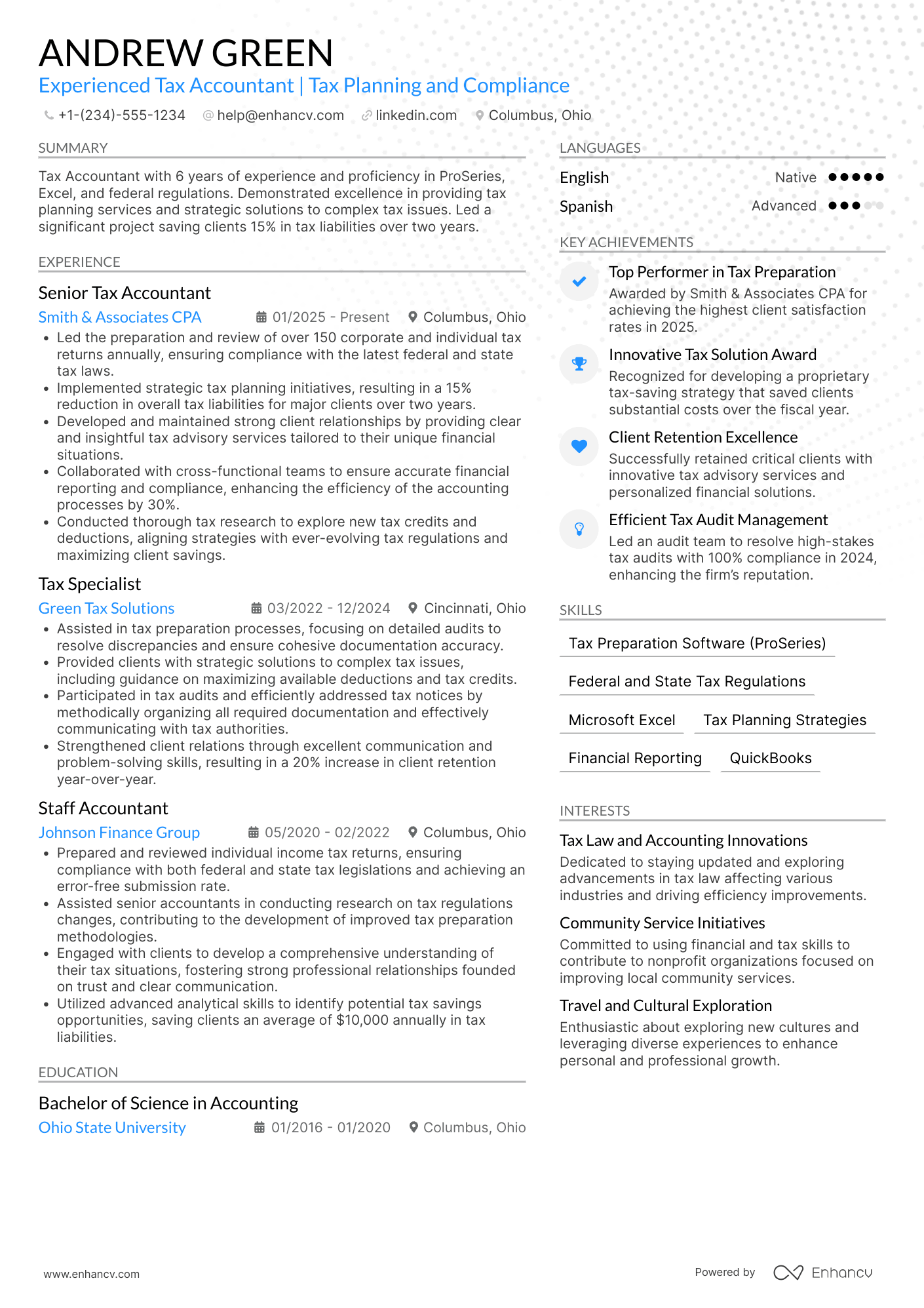
The example illustrates how a professional summary can be visually separated from the detailed experience section. For a senior tax candidate, that opening space is valuable because it can establish specialization before the reader reaches individual roles.
A common mistake is writing a summary that could belong to any accountant. Phrases such as “experienced professional with excellent communication skills” provide little differentiation. Instead, name the tax disciplines, reporting environment, systems, industries, jurisdictions, or leadership responsibilities that genuinely define your career.
The summary should also avoid unsupported claims. If you did not manage a tax department, do not describe yourself as a tax leader. If you did not achieve a particular savings figure, do not invent one merely because a template contains a numerical example. Accuracy is more persuasive than inflated language.
Building the Work Experience Section
For most senior tax candidates, experience is the most important part of the CV. Current guidance recommends reverse-chronological presentation and achievement-oriented bullets that combine an action with scope, outcome, or measurable impact.
Each role should begin with the job title, employer, location where relevant, and dates. Underneath, use concise bullets. A useful formula is action + technical work + scope or result. For example: “Reviewed quarterly tax provisions for multiple entities, investigating material variances and coordinating corrections before reporting deadlines.”
Senior candidates should use verbs that demonstrate ownership when accurate: led, reviewed, directed, managed, advised, evaluated, coordinated, developed, implemented, researched, resolved, and supervised. Words such as assisted or supported are appropriate when they genuinely describe the level of responsibility, but relying on them throughout the CV can unintentionally make a senior candidate sound junior.

The example shows how a senior tax profile can combine a summary with detailed employment evidence. Notice the emphasis on tax planning, compliance, software, leadership, and achievements rather than a simple chronological list of employers.
When describing tax work, specificity is useful. Depending on your actual background, relevant details might include corporate income tax, indirect tax, payroll tax, sales and use tax, tax provisions, transfer pricing, international taxation, tax audits, tax research, estimated payments, or regulatory reporting.
Do not list every tax topic you have encountered. Select the areas most relevant to the position you want. A corporate tax vacancy should receive more emphasis on corporate compliance, provisions, tax research, and business transactions than unrelated tasks that occupy little of the target role.

Another useful approach is to show complexity. A bullet can explain that you handled several entities, multiple jurisdictions, large filing volumes, complex transactions, or high-value tax portfolios when those details are accurate and appropriate to disclose.
Quantification can make this evidence easier to understand. Useful measures can include the number of entities supported, filing volume, team size, reporting frequency, audit portfolio, time saved, error reduction, or process cycle improvement. Never invent a number; if a precise figure is unavailable, describe scope honestly without forcing a statistic.
The strongest bullets also explain why the work mattered. “Prepared returns” is functional. “Prepared and reviewed multi-entity returns, resolving documentation gaps before filing deadlines” demonstrates quality control and risk awareness. The second style gives the reader a clearer picture of professional judgment.
Writing the Professional Summary on CV Senior Accountant Candidates Need
The phrase professional summary on cv senior accountant searches often reflect an important question: what should an experienced accountant say at the top of the document? The answer is not a biography. It is a compact positioning statement that connects experience, specialization, and value.
A senior accountant summary should normally answer three questions. What level are you? What accounting or tax areas do you know particularly well? What evidence suggests that you can perform at the target level? Certifications, industry specialization, leadership scope, complex assignments, and measurable improvements can all provide evidence.
For a senior tax accountant, the summary should usually mention tax rather than presenting only general accounting capabilities. A candidate may have extensive financial reporting experience, but if the vacancy centers on tax compliance and planning, those tax capabilities should appear early.

The layout shown here places skills prominently beside the professional summary and employment history. That can work when the design remains readable, although candidates targeting parsing-heavy recruitment systems may prefer a simpler structure.
Keep the summary factual and tailored. A hypothetical example could state: “Senior Tax Accountant with eight years of experience in corporate compliance, tax research, and audit support. Experienced in reviewing complex returns, maintaining tax workpapers, and advising finance teams on transaction-related tax issues. CPA-qualified with advanced Excel and tax software experience.”
The final sentence should be adjusted to the candidate’s genuine credentials. If a certification is pending rather than completed, say so accurately. If a system is familiar but not advanced, do not label yourself an expert. Precision protects credibility during interviews.
Choosing the Right Skills
A cv template for accountant should provide space for both technical and professional capabilities, but senior tax candidates should prioritize skills that are relevant to the actual vacancy. Current examples commonly emphasize tax compliance, tax research, tax planning, financial analysis, auditing, accounting software, regulatory knowledge, and communication.
Technical skills might include tax return preparation, tax provisions, corporate taxation, indirect taxation, tax research, financial reporting, reconciliation, audit support, forecasting, regulatory compliance, advanced spreadsheet work, and relevant accounting or tax systems. Include only technologies and technical areas you can genuinely discuss in an interview.
Soft skills should not become a long collection of generic adjectives. Instead of listing “excellent communicator,” demonstrate communication through experience bullets such as presenting tax findings to finance leadership, responding to authority inquiries, coordinating audit requests, or mentoring junior staff.

The skills section is most useful when it reinforces the evidence elsewhere. If “tax research” appears in the skills list, the experience section should show where research was performed and how the findings were used.
Software should be grouped logically when the list is substantial. For example, you might separate tax systems, accounting or ERP platforms, spreadsheet tools, and reporting systems. This is easier to scan than a single long line containing unrelated programs.
Job descriptions can also help identify relevant terminology. If the employer specifically mentions a tax system, accounting standard, jurisdiction, or reporting process that you genuinely know, use the same terminology where appropriate. This improves relevance without resorting to repetitive keyword placement.
Education, Certifications, and Professional Development
Education should normally be presented after experience for an established senior candidate unless a particular qualification is central to the role. Include the degree, institution, and relevant date information according to the conventions of your market. Earlier education can receive less space when extensive professional experience is available.
Certifications deserve more prominence when they materially affect eligibility or credibility. Depending on jurisdiction and employer, examples may include CPA, CMA, CTA, ACCA, ACA, or other recognized accounting and tax credentials. Do not imply that a credential is universally required when requirements vary by location and role.
Professional development can be useful when it demonstrates current technical knowledge. Relevant tax-law training, accounting standards education, specialist courses, or continuing professional education can show that your knowledge is maintained in a field where regulations change regularly.

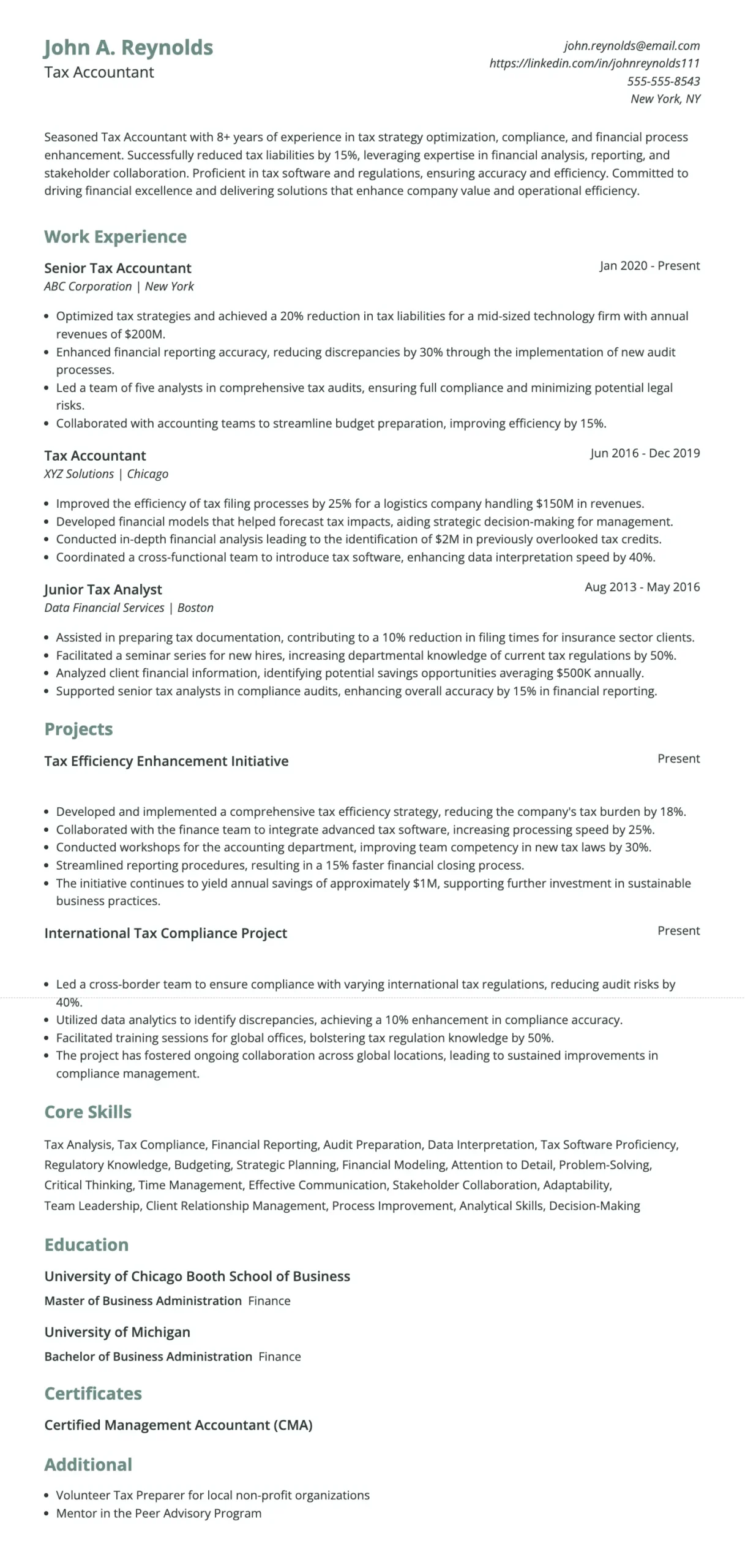
This example demonstrates a conventional structure in which education and qualifications follow professional experience. It is useful as a visual reference for deciding how much space to give academic credentials once a candidate has established a substantial career history.
For senior candidates, the key is relevance. A long list of every course ever completed can dilute the strongest credentials. Select professional development that supports the tax specialization or target position.
If a qualification is in progress, identify its status clearly. A hiring manager should never have to guess whether a credential has been earned, is pending, or is simply a course you attended.
Making the CV ATS-Friendly Without Making It Bland
Applicant tracking systems can parse structured resume information, so straightforward headings and predictable formatting are generally sensible. Current senior-accounting guidance recommends standard section names such as Professional Summary, Experience, Education, Certifications, and Skills.
A visually attractive CV can still be machine-readable, but excessive graphics, text embedded in images, unusual section labels, decorative icons, and complicated multi-column structures can create avoidable parsing problems. For a senior tax accountant, clarity should take priority over visual novelty.
Keyword alignment also matters, but it should be handled naturally. Compare the vacancy with your own experience and identify genuine matches. If the role asks for tax provisions and you have performed them, use that terminology. If you have never worked with a named system, do not add it simply because it appears in the vacancy.
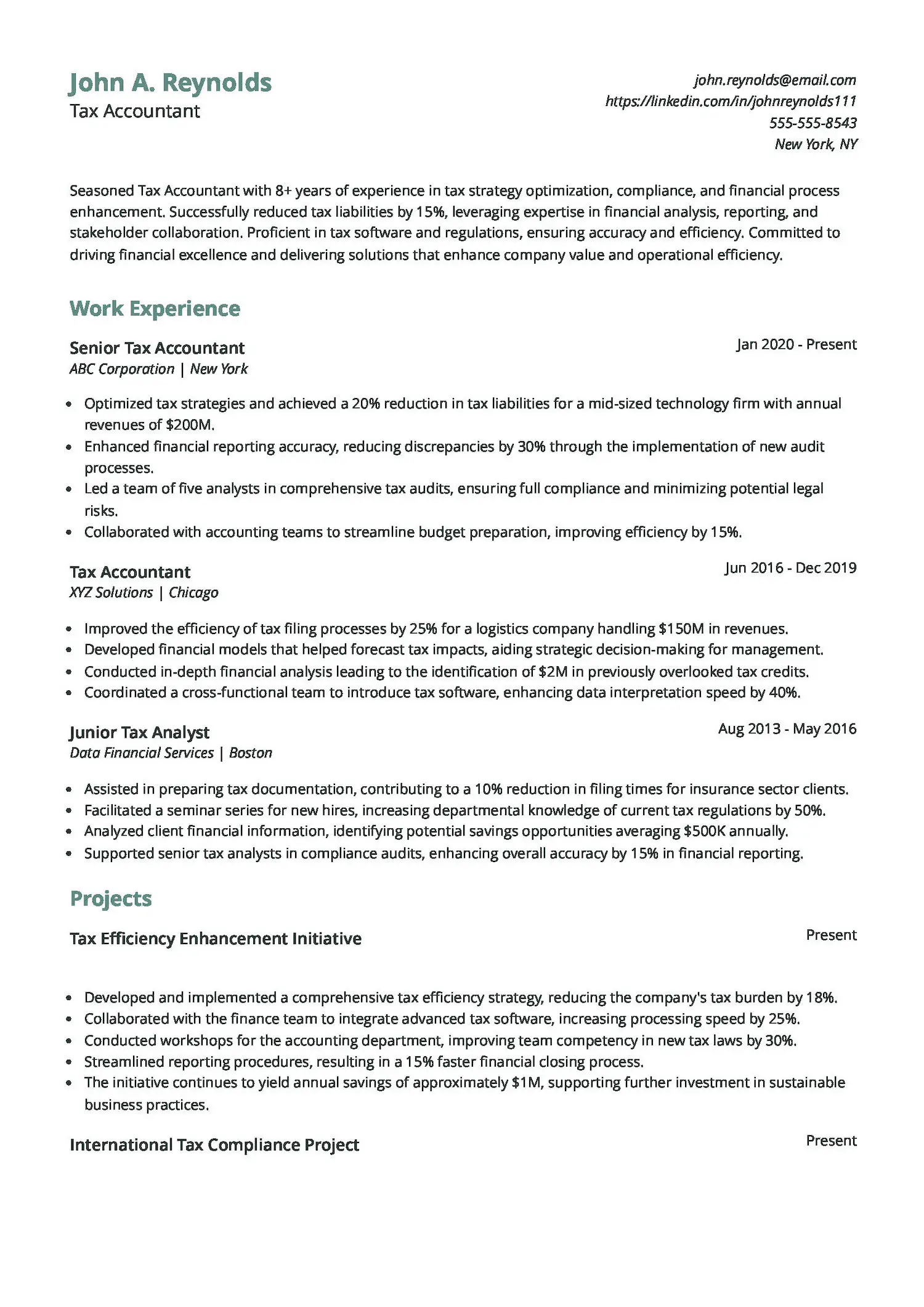
The plain structure of this tax accountant example demonstrates why readability matters. Headings, dates, role titles, and bullets can be understood quickly without relying on decorative elements.
ATS optimization should never turn the CV into a keyword list. Recruiters still need to understand the candidate’s career story. The best document satisfies both audiences by using relevant terminology inside meaningful descriptions of genuine experience.
Before submitting, inspect the final document at normal viewing size. Check headings, dates, bullet alignment, page breaks, spacing, and consistency. A technically correct CV can still look careless if one role uses a different date format or one section has inconsistent punctuation.
Word, PDF, Google Docs, and Other CV Formats
Searches such as senior tax accountant cv template word, senior tax accountant cv template pdf, and senior tax accountant cv template google docs usually reflect different editing and sharing preferences rather than fundamentally different content requirements. The same strong CV can often be maintained across several document formats.
Editable formats are useful while you are tailoring content. A Word-based document can make it convenient to adjust sections, spacing, and wording. A browser-based document can be useful when collaboration or access across devices matters. A PDF is often useful as the final presentation format because it can preserve layout across systems, although the employer’s instructions should always take priority.
The important distinction is between the content and the container. Changing a CV from Word to PDF does not make weak experience bullets stronger. Likewise, a visually sophisticated template cannot compensate for a vague summary or unsupported claims.

This single-column example demonstrates a format that gives substantial space to professional experience and projects. A tax candidate can adapt the same hierarchy while replacing general accounting projects with tax-focused work.
When using a template, preserve the structure but personalize the content. Remove placeholder names, sample companies, invented metrics, and irrelevant sections before the document reaches an employer.
File naming should also be professional. A practical naming pattern can include your name and target role, provided it follows any employer instructions. Avoid confusing filenames that contain multiple drafts or internal notes.
How to Use Examples Without Copying Them
A senior accountant cv sample can be valuable because it shows how experienced candidates balance detail and brevity. However, an example should be studied for structure, not copied for facts. Recruiters can quickly notice when several candidates use identical generic achievements.
Study examples for patterns: where the summary sits, how many bullets are used, how certifications are displayed, how technical skills are grouped, and how achievements are quantified. Then rebuild those patterns using your own career evidence.
For instance, a sample may say that a candidate reduced processing time by a certain percentage. That number belongs to the sample candidate. Your version should use your own verified result, or simply describe the process improvement without a number if no reliable measurement exists.

The Zety example shows a restrained one-column presentation that prioritizes the professional summary and work history. This kind of visual hierarchy can be particularly useful when the target role requires substantial technical detail.
Another useful technique is to compare several examples rather than choosing the first one you see. Look for recurring elements across reputable sources. Current examples consistently emphasize clear summaries, reverse-chronological experience, relevant technical skills, education, certifications, and measurable achievements.
Examples should also be evaluated for regional expectations. A CV intended for one country may not follow the same conventions as a resume intended for another. Consider local expectations for length, personal details, credentials, spelling, and professional terminology.
Common Mistakes in a Senior Tax Accountant CV
One of the most common mistakes is treating the CV as a record of duties rather than a professional argument. A senior candidate needs to show why their experience matters. Routine responsibilities can remain, but they should be balanced with evidence of judgment, scope, ownership, and outcomes.
Another problem is excessive detail. A candidate with ten or fifteen years of experience may have hundreds of relevant tasks, but a hiring manager does not need all of them. Focus on the most recent and relevant positions, then summarize older experience more selectively.
Inconsistent terminology is another avoidable issue. If the target vacancy uses “tax compliance,” “tax provision,” and “tax research,” and those concepts accurately describe your experience, use clear language rather than replacing them with vague synonyms. At the same time, avoid repeating the same phrase in every bullet.
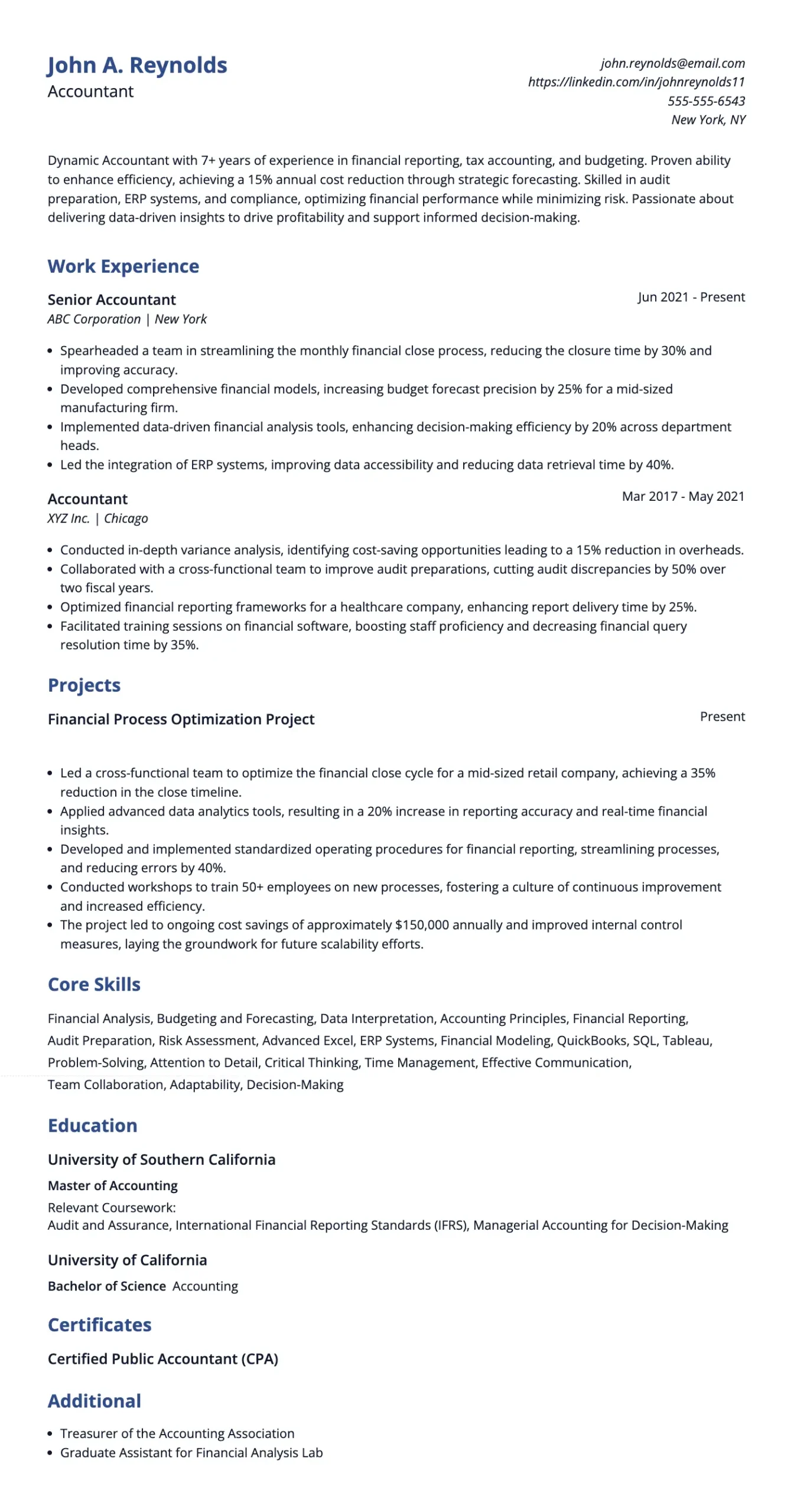
This example shows how projects can supplement employment history. For a senior tax candidate, project entries might cover tax-system implementation, provision process improvement, audit remediation, compliance restructuring, or a significant research assignment.
Another frequent weakness is an overdesigned header. A senior tax accountant CV should communicate professionalism and precision. Excessive color, decorative graphics, rating bars, or visual elements that do not convey evidence can consume space without improving the candidate’s story.
Finally, never submit a template containing placeholder content. Names, email addresses, sample employers, hypothetical achievements, and example dates must all be replaced with accurate information.
Practical Solution
Start by creating a private master career record containing every relevant employer, role, responsibility, project, certification, system, tax specialty, and achievement you can verify. Do not worry about length at this stage. The purpose is to establish a reliable source of information from which you can build targeted versions for different senior tax roles.
Next, read the target vacancy and mark the requirements you genuinely meet. Group them into technical tax skills, accounting skills, systems, leadership responsibilities, qualifications, and business outcomes. Select the strongest evidence from your master record and place it in the summary and most recent experience sections. This creates a direct connection between what the employer asks for and what your CV demonstrates.
Then build the document in this order: professional header, summary, professional experience, certifications, education, technical skills, and optional additional sections. Use reverse chronology for employment. Keep recent roles detailed and older roles progressively shorter. Replace every generic template bullet with a statement grounded in your own work.
After the first draft, perform a factual audit. Check every number, job title, date, certification, software name, tax specialty, and achievement. Ask whether you could explain every bullet confidently during an interview. If the answer is no, revise or remove it.
Perform a relevance audit next. Every major section should support the target senior tax position. Remove unrelated early-career details when they no longer contribute meaningful evidence. Expand the areas where your experience directly matches the role.
Finally, perform a visual and language audit. Look for inconsistent spacing, awkward page breaks, repeated phrases, overly long bullets, spelling errors, and unnecessary personal details. A final proofread is especially important for an accounting professional because precision is itself part of the professional impression.

The second Zety example demonstrates how a timeline-based structure can make career progression easy to follow. This approach can work well when promotions or increasing responsibility are important parts of the candidate’s story.
If you are evaluating a senior accountant resume template, use the same test: can the document communicate seniority within a few seconds, does it make relevant technical expertise easy to find, and does the experience section prove the claims made near the top?
For candidates comparing a senior tax accountant cv template free option with a paid design, the deciding factor should not be price alone. Examine readability, editability, section hierarchy, compatibility with the employer’s requested format, and how much space remains for meaningful evidence. A simple structure that supports strong content is often more useful than an elaborate design.
How to Tailor the CV for Different Senior Tax Roles
A corporate tax role may emphasize entity compliance, tax provisions, business transactions, tax research, and reporting. A public-practice role may place more weight on client portfolios, return preparation, advisory work, audits, and communication. An international tax role may require evidence of cross-border work, transfer pricing, jurisdictional analysis, and multinational structures.
Do not create an entirely different career history for each position. Instead, adjust emphasis. Select the most relevant bullets, reorder skills, refine the summary, and bring the strongest matching achievements closer to the top.
This is where a template becomes especially useful. A stable structure lets you change the content without repeatedly redesigning the entire document. The result is a consistent professional identity with role-specific evidence.

The example provides another illustration of how a senior candidate can combine technical competencies with a strong summary and detailed experience. When adapting a layout like this, use your own verified tax specialties and career outcomes.
For public practice, consider emphasizing client complexity, return volume, advisory relationships, audit support, and technical research. For industry roles, emphasize internal tax reporting, provisions, process controls, tax risk, business partnering, and interactions with finance or legal teams.
The underlying principle is simple: the best senior tax CV is not the one with the most information; it is the one with the most relevant evidence presented clearly.
Using Search Results and Community Examples Carefully
Some candidates search for senior tax accountant cv template reddit because community discussions can reveal practical opinions about formatting, recruiter behavior, or the strengths and weaknesses of particular designs. Such discussions can be useful for generating questions, but individual comments should not automatically be treated as professional or regulatory requirements.
Community examples can also contain outdated advice. Hiring practices, software, ATS behavior, and regional expectations change. Compare informal recommendations with current guidance from established career resources and the actual requirements stated by the employer.
The same principle applies to template websites. A template can illustrate structure, but claims made within a sample document may be hypothetical. Never copy numerical achievements or credentials unless they are genuinely yours.

This senior accountant example is useful for seeing how general accounting competencies can be integrated with tax preparation and risk management. A senior tax accountant should make the tax specialization more prominent when that is the target role.
When researching templates, distinguish between the visual asset and the editorial advice surrounding it. The visual can show layout; the accompanying guidance may contain assumptions that do not apply to every country, employer, or accounting specialty.
Your own job description remains the most important tailoring reference because it tells you which capabilities the employer is actually seeking.
Final Editing Checklist for a Senior Tax Accountant CV
Before sending the document, verify that your name and contact information are accurate, your target job title is clear, and your professional summary is specific. Confirm that your most recent role appears first and that the strongest achievements are visible without excessive scrolling.
Check every experience bullet for three qualities: relevance, clarity, and evidence. A strong bullet should tell the reader what you did and why it mattered. Where reliable numbers exist, use them. Where they do not, explain scope or outcome honestly rather than inventing metrics.
Review certifications, education, tax specialties, software, and professional affiliations for accuracy. Remove skills that you cannot comfortably discuss. Finally, inspect the finished file visually and ensure the selected format follows the employer’s instructions.
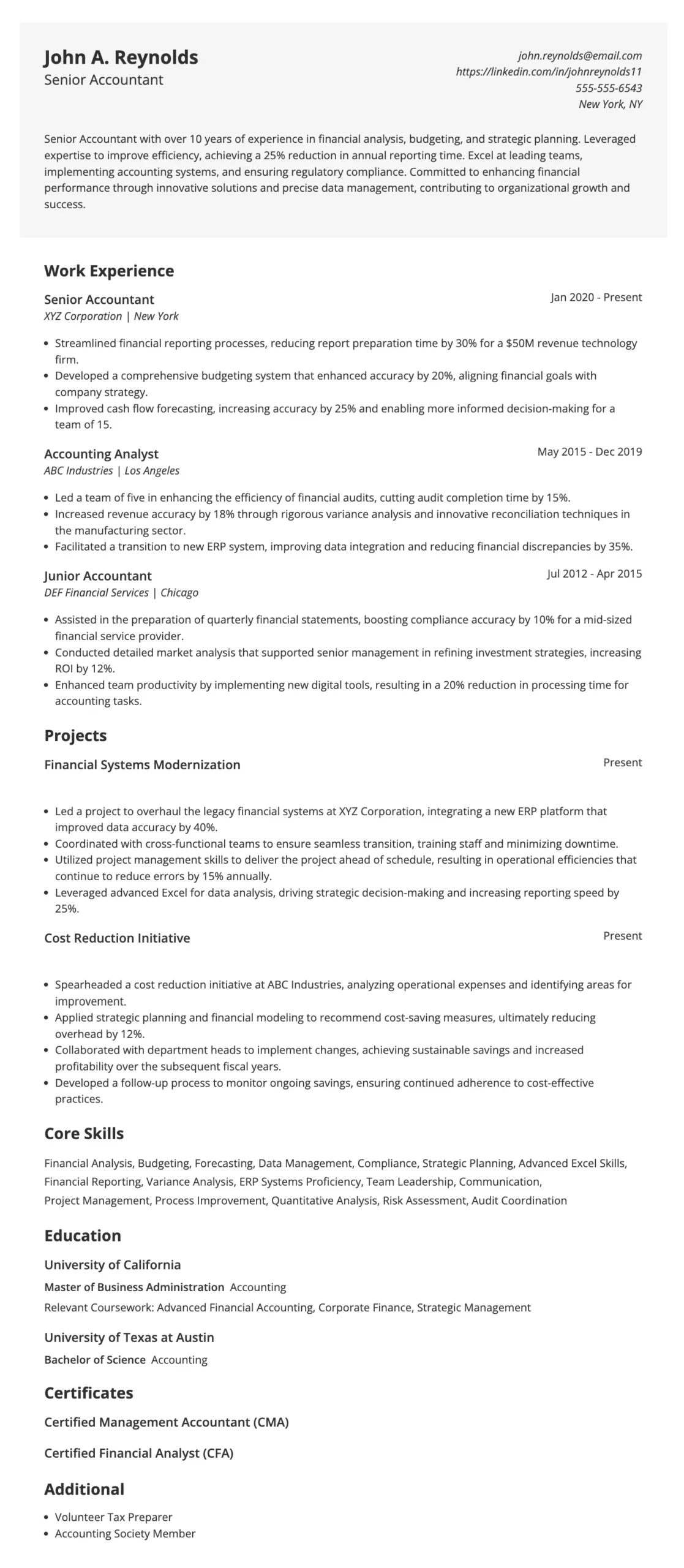
A strong final review should also check consistency. Use one date style, one punctuation style, consistent capitalization, and consistent naming for software and qualifications. Small inconsistencies can make an otherwise polished accounting CV appear unfinished.
If your CV exceeds two pages, do not automatically cut valuable evidence simply to reach one page. Senior candidates may need additional space when the information is relevant. Instead, remove repetition, outdated details, generic statements, and low-value bullets first.
The objective is a document that feels precise, credible, and targeted. A well-structured senior tax accountant CV should allow a recruiter to understand your specialization, progression, technical capability, leadership level, and potential business contribution without having to interpret vague language.
Reference Examples
A senior tax accountant cv Template is easiest to evaluate when readers can see several genuine examples of how professional information is organized on the page. The references below illustrate different approaches to summary placement, experience density, skills presentation, certification visibility, project sections, and overall hierarchy. Some examples focus specifically on tax accounting, while others show closely related senior accounting structures that can be adapted for tax-focused roles. The most useful lesson is not to reproduce any one design, but to observe how strong examples make technical experience easy to locate and how they balance detail with readability.
These visual references can help compare single-column and two-column layouts, restrained and more visual designs, detailed and concise experience sections, and different ways of presenting professional summaries. When reviewing them for a senior tax accountant cv Template, pay particular attention to whether the design leaves enough room for tax specialization, measurable achievements, certifications, software knowledge, and senior-level responsibilities. A suitable structure should make those elements prominent without overwhelming the reader. Use the examples as layout references and replace every sample fact with your own verified professional information.
Senior Tax Accountant Resume example
Source: QwikResume

Certified Senior Tax Accountant Resume example
Source: QwikResume
Tax Accountant Resume example
Source: Jobscan
Senior Accountant Resume example
Source: Jobscan
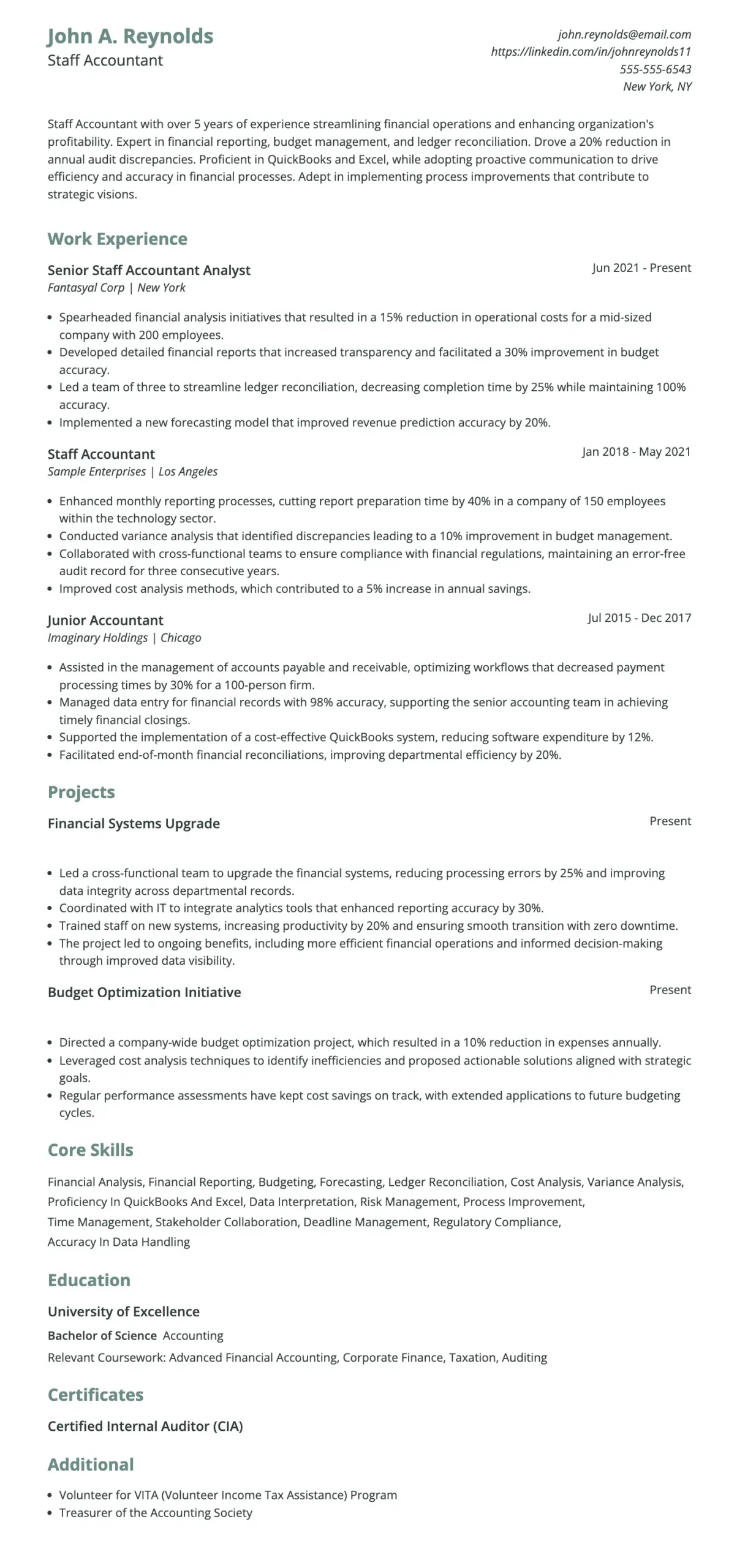
Staff Accountant Resume example
Source: Jobscan
Tax Accountant Resume sample
Source: Zety
Tax Accountant CV example
Source: CVmaker
Tax Accountant resume example
Source: Enhancv
Senior Accountant CV example
Source: Resumaker.ai
