A well-structured customer service level agreement Template turns broad promises about support quality into measurable expectations. Instead of saying that customers will receive “prompt assistance,” the agreement can define what prompt means, which channels are covered, when the service clock begins, how priority is assigned, and what happens when a target is missed. This makes the document useful to both customers and service teams because it creates a shared reference for day-to-day decisions.
The strongest agreements are not necessarily the longest. They are precise about scope, service hours, response targets, resolution targets, escalation rules, measurement methods, responsibilities, exclusions, reporting, review dates, and remedies. A practical template should also be easy to adapt to different customer tiers, communication channels, and operating schedules without creating contradictory commitments.
Searchers looking for a customer service agreement format are often trying to solve a very practical problem: they need a reliable structure they can adapt to their organization. They may be comparing a service level agreement template, looking for a sample service level agreement template, or deciding whether a document should be maintained in a word-processing format, spreadsheet, or shared document environment. The right choice depends on what the document is expected to accomplish.

What a customer service level agreement should accomplish
A customer service SLA establishes a common understanding between a service provider and a customer about the level of support that will be delivered. It can cover customer inquiries, technical support, account assistance, incident handling, complaints, maintenance coordination, or other defined service activities. The agreement should make the expected service observable rather than relying on vague language such as “high priority” or “as soon as possible.”
The document normally identifies the parties, covered services, operating hours, support channels, performance measures, target times, escalation arrangements, customer responsibilities, provider responsibilities, review procedures, and consequences for material failures. The exact structure varies by business model. A SaaS provider may emphasize service availability and incident response, while a professional services firm may emphasize response commitments, communication standards, and milestone support.
An SLA also separates a service promise from a general customer service policy. A policy can describe how a company prefers to operate. An SLA establishes specific expectations for a defined relationship or service. That distinction matters when performance is reviewed because the parties need to know which commitments are contractual or formally agreed and which statements are simply internal operating guidance.

Core sections to include in the template
The opening section should identify the service provider and customer, the effective date, the agreement term, the document owner, and the services covered. If multiple business units or support teams are involved, identify them clearly. This prevents a common problem in which a customer assumes that every support function is covered by the same commitment even though different teams operate under different hours or targets.
The service scope should describe both what is included and what is excluded. For example, a customer support SLA might cover email inquiries, support tickets, live chat, account questions, and incident coordination while excluding consulting work, product customization, third-party failures, or requests outside the purchased service tier. Explicit boundaries make the agreement easier to administer and reduce disagreements about whether a particular request qualifies.
Performance definitions deserve equal attention. Define terms such as first response time, resolution time, business hours, calendar hours, priority, escalation, customer waiting time, and service restoration. Without these definitions, two parties can interpret the same target differently. A response target of four hours is meaningless if one side counts weekends and the other counts only staffed hours.

Parties, scope, and service definitions
A useful scope section should answer three questions: who receives the service, what service is being measured, and under what conditions the commitment applies. If the provider serves several customer segments, the SLA can identify the relevant plan, contract, region, or support package. This is particularly important when premium customers receive different support targets from standard customers.
Service descriptions should be written in operational language. “Customer support” may sound sufficiently clear, but it can include billing questions, product troubleshooting, account changes, incident investigation, returns, complaints, and technical consulting. A better document lists the actual service categories and explains which team owns each category.
Exclusions should be written carefully rather than used as a broad escape clause. If scheduled maintenance, customer-caused outages, third-party service interruptions, force majeure events, or missing customer information affect measurement, explain how they affect the SLA clock. A narrow and transparent exclusion is easier to defend than a general statement that removes responsibility whenever conditions become difficult.
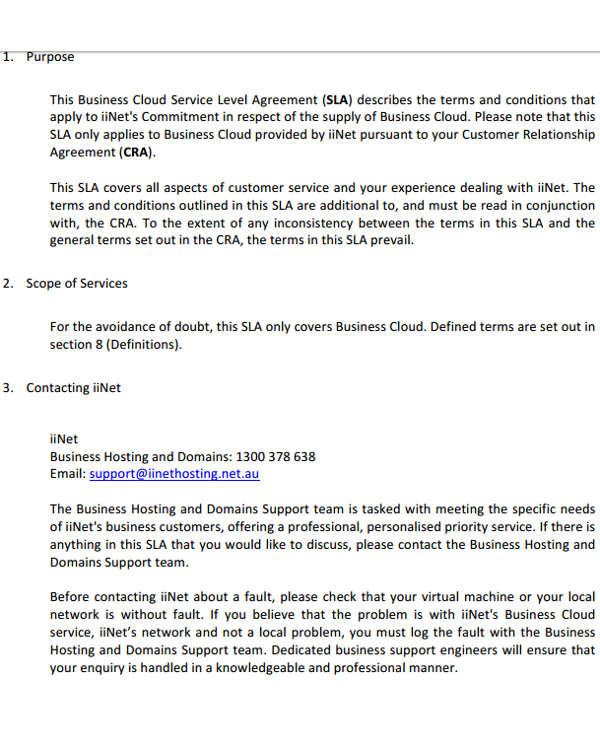
Support hours and coverage
Coverage hours determine when response and resolution targets are measured. A team operating Monday through Friday may use business-hour commitments, while a continuously staffed support operation may measure around the clock. The document should specify the time zone, holidays, planned closures, and whether different channels have different operating periods.
Channel coverage should also be explicit. Email, phone, live chat, portal tickets, and other communication channels can have different response characteristics. A single target across every channel can create unrealistic expectations if the provider handles urgent incidents by phone but routine inquiries through email. A better structure assigns targets according to the channel and service category.
For international customers, define the governing time zone or explain how time is calculated for each region. If the provider uses business hours, state whether the clock pauses outside coverage. If customer waiting periods pause the resolution clock, that rule should be stated clearly and consistently applied in performance reporting.

Response time and resolution time targets
Response time and resolution time are related but distinct. Response time measures how quickly the support organization acknowledges or begins handling a request. Resolution time measures how long it takes to solve the issue according to the agreed definition of resolution. A customer may receive an immediate acknowledgment while the underlying issue still requires several hours of investigation.
Targets should normally vary according to priority. A critical incident affecting a major business function may require a substantially faster response than a routine information request. Priority definitions should therefore be tied to customer impact rather than the emotional wording used in a ticket. This helps prevent every request from being marked urgent simply because the requester wants faster service.
Resolution targets need special care because some problems cannot be solved solely by the support team. A defect may require engineering work, a vendor may need to investigate an external dependency, or the customer may need to provide additional information. In these situations, the SLA should define whether the target is full resolution, restoration of service, provision of a workaround, or another measurable milestone.

Priority levels
A practical priority model might contain four levels such as critical, high, medium, and low. The labels themselves are less important than the definitions. Each level should describe the degree of customer impact, number of affected users, availability of a workaround, and business consequences. The same issue can legitimately receive different priorities for different customers depending on the contracted service.
For example, a critical category could describe a complete service outage affecting a major business function. A high category could describe substantial degradation with no reasonable workaround. A medium category could cover a significant but contained problem, while a low category could cover routine questions or minor defects. These are illustrative categories, not universal standards.
The template should also explain who can change priority and when. A support team may initially classify an incident as medium and later raise it after discovering wider impact. Recording the reason for priority changes improves accountability and makes later SLA reporting easier to interpret.

Escalation rules
Escalation is the bridge between an SLA target and an operational response when a case becomes difficult or time-sensitive. The agreement should identify escalation levels, ownership, triggering conditions, communication responsibilities, and expected handoff times. A useful escalation path might move from frontline support to a specialist, then to an operational manager, and finally to an executive contact for serious contractual issues.
Escalation should not be reserved only for breaches. A case can require specialist involvement before the response or resolution deadline is reached. For example, a security-sensitive issue may need immediate specialist review even if the initial response target is comfortably within range. The SLA should allow operational judgment without making escalation so broad that every ordinary case becomes a management issue.
Each escalation level should have a clear owner. Merely listing a department is not enough if nobody knows who is accountable for the next action. Contact roles should be reviewed whenever the agreement changes, especially where named individuals or rotating teams are involved.

Performance metrics and reporting
A customer service SLA becomes useful only when the agreed measures can actually be calculated. Common measures include first response time, resolution time, SLA compliance rate, customer satisfaction, reopen rate, escalation rate, backlog age, and service availability where availability is relevant to the service. The agreement does not need every possible metric; it should focus on measures that reflect the service commitments being made.
Measurement rules should explain the data source and calculation method. If response time comes from a support ticket system, specify which timestamp starts the clock and which event stops it. If customer waiting periods pause measurement, the reporting process must record those periods consistently. A metric that cannot be reproduced from the underlying records is a poor contractual measure.
Reports should make exceptions visible rather than hiding them inside an overall average. A blended average can look healthy while critical cases repeatedly miss their targets. Segmenting results by priority, channel, customer tier, and service category can reveal where the agreement is actually performing well and where operational changes are needed.

Useful KPI definitions
First response time measures the elapsed period before the first qualifying human response or other agreed response event. Automated acknowledgments should only count if the parties explicitly define them as a qualifying response. Otherwise, a system-generated message can make a support organization appear faster without actually providing assistance.
Resolution time measures the period until the agreed resolution state is reached. The definition should distinguish between a temporary acknowledgment, a workaround, restoration of service, and complete correction. For complex incidents, a restoration target may be more realistic than promising permanent correction within a fixed number of hours.
SLA compliance rate can be expressed as the proportion of measured cases that met their applicable target during the reporting period. The denominator should be defined carefully, especially when cases are excluded because they fall outside scope or because the customer did not provide required information. Otherwise, different reporting teams can produce different results from the same ticket history.

Responsibilities of the provider and customer
An SLA should not describe only what the provider must do. Customer responsibilities can directly affect service performance. The customer may need to provide accurate account information, supply logs or diagnostic details, nominate authorized contacts, maintain required configurations, approve changes, or respond to clarification requests within a reasonable period.
Provider responsibilities can include maintaining support coverage, recording incidents accurately, responding within agreed targets, escalating appropriate cases, communicating material incidents, producing performance reports, and maintaining the systems used to measure service performance. Responsibilities should be specific enough that ownership can be determined when a target is missed.
Shared responsibilities are especially important when service delivery depends on both sides. A support team cannot complete an account investigation if the customer withholds required information, just as a customer cannot reasonably be expected to troubleshoot an internal provider failure. The SLA should define how such dependencies affect measurement without creating an unlimited exclusion.

Remedies, service credits, and exceptions
Not every SLA needs financial remedies, but the agreement should state what happens when a material commitment is missed. Possible remedies can include a corrective action plan, formal escalation, service review, service credit, fee adjustment, or termination rights. The appropriate mechanism depends on the commercial relationship and the underlying contract.
Any remedy should have a clear trigger and calculation method. Avoid wording that says a customer is entitled to “reasonable compensation” without explaining how that determination will be made. If service credits are used, the document should identify the measurement period, qualifying breach, claim process, maximum credit, and relationship to other contractual remedies.
Exceptions should be equally precise. Planned maintenance may be excluded from availability calculations if it occurs within an agreed maintenance window. Extraordinary events may be handled separately. Customer-caused incidents may have different treatment. These rules should be written before a dispute occurs rather than improvised after performance has already fallen below target.

Choosing the right document format
People searching for a customer service level agreement template pdf usually want a stable document for review, signing, printing, or formal recordkeeping. A PDF is particularly useful once the wording has been approved because the layout remains consistent across devices. It is less convenient, however, when the organization needs frequent revisions to targets or service categories.
A customer service level agreement template word format is generally better suited to collaborative drafting, redlining, comments, and controlled revisions. A word-processing document can also serve as the master version before a final signed version is produced. Strong version control is important because multiple edited copies can quickly become difficult to reconcile.
A customer service level agreement template excel structure is more appropriate when the primary need is measurement rather than contract language. A spreadsheet can track ticket IDs, priorities, response durations, resolution durations, targets, compliance status, and reporting periods. It should normally support the agreement rather than replace the agreement itself.

Shared document workflows
A customer service level agreement template google docs workflow can be useful when several stakeholders need to review the same draft. Shared editing can simplify comments, revision tracking, and internal approval, but access permissions and document ownership should be controlled. The final approved version should be clearly identified so that operational teams do not accidentally work from an outdated draft.
When the agreement is expected to be printed or attached to a formal contract, a document format with stable pagination can be useful for the final record. When the service targets change frequently, it may be better to keep contractual language relatively stable and maintain a separate performance schedule that can be reviewed under a defined change process.
The format should follow the workflow rather than dictate it. A small business may need only a concise document and a basic tracking sheet. A larger organization may need a formal agreement, a service-level schedule, an escalation matrix, a KPI report, and a controlled revision history. The template should be proportionate to the complexity of the service.
Adapting the template for different businesses
A technology provider might emphasize uptime, incident severity, response time, restoration time, maintenance windows, and escalation. A logistics provider might focus on delivery timing, exception handling, tracking visibility, and notification requirements. A professional support provider may place more weight on response quality, communication cadence, issue ownership, and customer satisfaction.
Industry adaptation should change the measurements, not the fundamental logic of the agreement. Every version should still answer what is covered, who owns the work, how performance is measured, when the clock runs, how priority is determined, how exceptions are handled, and what happens when performance falls below the agreed level.
For organizations operating in Britain, a service level agreement template uk may need terminology, contract wording, time-zone conventions, and legal review appropriate to the relationship and jurisdiction. A generic template should not be presented as an official legal requirement. The correct contractual wording depends on the parties, service, governing law, and wider agreement.

Common mistakes when creating an SLA
One of the most common mistakes is choosing targets that sound impressive but cannot be consistently achieved. An unrealistic response target can create repeated breaches, unnecessary escalation, and loss of confidence. Targets should be based on actual staffing, channel capacity, historical workload, customer impact, and the operational process required to meet them.
Another mistake is measuring only averages. A support organization might have a good average response time while repeatedly missing critical cases. Priority-specific reporting is therefore more informative. It also helps managers distinguish between a general capacity problem and a problem concentrated in one service category or escalation path.
A third mistake is failing to define the SLA clock. Terms such as “within one business day” should be accompanied by a definition of business day, service hours, holidays, time zone, and pause conditions. The document should also explain what happens when a ticket is transferred between teams so that ownership does not become ambiguous.
Avoiding over-complex templates
A template can become counterproductive when every possible service scenario receives a separate clause. Excessive complexity makes it harder for support staff to interpret the agreement and harder for customers to know what applies to their request. Start with the smallest structure that can accurately represent the service, then add detail where real operational differences require it.
Another risk is separating the legal document from the operational reality. If the contract says one thing while the ticketing process measures something else, disputes are likely. The people responsible for support operations should therefore review the SLA before approval and confirm that every target can be measured using the available records.
Finally, avoid treating the template as permanent. Customer needs, staffing models, service channels, product capabilities, and support hours change. A scheduled review gives both parties an opportunity to examine performance data, remove obsolete targets, clarify ambiguous definitions, and revise commitments in an orderly manner.

Practical Solution
Start by writing the service scope before choosing any performance number. List every customer-facing support service that belongs in the agreement, then identify exclusions. Next, define support hours and channels. This gives you the boundaries within which the SLA will operate and prevents response commitments from being interpreted more broadly than intended.
Next, create a small priority model and assign a response target and resolution target to each level. Define the measurement clock at the same time. For every target, ask how a report would prove that the target was met. If the answer depends on manual interpretation or information that is not reliably recorded, revise the metric before putting it into the agreement.
Then add escalation, responsibilities, reporting, remedies, exceptions, review procedures, and document control. Test the draft against realistic scenarios: a critical outage outside service hours, a routine question submitted before a holiday, a case waiting for customer information, a ticket transferred to another team, and an issue requiring a third-party provider. If the template produces a clear answer in each case, it is much more likely to work in practice.

For teams building the document from an existing service level agreement template pdf, the most important step is customization rather than copying. Replace generic targets with commitments that reflect actual service capacity, define every measurement term, and remove clauses that do not apply. A template is a framework; the quality of the final SLA depends on how accurately that framework represents the real service.
A service level agreement template word pdf workflow can also be useful when drafting begins in an editable document and the approved version is later preserved as a fixed record. The key is to maintain one authoritative version and a clear revision history. If the agreement is changed, record what changed, when it changed, who approved it, and when the revised terms become effective.
For a concise sample service level agreement template, focus on the essentials: parties, scope, service hours, priority definitions, response targets, resolution targets, escalation, responsibilities, measurement, reporting, exceptions, remedies, review, and approval. Those sections form a strong foundation for most customer support relationships without forcing every organization into the same operational model.

How to review the agreement before approval
Review the SLA from the customer’s perspective first. Ask whether a customer could determine when support is available, what response to expect, how urgent cases are classified, and what happens when a target is missed. If a customer must interpret several clauses to answer a simple operational question, the document probably needs clearer wording.
Review it again from the support team’s perspective. Agents should be able to determine which target applies to a ticket without asking a manager to interpret the agreement. The escalation route should be understandable, and the ticketing or reporting system should contain the fields required to measure compliance. A formally impressive SLA that support staff cannot operationalize is unlikely to deliver the intended result.
Finally, review the document from a governance perspective. Confirm the effective date, review schedule, version identifier, approval authority, change process, and relationship to the underlying commercial contract. Where the SLA creates legal or financial obligations, appropriate professional review should be obtained before execution.

Using examples without copying them blindly
Visual examples can help teams recognize how different SLA structures handle the same basic concepts. One document may emphasize formal contract language, another may place service targets in a matrix, and another may use a concise operational schedule. Comparing several examples helps reveal which structure fits the organization’s workflow rather than encouraging a direct copy of another company’s terms.
The most useful comparison is functional. Look for how each example identifies scope, service hours, response targets, resolution targets, responsibilities, measurement, escalation, and review. A visually attractive document is not automatically a strong SLA. The quality of the underlying definitions and measurement rules matters more than typography or page design.
When adapting an example, remove organization-specific names, numbers, contact details, and assumptions that do not apply. Replace them with verified information from your own service operation. If a target is hypothetical during drafting, label it internally as a proposed target until operational data supports the commitment.

Reference Examples
A customer service level agreement Template is easiest to evaluate when its structure can be compared with real document examples. The references below show different ways an SLA can present service scope, response and resolution targets, document control, performance reporting, escalation, and formal agreement language. They are useful for visual comparison, but they should not be treated as universal contractual standards. Each organization should adapt terminology, metrics, service hours, remedies, and responsibilities to its own service model and contractual relationship.
These reference images also demonstrate why the same core SLA concepts can appear in very different layouts. Some documents prioritize formal agreement pages, some use operational matrices, and others present performance information through dashboards or structured reporting screens. When evaluating an example, focus on whether the visual structure makes the service commitments easy to understand and measure. A strong customer service level agreement Template should make important expectations visible without making the agreement unnecessarily complicated.
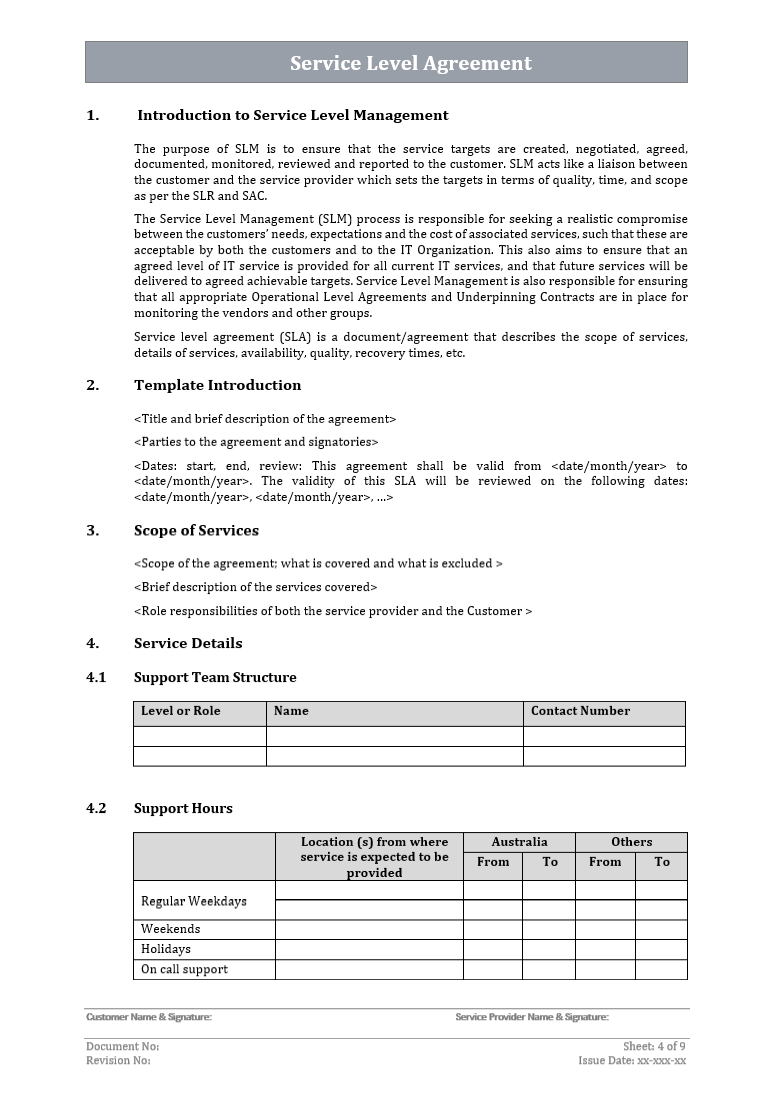
Service Level Agreement Template Overview
Source: ISO Templates and Documents
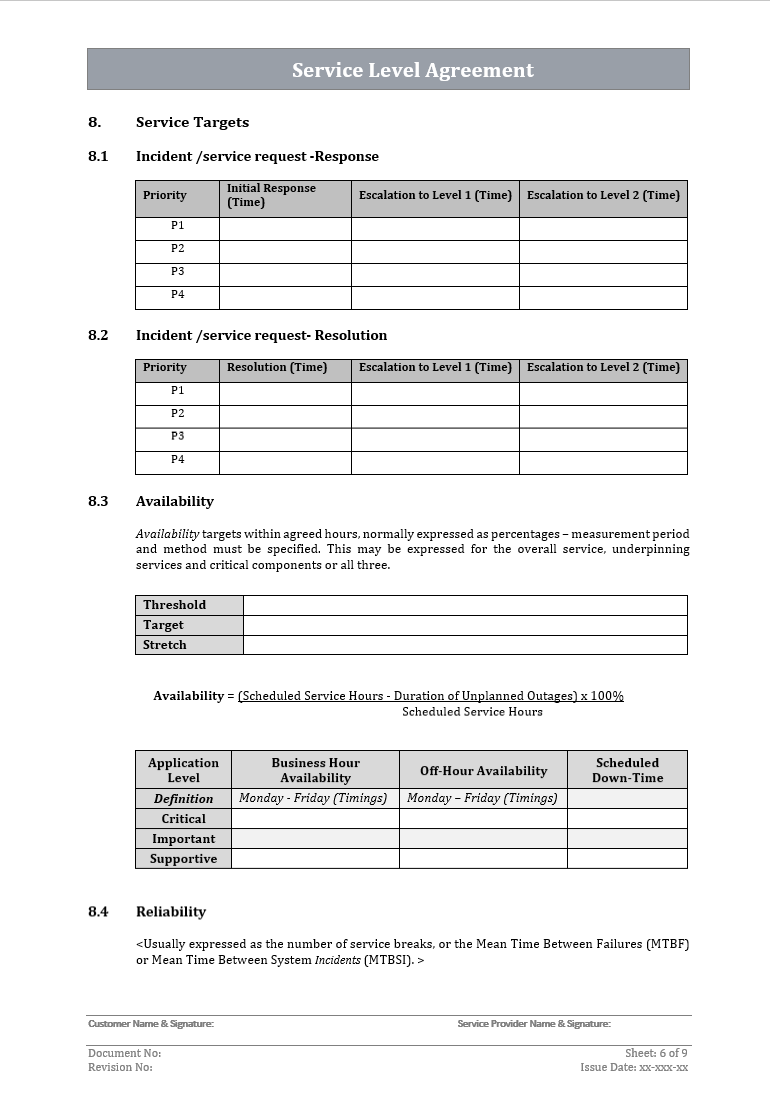
Service Level Agreement Service Targets
Source: ITSM Docs
Jira Service Management SLA and CSAT Dashboard

Source: Atlassian Community
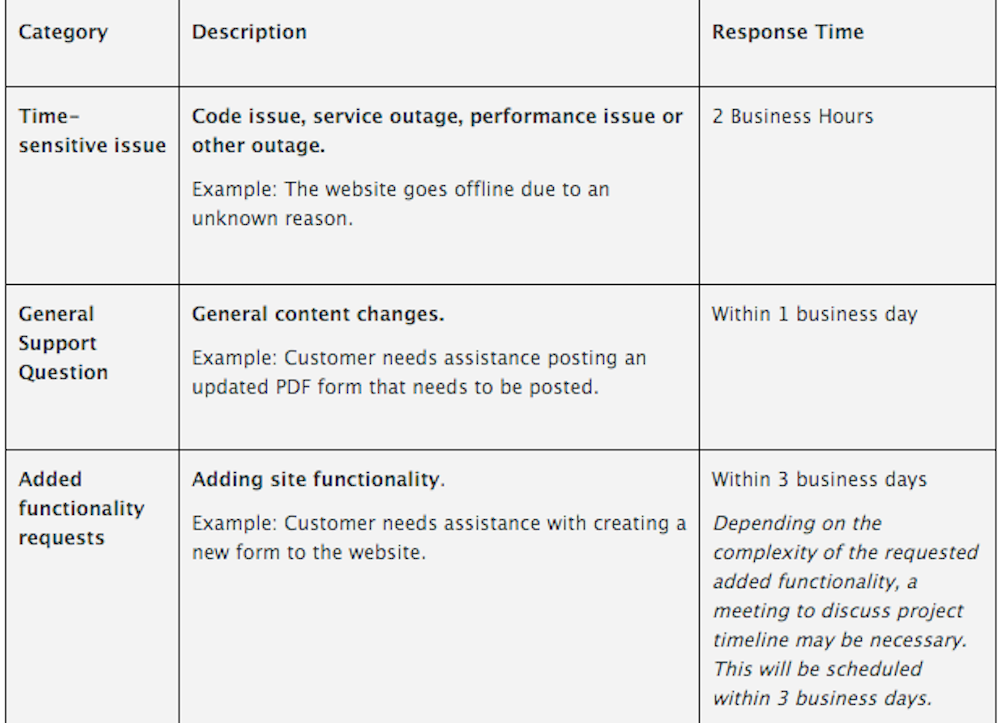
SLA Response Time Categories
Source: GetVoIP

Customer Service KPI Dashboard
Source: SlideTeam
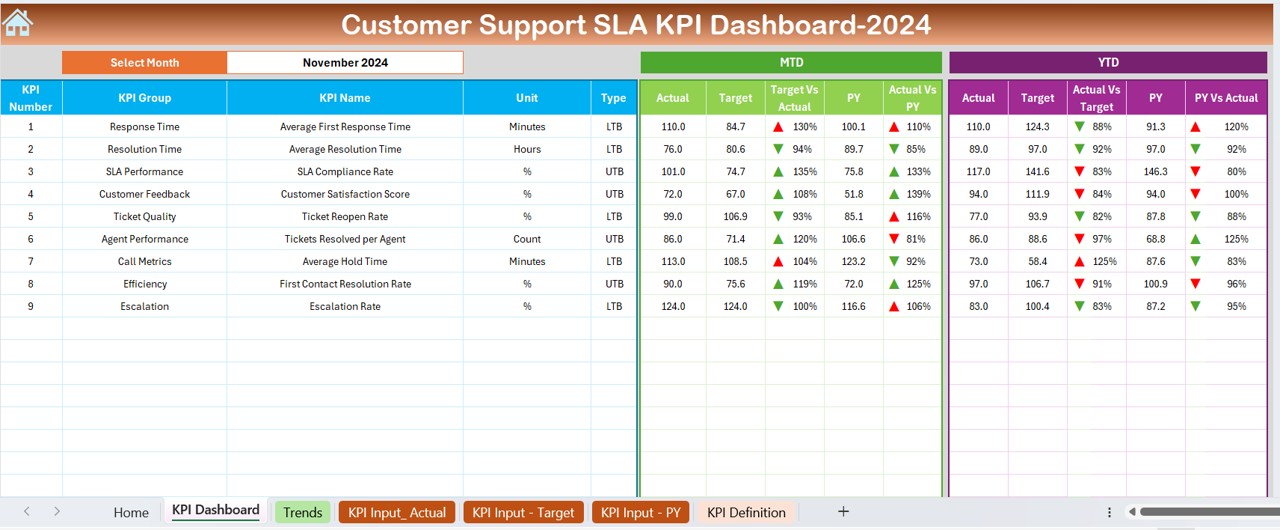
Customer Support SLA KPI Dashboard
Source: PK: An Excel Expert

Response and Resolution Time Matrix
Source: HelpDesk

Service Level Agreement Service Credits Page
Source: Oneflow
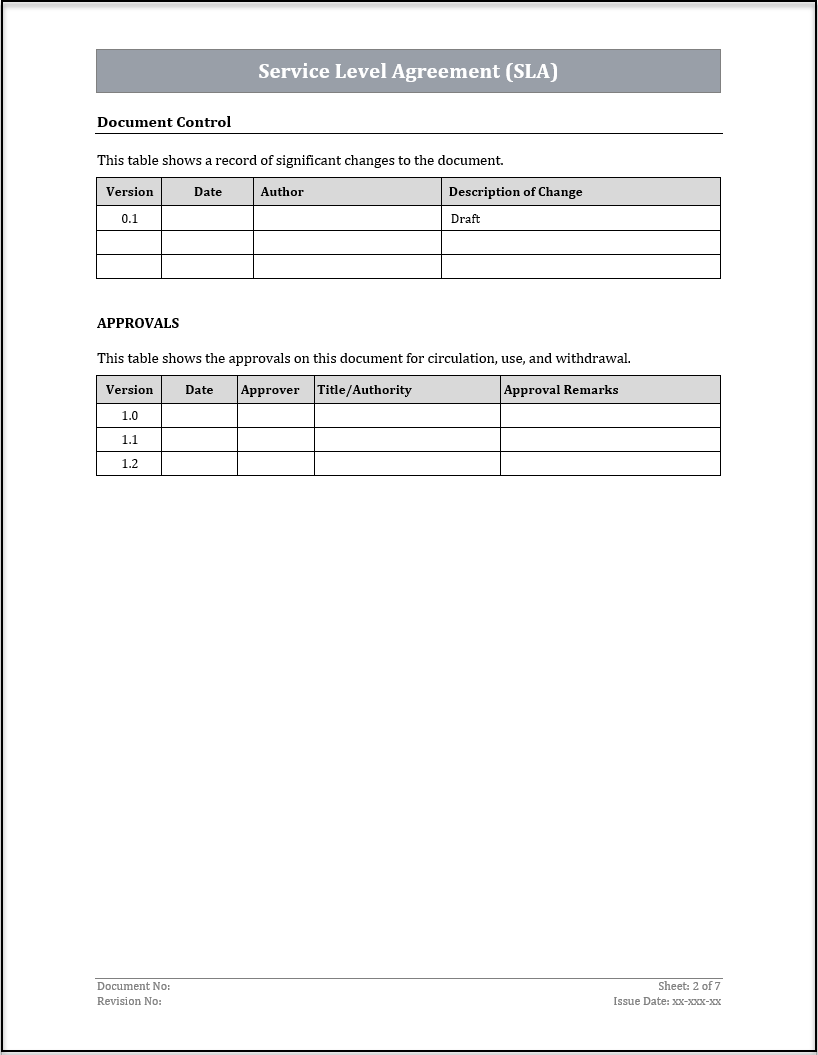
Service Level Agreement Document Control and Approvals
Source: ISO Templates and Documents
Service Level Agreement Document Reference
Source: Juridict
