When a business hires employees, contractors, designers, engineers, writers, developers, or consultants, the work created during that relationship can become one of its most valuable assets. Software, technical drawings, written materials, inventions, designs, databases, product concepts, branding elements, documentation, and confidential know-how may all raise intellectual property questions. A well-structured intellectual property work for Template should therefore do more than provide a signature page. It should help an organization identify what is being created, establish how ownership is handled, distinguish existing assets from newly created work, and create a practical record that can be maintained as the relationship develops.
The central challenge is that intellectual property ownership is not governed by one universal rule. The result can depend on the type of intellectual property, the identity of the creator, the employment or contractor relationship, the wording of the agreement, and the law that applies to the transaction. The World Intellectual Property Organization explains that ownership of employee-created inventions and creative works can vary substantially between jurisdictions and according to the circumstances of the relationship. :contentReference[oaicite:0]{index=0}
For that reason, a useful template should be treated as a structured drafting aid rather than as a substitute for jurisdiction-specific legal review. The strongest document begins with a clear business purpose, defines relevant terms, identifies covered work product, addresses pre-existing intellectual property, explains assignment or licensing mechanics, and establishes procedures for disclosure, recordkeeping, confidentiality, and departure. Those elements make the document useful to both management and the people creating the work.
What an intellectual property work for Template should accomplish
A strong template should first answer a basic question: what relationship is the document governing? An employee agreement, contractor agreement, invention assignment, collaboration agreement, licensing arrangement, and sale of intellectual property may all contain similar concepts, but they do not serve the same purpose. A document intended for employees usually focuses on work created within the employment relationship, while a contractor arrangement may need much more detailed language about deliverables, background materials, licenses, and ownership of commissioned work.
The document should then establish the parties with enough precision to avoid uncertainty later. Legal names, organizational status, effective date, and the relevant relationship should be clear. If the creator is an individual contractor, the agreement should distinguish that person from any business entity through which services are provided. If several parties contribute to a project, the template should identify their roles and explain whether ownership is centralized, divided, jointly held, or assigned to another party.
A third objective is traceability. Intellectual property ownership is easier to demonstrate when the organization can connect a particular creation to a person, project, date, agreement, and delivery record. A template can support this by providing fields for project identifiers, descriptions of deliverables, prior inventions, repositories, design files, registration details, and related schedules. The result is not merely a contract; it becomes part of an internal chain-of-title record.

What does intellectual property include in workplace documents?
The phrase intellectual property covers several different legal categories. WIPO describes intellectual property broadly as creations of the mind and identifies areas including inventions, literary and artistic works, symbols, names, images used in commerce, patents, trademarks, industrial designs, geographical indications, copyright, and related rights. :contentReference[oaicite:1]{index=1} A workplace template should therefore avoid assuming that intellectual property means only patents or registered assets.
Copyright can be relevant to written materials, photographs, illustrations, videos, architectural works, software, manuals, presentations, and other original expression. The U.S. Copyright Office notes that copyright protects original works of authorship but does not protect facts, ideas, systems, or methods merely because they are described in a work. :contentReference[oaicite:2]{index=2} This distinction matters when a workplace document describes both creative output and underlying business concepts.
Patents and inventions require different treatment because invention ownership can be governed by employment agreements as well as local statutory rules. Trademarks can cover names, logos, symbols, and other source-identifying elements. Trade secrets may include confidential technical information, formulas, source code, customer information, pricing information, manufacturing processes, or business strategies when the applicable legal requirements are satisfied. A template should define these categories carefully rather than treating every piece of information as interchangeable.


Work product and ownership boundaries
The phrase work product intellectual property is useful because it focuses attention on what the creator actually produces for the organization. A template might cover reports, source code, designs, inventions, drawings, specifications, written content, research materials, prototypes, documentation, databases, formulas, processes, or other deliverables. The exact scope should match the actual role and project instead of relying on an unnecessarily broad definition.
One of the most important boundaries is between work created for the organization and intellectual property that existed before the relationship began. A creator may bring pre-existing code libraries, writing, illustrations, inventions, processes, templates, research, or design elements into a project. If those assets are not identified, a later ownership dispute can become difficult to resolve because the organization may believe it owns the entire resulting work while the creator may believe certain components remain personal property.
A practical template can address this problem with a background intellectual property schedule. The creator lists relevant pre-existing assets, explains whether those assets will be incorporated into the project, and identifies what permission the organization receives if incorporation occurs. This structure can be more precise than a blanket statement that every item connected with the project belongs to one party.

Key sections to include in an intellectual property agreement
An intellectual property agreement template normally benefits from a modular structure. The opening section identifies the parties and explains the purpose of the agreement. Definitions follow, establishing terms such as intellectual property, work product, confidential information, background intellectual property, inventions, deliverables, and third-party materials. The ownership section then explains what rights are assigned, retained, licensed, or otherwise handled.
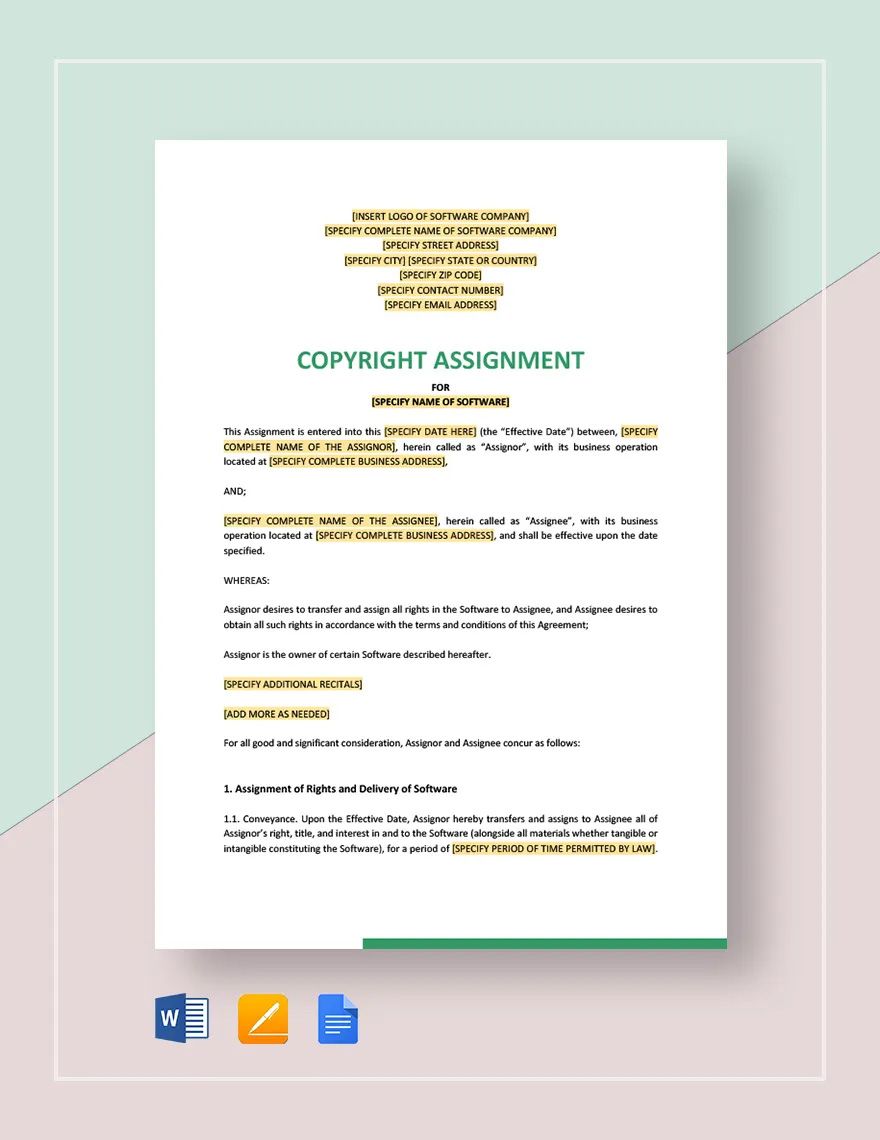
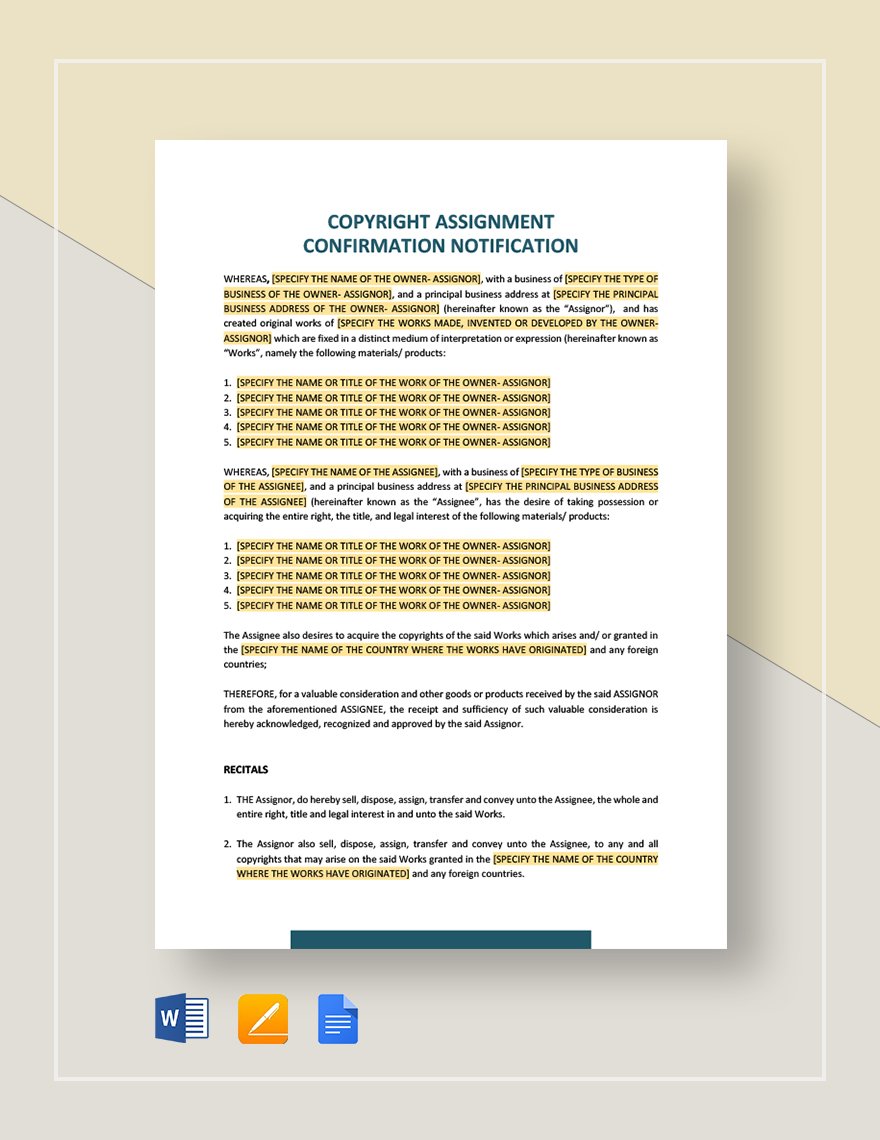
The assignment language deserves particular care. An assignment is different from a license. An assignment generally transfers specified rights or interests, while a license permits specified use while ownership may remain with the original owner. The template should state which mechanism is intended and describe its scope. Where registration or further documentation may be necessary, the agreement can also address cooperation with future filings and recordkeeping.
Confidentiality should not be treated as a substitute for ownership provisions. An employee can be required to keep information confidential while ownership of a particular work remains disputed. Likewise, a company may own a work but still need separate confidentiality rules for information that should not be publicly disclosed. A carefully drafted document keeps these concepts distinct while making them work together.

Employee intellectual property and jurisdiction
Workplace intellectual property rules should never be assumed to be identical across countries. WIPO specifically notes that ownership of inventions, designs, and creative works produced by employees can vary considerably by jurisdiction and by the facts of the employment relationship. :contentReference[oaicite:3]{index=3} The same document structure can therefore require different substantive wording depending on where the employer and creator are located.
For example, the United Kingdom has statutory rules concerning certain employee inventions. Under section 39 of the Patents Act 1977, particular inventions made in the course of an employee’s duties may belong to the employer, while other inventions may belong to the employee. :contentReference[oaicite:4]{index=4} This illustrates why a general template should not be presented as a universal statement of ownership law.
Indonesia also demonstrates the importance of jurisdiction-specific drafting. The European Commission’s IP Helpdesk states that, under Indonesian law, copyright in works created by employees does not automatically belong to the employer merely because the work was created during employment; the employment contract is important in determining the ownership regime. :contentReference[oaicite:5]{index=5} A template intended for Indonesian use should therefore be reviewed against Indonesian law rather than imported unchanged from another jurisdiction.

Assignment, licensing, and retained rights
A good template makes the commercial intention unmistakable. If a company intends to own newly created work, the document should identify the covered work and the rights that are intended to transfer. If the creator retains ownership but grants the company permission to use the work, the document should instead describe the license, including its permitted uses, territory, duration, exclusivity, sublicensing rights, and termination provisions where relevant.
Retained rights are especially important for independent contractors. A designer might use a pre-existing design system, a developer might rely on an existing library, and a consultant might bring an established methodology to a project. The agreement should identify those elements and distinguish them from newly created deliverables. This reduces the chance that a legitimate background asset is unintentionally treated as newly transferred property.
Joint development creates another layer of complexity. When two parties contribute significant intellectual property, the agreement should state how ownership is divided, who may exploit the resulting work, how expenses are handled, and whether either party can license or transfer its interest independently. WIPO’s model agreement resources illustrate how assignment, confidentiality, licensing, and research cooperation can be handled through different contractual structures. :contentReference[oaicite:6]{index=6}


How to structure work-related intellectual property records
A contract is strongest when it is supported by operational records. For each significant project, an organization can maintain a simple intellectual property register containing the project name, creator, creation date, asset description, agreement reference, ownership status, registration status, and any relevant license restrictions. The register can be maintained as a spreadsheet or another controlled business record.
The record should also distinguish between confirmed ownership and assumptions. For example, a field can identify whether ownership was established by an employment agreement, contractor assignment, separate assignment instrument, license, statutory rule, or another documented source. This makes later legal review faster because the organization does not have to reconstruct the history of every asset from emails and informal discussions.
Version control is equally important for digital work. Software repositories, design files, research notebooks, document histories, and dated deliverables can help establish what existed at particular points in time. A template cannot replace these records, but it can require the parties to identify where the relevant records are maintained and who is responsible for preserving them.


Using Word and spreadsheet formats effectively
Readers searching for intellectual property work for template in word are often looking for a document structure that can be adapted to a particular employment or contractor relationship. A word-processing format is generally useful for narrative agreements because it supports clauses, definitions, signature blocks, schedules, and explanatory notes. The document should be reviewed carefully after editing so that references, defined terms, numbering, and cross-references remain consistent.
An intellectual property work for template excel structure serves a different purpose. A spreadsheet is particularly useful for tracking assets rather than replacing the legal agreement itself. Useful columns can include asset name, IP category, creator, creation date, project, agreement reference, registration identifier, jurisdiction, ownership status, renewal date, license status, and notes. A spreadsheet should be treated as an administrative register, not as evidence that ownership exists merely because a row says “company owned.”
A printable or PDF-style record can be valuable for executed agreements because it preserves the version that was actually signed. However, the important question is not the file extension. The organization should be able to demonstrate which version was approved, who signed it, when it became effective, and whether later amendments changed the ownership arrangement.


How an intellectual property policy supports the agreement
An intellectual property policy template can provide the organizational layer that a contract alone cannot. A policy can explain how employees should disclose inventions, where confidential materials should be stored, how third-party intellectual property should be handled, who reviews new creations, and what happens when a worker leaves. The individual agreement can then establish the contractual relationship while the policy provides consistent internal procedures.
A policy should also explain acceptable use of third-party materials. Employees frequently encounter code, images, fonts, datasets, research publications, open-source components, and licensed commercial materials. The organization should have a process for determining whether those materials may be incorporated into a deliverable and what obligations accompany their use.
Trade secrets require particularly disciplined operational controls. WIPO identifies confidential technical information, inventions, software, designs, and other creative outputs as possible forms of intellectual property in research environments. :contentReference[oaicite:7]{index=7} A policy can reinforce access restrictions, confidentiality obligations, secure storage, disclosure procedures, and exit processes without confusing those operational measures with the legal ownership of the underlying work.


Patents, inventions, and employee-created innovations
Patent-related provisions deserve special attention because an invention may arise gradually from ordinary work rather than from a single deliverable. An engineer may improve a process, a researcher may develop a new method, or a product team may create a technical solution during routine development. A template can require timely disclosure of potentially patentable inventions so that the organization can evaluate ownership and filing strategy before public disclosure creates complications.
The document should also avoid assuming that every employee invention belongs automatically to the employer. As the WIPO material explains, national rules differ, and some systems provide employees with specific rights or compensation relating to inventions. :contentReference[oaicite:8]{index=8} The safest approach is to combine clear contractual drafting with review under the law governing the employment relationship.
Patent records can be connected to the broader IP register. The organization can record the invention description, inventors, disclosure date, relevant project, assignment status, filing status, and jurisdiction. This creates a useful bridge between the legal agreement and the operational process of managing intellectual property.


Software, data, designs, and digital work product
Software projects often demonstrate why precise drafting matters. A single product may contain source code, documentation, interface designs, databases, algorithms, graphics, technical specifications, test materials, and third-party components. A useful template should allow the parties to distinguish original work created for the project from pre-existing libraries and third-party materials.
Data requires similar care. A business may create a database structure, collect information, produce analytical models, or generate reports from third-party data. The template should not assume that ownership of a database automatically means ownership of every underlying data element. Contractual rights, privacy obligations, licensing conditions, and sector-specific rules may affect what can legally be controlled or transferred.
Design work can also contain multiple layers. A product design may involve an industrial design, copyrightable artwork, technical drawings, brand elements, and confidential specifications. The agreement should identify the relevant deliverables and avoid relying on a single generic phrase when different rights are intended to receive different treatment.

Common mistakes when preparing an IP work template
One common mistake is using a template that is broader than the actual relationship. A small design engagement does not necessarily require the same ownership structure as a research collaboration involving patents and confidential technical information. Overly broad drafting can create uncertainty, particularly when it attempts to claim unrelated personal work or pre-existing intellectual property.
Another mistake is failing to identify background intellectual property. If a creator uses an existing library, design system, invention, methodology, or creative asset, that fact should be addressed before the project begins. Otherwise, the parties may later disagree about whether the asset was part of the newly created work or merely incorporated into it.
A third mistake is treating a signature as the end of the process. Effective IP management continues after signing. Organizations should record newly created assets, preserve supporting evidence, update registrations where necessary, review licenses, and confirm that departing workers return or relinquish access to relevant materials. The agreement establishes rights; disciplined administration helps preserve the evidence and operational controls needed to support those rights.


Practical Solution
The most practical way to implement an intellectual property work for Template is to create a controlled document package rather than relying on one generic form. Start with a core agreement that identifies the parties, relationship, covered work product, ownership mechanism, background intellectual property, confidentiality obligations, third-party materials, further-assurance obligations, and termination or post-termination requirements. Then add schedules for pre-existing intellectual property and project-specific deliverables when the relationship warrants them.
Next, connect the agreement to an internal intellectual property register. Give every significant asset a unique internal reference and record its creator, project, date, ownership basis, jurisdiction, registration information, and relevant restrictions. For software, include the repository or project reference. For designs, identify the relevant files or project records. For inventions, record the disclosure and patent-management status. The register should identify uncertainty rather than conceal it, so unresolved ownership questions can be escalated for review.
Finally, build the template into onboarding, project initiation, delivery, and offboarding workflows. At onboarding, identify background intellectual property and confirm the governing agreement. At project initiation, clarify expected deliverables and ownership. During delivery, preserve records of creation and contribution. At completion, confirm what was delivered and what third-party material was used. At departure, recover confidential materials, review continuing obligations, and preserve the executed agreement and supporting records.
This approach also makes review more efficient. Instead of asking a legal reviewer to reconstruct an entire project history, the organization can present the agreement, background-IP schedule, asset register, delivery records, and relevant licenses as one coherent package. A legal professional can then focus attention on jurisdiction, unusual ownership structures, regulatory considerations, employee-invention rules, third-party rights, and other issues that require specialized judgment.
Templates are most valuable when they create consistency without pretending that every situation is identical. The objective is not to make every IP relationship look the same. The objective is to make the important questions visible early, document the parties’ actual intentions, and create reliable records that can be maintained as the business creates, acquires, licenses, and transfers intellectual property.

Reference Examples
Visual references for an intellectual property work for Template are most useful when they show how ownership concepts become concrete document structures. Agreement covers, assignment pages, schedules, signature sections, portfolio registers, and licensing layouts can reveal the practical building blocks that a strong IP record may contain. They also demonstrate why a template should be adapted to the underlying relationship rather than treated as a universal legal instrument. A useful reference should help readers recognize the difference between a contractual ownership provision, an administrative asset register, and a document used to evidence a transfer or license.
The examples below provide several perspectives on intellectual property work for Template without suggesting that any particular third-party document is suitable for every jurisdiction or transaction. They include assignment records, technology agreements, portfolio tracking layouts, and other document structures relevant to workplace intellectual property management. Use them as visual references for organization, terminology, and document architecture, while obtaining appropriate legal review before relying on substantive provisions in a real transaction.

IT Intellectual Property Protection Checklist Template
Source: Template.net

Intellectual Property Checklist Graphic
Source: Pinterest
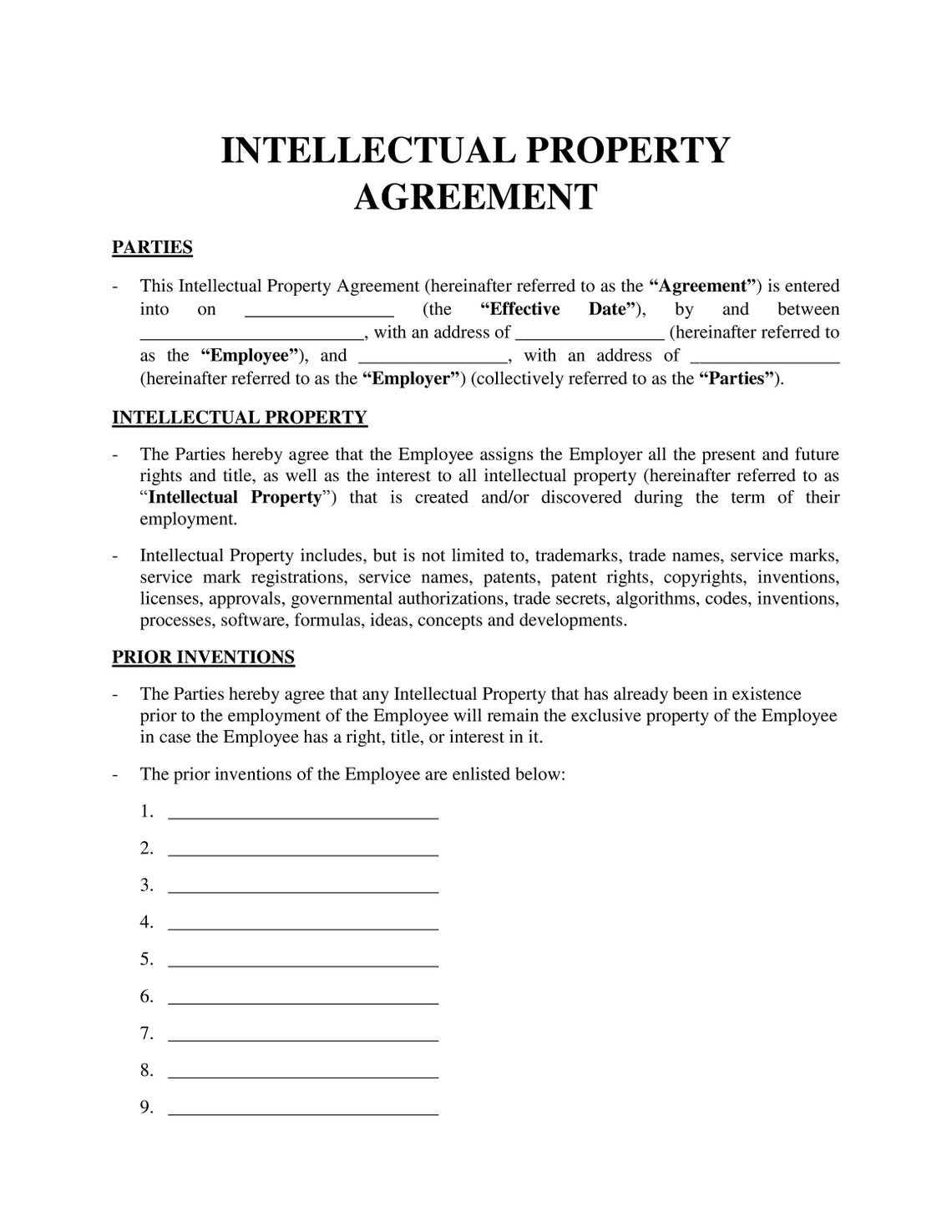
Intellectual Property Agreement Form
Source: Etsy

Intellectual Property Advertising Agreement Template
Source: Template.net
Intellectual Property Assignment Template
Source: Template.net
