A template is not the same thing as an official government application form. The actual requirements come from the funding opportunity, its notice of funding opportunity or equivalent instructions, the awarding agency, and the submission system. For U.S. federal opportunities, Grants.gov explains that applicants should first confirm eligibility, find an opportunity that fits their work, register as required, use Workspace, complete the required forms and attachments, check the application for errors, and submit it before the deadline.
This distinction matters because many searches for a grant template are really searches for a practical working document. Applicants want somewhere to organize the project description, objectives, outcomes, budget assumptions, evaluation plan, organizational information, attachments, and submission checklist before transferring information into the official package. A good working template therefore reduces confusion without pretending to replace agency instructions.
This guide explains how to build that working document, how to adapt it for nonprofits and other organizations, how to organize Word, PDF, Google Docs, and spreadsheet workflows, and how to approach the actual federal submission process. It also covers common mistakes, research methods, budget preparation, evidence gathering, review procedures, and practical ways to improve an application before submission.
The goal is not to promise funding. Government grants are competitive, and eligibility does not guarantee an award. The goal is to create a repeatable application process that helps you determine whether an opportunity is a genuine fit, develop a responsive proposal, document your assumptions, and submit a complete package with fewer avoidable errors.
What Is a to apply government grants Template?
A to apply government grants Template is best understood as an internal planning framework used to organize the information required for a grant application. It can be a Word document, a Google Docs file, a spreadsheet workbook, a PDF worksheet, or a combination of these formats. The most useful version is designed around the requirements of a specific funding opportunity rather than being treated as a universal form.
A strong template normally begins with an opportunity profile. This identifies the agency, funding opportunity title, opportunity number, deadline, applicant type, project period, funding range if stated, geographic requirements, program priorities, and key contact information. These fields prevent an applicant from accidentally using material prepared for another opportunity.
The next layer is a compliance matrix. This is one of the most valuable parts of a working template because it converts lengthy instructions into a manageable table. A typical matrix can include the requirement, where it appears in the notice, who owns it, the document or section where it will be addressed, the status, and the final verification date.
The narrative section then captures the substance of the proposed project. Depending on the opportunity, that may include a problem statement, need or opportunity, goals, objectives, activities, beneficiaries, implementation approach, partnerships, staffing, timeline, evaluation strategy, sustainability, organizational capacity, and budget narrative.
The final layer is submission control. This records attachments, file names, page limits, formatting restrictions, signatures or certifications, internal approvals, technical checks, and confirmation information. Grants.gov specifically advises applicants to review the agency’s instructions for file naming and other restrictions, so a good template should include a field for those requirements rather than assuming one naming convention applies everywhere.
Why a working template is useful
The primary benefit is consistency. If several people are contributing to an application, a shared structure makes it easier to see which sections are complete and which still require evidence, editing, or approval.
A template also exposes missing information early. For example, an organization may have a compelling program idea but discover during planning that it has not defined measurable outcomes, confirmed its eligible applicant category, identified the required partner documentation, or reconciled its proposed activities with the available budget.
Templates are particularly useful when an organization applies repeatedly. A reusable framework can hold stable organizational information while keeping opportunity-specific requirements separate. This prevents applicants from copying old proposal language blindly into a new application.
For experienced grant teams, the template can become a project-management tool. Different sections can be assigned to program staff, finance staff, leadership, evaluators, and authorized submitters. For smaller organizations, the same structure can function as a simple checklist that keeps one person from overlooking a critical requirement.
The important principle is to treat the template as a planning instrument rather than as an official government document. The official opportunity instructions always control when there is a conflict.
Understanding the Government Grant Application Process
For U.S. federal funding opportunities, the application process begins before the proposal itself is written. Grants.gov tells applicants to determine eligibility, find an appropriate federal funding opportunity, register, and then complete and submit the application using Workspace. Organizations generally also need an active SAM.gov registration and a Unique Entity ID before they can apply directly through Grants.gov.
SAM.gov is the federal system used for entity registration and identification. SAM.gov explains that organizations applying directly for federal assistance need registration and receive a Unique Entity ID as part of that process. Entity registrations must also be renewed periodically to remain active.
After registration, the applicant needs to understand the specific funding opportunity. The opportunity notice is more important than any generic template found online because it defines the program’s purpose, eligibility rules, required forms, evaluation factors, submission instructions, deadlines, and other conditions.
The next stage is application development. This normally involves interpreting the opportunity, defining the project, gathering evidence, writing the narrative, preparing the budget, collecting attachments, conducting internal review, and resolving compliance issues.
Submission is the final technical stage, but it should not be treated as a last-minute activity. Grants.gov recommends submitting well before the deadline because technical or validation problems can require time to resolve. A strong internal workflow therefore establishes an earlier organizational deadline than the official deadline.

How to Apply for Government Grants Step by Step
1. Define the project before searching for money
Start with the project rather than with a dollar amount. Write down the problem you want to address, the population or community affected, the proposed intervention, the expected results, the approximate timeline, and the organization responsible for delivery.
This step helps prevent a common mistake: reshaping an organization around whatever grant happens to be available. A grant should normally support a legitimate organizational or community need rather than create a disconnected project simply because funding appears available.
A short concept note is enough at this stage. It can contain a one-paragraph problem statement, three to five objectives, major activities, expected outputs, expected outcomes, and an approximate budget category list.
The concept note also becomes a screening tool. If an opportunity emphasizes research but your project is direct service delivery, the mismatch may be obvious before your team spends days writing an application.
Use the concept note as the first page of the internal template. Keep it concise enough that a senior decision-maker can understand the proposed project quickly.
2. Confirm eligibility
Eligibility is not merely a box to check. Read the applicant eligibility section carefully and compare every condition with your organization. Grants.gov notes that funding opportunities can specify eligible applicant categories such as government entities, educational organizations, nonprofits, businesses, tribal governments, or other defined groups.
Check whether eligibility depends on geography, organizational status, project location, population served, prior funding, partnership status, accreditation, or another condition.
If the opportunity allows multiple applicant categories, determine whether the requirements differ between them. An eligible nonprofit may face different documentation or partnership expectations than an eligible government entity.
Record the eligibility conclusion in your template and identify the evidence supporting it. This creates an audit trail for internal decision-making.
Do not assume that a phrase such as “government grant” means an individual can apply for personal financial assistance. Grants.gov explicitly states that its opportunities generally support organizations and government-funded programs rather than personal financial assistance.
3. Build an opportunity compliance matrix
Create a table with columns for requirement, source location, response section, responsible person, evidence needed, status, and review date.
For example, a requirement may state that an applicant must describe measurable outcomes. The matrix should identify the narrative section where those outcomes will appear and the staff member responsible for producing the measurement approach.
Another requirement may specify a page limit. Record the limit in the matrix and make it visible to the writer and editor. Do not rely on memory.
Do the same for file formats, attachment requirements, budget forms, certifications, letters, partnership documents, and other supporting material.
The compliance matrix is often more valuable than a beautifully formatted proposal template because it protects the team from missing instructions that are buried deep in the opportunity documentation.
4. Research the awarding agency
Read the opportunity itself first, then use official agency resources to understand the program’s broader context. Look for previous award information, program descriptions, technical assistance materials, performance expectations, and definitions.
Do not copy language simply because an agency uses it. Instead, identify what the agency appears to be asking applicants to demonstrate and then provide your own evidence.
Research should answer practical questions: Why does the problem matter? What population is affected? What evidence supports the proposed intervention? What similar programs exist? What gap will the project address?
For quantitative claims, record the original source and publication date. For local claims, prefer authoritative local data when available. For organizational claims, distinguish between documented achievements and future intentions.
A research log inside the template can include source, date accessed, key finding, relevance to proposal, quotation or data point if permitted, and where the source will be cited.

Core Components of a Government Grant Application Template
Project summary
The summary should explain what the project will do, why it matters, who will benefit, where it will occur, the major activities, and the expected results. Write it after the rest of the proposal when possible so it accurately reflects the complete application.
A strong summary does not attempt to include every detail. It provides a clear decision-level overview that lets a reviewer understand the proposal’s central logic.
Keep terminology consistent. If the project calls participants “program beneficiaries” in one section and “clients” in another, the distinction should be intentional rather than accidental.
Numbers in the summary should match the detailed narrative and budget. If the proposal says 200 participants will be served, the staffing plan, budget assumptions, and evaluation plan should be capable of supporting that number.
Do not claim outcomes that the project cannot reasonably measure. A credible modest promise is stronger than an inflated prediction.
Statement of need
The need section explains the problem that makes the project necessary. It should combine context with evidence rather than relying only on emotional language.
Start by defining the problem. Then describe who is affected, the relevant geographic or demographic context when appropriate, existing gaps, and why the proposed response is timely.
Use sources that can be checked. Government datasets, university research, established research organizations, administrative data, and credible community assessments may be useful depending on the subject.
Avoid turning the section into a general essay about the issue. The reviewer needs to understand the connection between the documented need and the proposed project.
The final paragraph of the need section should naturally lead to the proposed solution. It should explain why the project activities are a reasonable response to the identified gap.
Goals and objectives
A goal expresses the broader change the project seeks to support. Objectives are more specific and should describe what the project will accomplish within the proposed period.
Useful objectives are measurable enough to evaluate. Depending on the program, they may include numbers served, completion rates, service milestones, adoption targets, process improvements, or changes in defined indicators.
Do not confuse activities with objectives. “Conduct workshops” describes an activity. “Deliver twelve workshops to a defined participant group with a specified completion target” is more measurable.
Every objective should connect to activities, resources, outputs, outcomes, and evaluation methods.
This creates a logical chain that makes the proposal easier to review and easier to manage after an award.
Work plan and timeline
A work plan translates the narrative into action. It should show what happens, when it happens, who is responsible, and what evidence demonstrates completion.
Break large activities into milestones. A project launch, recruitment period, service delivery phase, evaluation period, reporting stage, and closeout process may each require separate tasks.
Assign realistic dependencies. If a partner agreement must be signed before implementation begins, the timeline should reflect that dependency.
Use a calendar or spreadsheet for internal management even if the official application requires a different format.
A timeline should be consistent with the budget. Staffing costs, contractor expenses, travel, supplies, and evaluation expenses should occur during periods when the associated work is actually scheduled.
Budget and budget narrative
The budget should be developed alongside the work plan rather than as an afterthought. Start by listing the activities and the resources needed to deliver them.
Typical categories may include personnel, fringe benefits where applicable, contractual services, travel, equipment, supplies, participant support, other direct costs, and indirect costs when permitted by the specific opportunity.
Do not assume every category is allowable. The funding opportunity and applicable rules determine what costs may be proposed.
The budget narrative should explain the logic behind significant costs. A reviewer should be able to understand why the resource is needed and how it supports the project.
Check arithmetic independently. A second person should review formulas, totals, percentages, quantities, unit costs, and relationships between the detailed budget and narrative.

Choosing Between Word, PDF, Google Docs, and Excel
The phrase to apply government grants template word reflects a common practical need: many applicants want a flexible document for drafting narrative sections. Word-style documents work well when the proposal involves substantial prose, headings, tables, and tracked revisions.
Word is especially useful for a master narrative because sections can be reorganized and reviewed without changing the underlying official forms. It is also convenient for internal editing and version control when an organization has an established document-management process.
However, a Word file should not automatically be uploaded to a federal application. The official opportunity may specify a required form, PDF attachment, webform, or another submission format.
PDF is useful for preserving a finalized layout. Grants.gov notes that applicants who complete certain individual PDF forms need compatible PDF software. The important point is that a PDF used for planning is not automatically the same thing as an official government application form.
A spreadsheet is strongest when the information involves calculations, budgets, timelines, staffing allocations, unit costs, or compliance tracking.
Google Docs can be valuable for collaborative drafting when an organization needs multiple reviewers to work from a common document. The final application should still be checked against the official submission requirements, because collaboration software does not change the government’s required format.
The best workflow often uses several formats together: a Word or Google Docs narrative, an Excel-style budget and compliance tracker, and the official Grants.gov Workspace forms and attachments for submission.
Building a Template for Nonprofits
A to apply government grants template for nonprofits should include the organizational information that funders commonly need while keeping those details separate from opportunity-specific requirements.
Start with a nonprofit profile containing the legal organization name, mission, program areas, geographic service area, leadership structure, relevant experience, financial-management capacity, and prior project experience.
Keep supporting evidence available but do not overload the proposal with information that the opportunity does not request. The purpose of the template is to make relevant information easy to retrieve when required.
Nonprofits should also create a partnership section if their projects involve schools, local governments, community organizations, healthcare providers, universities, contractors, or other entities.
Each partnership should have a clear purpose. Avoid listing organizations merely to make the proposal appear collaborative. Explain what each partner contributes and why that contribution matters to implementation.
For recurring applications, maintain a controlled organizational profile so staff are not repeatedly rewriting basic facts. Review that profile regularly so outdated leadership, program figures, addresses, or descriptions do not migrate into a new proposal.
Research Methods for a Strong Grant Proposal
Good grant writing is partly a research exercise. Before drafting a persuasive proposal, collect enough evidence to understand the problem, demonstrate organizational relevance, justify activities, and establish a credible evaluation approach.
Start with primary or authoritative sources whenever practical. Government agencies, official statistical systems, universities, recognized research organizations, and established institutions are generally preferable to anonymous summaries.
Record source information while researching rather than attempting to reconstruct it later. Your research table should capture the source title, publisher, publication date, URL if applicable, relevant finding, and the proposal section where it will be used.
Separate evidence from interpretation. A source may document a problem, while your proposal explains what that problem means for your target population and why your intervention is appropriate.
Use recent information where the subject changes quickly. For stable historical context, older authoritative sources may still be useful.
Never manufacture a statistic to make the need appear stronger. If a local figure is unavailable, say so and use the best available evidence while explaining its limitations.
Qualitative evidence can also be valuable when appropriate. Community assessments, program records, documented service gaps, stakeholder feedback, and prior evaluation findings can help explain why a problem exists and how it affects the intended population.
When using testimonials or participant stories, follow applicable consent, privacy, and organizational policies. A compelling story should never compromise confidentiality.
The research section of your template should therefore function as a source-control system, not merely a list of links.

Turning Research Into a Persuasive Proposal
Research only becomes useful when it supports a clear argument. A proposal should make the relationship between need, intervention, resources, and outcomes easy to follow.
One practical method is to write a simple logic chain before drafting the narrative: identified problem, contributing factors, proposed activities, immediate outputs, expected short-term outcomes, longer-term contribution, and measurement method.
For example, a hypothetical community training project might identify a documented skills gap, provide structured training sessions, track attendance and completion, assess knowledge gains, and then monitor a longer-term indicator that the funding opportunity specifically values.
The example is hypothetical, but the method is broadly useful. It prevents a proposal from becoming a collection of disconnected promises.
Reviewers should not have to infer why an activity belongs in the project. The narrative should make that relationship explicit.
Data Collection and Evaluation
Evaluation should be designed before the application is submitted. Start with the outcomes you promise and determine what evidence would demonstrate progress.
For process measures, the evidence might include enrollment records, attendance, completion records, service counts, delivery dates, or implementation milestones.
For outcome measures, the evidence might include surveys, assessments, administrative records, performance indicators, follow-up interviews, or other methods appropriate to the project.
Do not select sophisticated evaluation methods simply because they sound impressive. The method must be feasible within the budget, staff capacity, timeline, and data environment.
Define who collects each measure, when it is collected, where it is stored, how quality is checked, and how results will be reported.
Privacy and data governance should be considered whenever participant information is collected. The application should not promise a data-collection system that the organization cannot responsibly operate.
Evaluation findings should ultimately feed back into program management. A strong grant project does not collect data only because a funder asks for it; it uses appropriate information to understand whether implementation is working.

How to Use Tables, Charts, and Spreadsheets
Visual structures can make a complex application easier to manage. A compliance table can show which requirements are complete, while a timeline can reveal scheduling conflicts.
Budget spreadsheets are particularly useful because they can calculate subtotals and compare proposed resources against project activities.
Charts can also help internal teams identify patterns in survey results, service volume, geographic distribution, or performance indicators. They should be used for decision-making rather than decoration.
When a chart is included in an official proposal, check whether the funding opportunity permits it and whether the formatting is readable in the final submission.
Keep the underlying data available. A chart should never become the only record of the calculation that produced it.
Use consistent labels and definitions. If a spreadsheet uses “participants,” the evaluation plan should clarify exactly what qualifies as a participant.

Managing Collaboration in a Grant Team
Grant applications often involve more people than the final submitter. Program staff understand the intervention, finance staff understand costs, evaluators understand measurement, leadership provides organizational direction, and the authorized representative may control final submission.
Grants.gov Workspace is designed to support collaborative application work. Its guidance describes roles and workspace participants that can divide responsibilities while controlling access to application materials.
Even small teams benefit from explicit ownership. Assign one person to maintain the master template, one person to control the compliance matrix, one person to coordinate the budget, and one person to manage final submission where appropriate.
Use version names that make status obvious. For example, an internal draft might include the date and status rather than simply being called “final.”
Establish a rule that changes to the narrative and budget are communicated to the other owners. A budget revision can affect the narrative, staffing plan, timeline, and evaluation section.
Before submission, freeze the application for final review so no one accidentally changes a completed section after approval.

How to Apply for Gov Grants Without Losing Track of Requirements
People searching for how to apply for gov grants often want a short answer, but the real process is a sequence of decisions. First determine whether the opportunity is appropriate and whether the applicant is eligible.
Next, understand the submission system and registration requirements. For organizational federal applicants, Grants.gov’s current guidance points applicants to SAM.gov registration, a Unique Entity ID, a Grants.gov account and organization profile, and the Workspace process.
Then read the entire funding opportunity before writing. Identify every required form, attachment, page limit, formatting rule, deadline, and evaluation criterion.
Build the proposal around those requirements rather than writing a generic proposal and trying to fit it into the opportunity afterward.
Finally, validate the complete package and submit early enough to address technical issues. Grants.gov provides tools for checking application errors and tracking a submission after it is sent.

How to Apply for a Grant From Government Agencies
The question how to apply for grant from government is broader than the federal Grants.gov process. Different governments and agencies can use different portals, eligibility rules, forms, deadlines, and award structures.
Start by identifying the government level involved. Federal, state, provincial, regional, municipal, and international public funding programs may have completely different systems.
Confirm the official funding source before sharing organizational information or paying a third party. Government grant scams often rely on confusing terminology and promises of guaranteed funding.
Read the official program notice and determine whether applications are open, whether the organization is eligible, and whether the project meets the program’s purpose.
Use the same template principles regardless of jurisdiction: opportunity profile, eligibility test, requirements matrix, narrative framework, budget, evidence file, attachments list, review process, and submission record.
Never assume that a federal template applies to a state or local program. The working structure can be reused, but the official requirements must be rebuilt for each funding source.

Grants.gov: How to Apply for Grants
The phrase grants.gov how to apply for grants usually signals that the searcher needs the official federal process rather than a generic proposal-writing article. Grants.gov describes the basic application sequence as finding an opportunity, creating or accessing a Workspace, completing the required forms and attachments, checking the application, and submitting it.
Organizations should also distinguish between the Grants.gov account and the underlying organization registration. The federal registration process involves SAM.gov, and Grants.gov uses organizational information associated with that registration.
Workspace supports different approaches to completing forms. Applicants can work online, download forms for offline completion where supported, and in some circumstances reuse previously completed forms.
Before submission, the applicant should use the available error-checking functions and confirm that all required forms and attachments are included.
The authorized organization representative or another appropriately authorized user must have the necessary submission privileges. Internal approval should therefore occur before the final sign-and-submit stage.
After submission, retain the tracking information and a copy of the final application package for organizational records.

Common Grant Application Mistakes
One of the most common mistakes is writing before reading the complete funding opportunity. Applicants may spend substantial time developing a strong narrative that does not answer the actual evaluation criteria.
Another mistake is treating a generic template as an official government form. A template can organize content, but it cannot replace an agency’s current requirements.
Budget inconsistency is another frequent problem. If the narrative describes activities that require staff, travel, supplies, or contractors but the budget does not include those resources, the proposal may appear incomplete.
Unclear outcomes can weaken otherwise strong applications. Reviewers need to understand what will change, how the project will measure progress, and whether the proposed measures are realistic.
Late registration is particularly risky. SAM.gov and Grants.gov setup should be completed well before the application deadline, especially for organizations that have never applied before.
Another avoidable problem is failing to control versions. Multiple people may edit different copies of a document and accidentally submit outdated information.
Finally, do not assume that submitting successfully means winning. Technical acceptance only means the application entered the awarding process; the agency still evaluates it according to the opportunity’s rules.
Free Government Grants Application Tips for Better Quality Control
The phrase free government grants application tips should not be interpreted as a promise of free money or guaranteed approval. The most useful free advice is usually procedural: read the official instructions, verify eligibility, register early, create a compliance checklist, document evidence, reconcile the budget, and submit ahead of the deadline.
Use a reviewer who did not write the proposal. A fresh reader can identify unexplained acronyms, unsupported assumptions, contradictory numbers, unclear objectives, and sections that do not directly answer the opportunity.
Perform a requirement-by-requirement review rather than simply proofreading. A proposal can be grammatically excellent and still fail to address a mandatory requirement.
Perform a numerical review separately. Check every amount, percentage, unit, total, and budget narrative reference.
Perform a final technical review of file names, file formats, page counts, signatures, attachments, and submission permissions.
Maintain a final submission folder containing the exact version submitted, the opportunity notice, supporting evidence, approvals, and submission confirmation. This becomes valuable for future applications and organizational records.

Practical Example: A Hypothetical Nonprofit Application Workflow
Consider a hypothetical nonprofit that wants funding for a community workforce-readiness program. The organization begins by documenting the population it serves, the problem it wants to address, and the services it already provides.
The team then identifies a government funding opportunity that explicitly allows organizations of its type to apply. It creates an opportunity profile containing the deadline, eligible activities, geographic rules, funding period, required forms, evaluation criteria, and contact information.
The program manager writes the project concept and work plan. The finance manager builds a preliminary budget based on the activities rather than selecting a funding amount first.
The evaluation lead creates indicators for recruitment, participation, completion, and the outcome measures specified by the opportunity. The organization then connects those indicators to the work plan.
The team places every requirement in the compliance matrix. Missing attachments are assigned to named staff members, and leadership receives a review draft several days before the internal deadline.
The final reviewer checks the narrative against every evaluation criterion, compares the budget to the work plan, verifies attachments, checks file names, and confirms that the authorized submitter can complete the final submission.
This example does not guarantee success. Its value is the workflow: project definition, eligibility, opportunity analysis, evidence, narrative, budget, evaluation, compliance review, approval, and controlled submission.
Practical Solution: Build a Reusable Grant Application System
The most practical solution is to create a small grant-management system rather than relying on one document. The system can contain a master application template, opportunity tracker, compliance matrix, research log, budget workbook, attachment register, review checklist, and submission archive.
Begin with the master template. Include only information that is genuinely reusable, such as organization history, mission, standard program descriptions, leadership information, documented capabilities, and recurring evaluation methods. Mark every reusable section with a review date so old information does not automatically enter a new proposal.
Next, create an opportunity-specific copy. Add the funding opportunity number, deadline, applicant eligibility, program priorities, required forms, page limits, attachment rules, evaluation factors, and submission instructions.
Build the compliance matrix before drafting. Each requirement should have an owner and a location in the proposal. If a requirement cannot be assigned to a section or attachment, investigate it before writing.
Develop the budget from the work plan. List every major activity and determine what resources are required to deliver it. Then map those resources into the appropriate budget categories allowed by the opportunity.
Create a research log and attach source evidence to the relevant proposal sections. This makes fact checking faster and helps reviewers distinguish documented claims from assumptions.
Set an internal deadline that precedes the government deadline. Use the extra time for leadership approval, proofreading, compliance review, budget reconciliation, and technical submission checks.
Finally, archive the exact submitted package. Record the submission date, tracking information, final narrative, budget, attachments, and reviewer notes. If the application is unsuccessful, those records can support a more informed future application rather than forcing the organization to start again from scratch.
Reference Examples
The following examples illustrate document, form, chart, workflow, and reporting visuals that can help when designing an internal grant-application workflow. They are examples for planning and visual reference, not substitutes for the official requirements of a specific funding opportunity.
to apply government grants template free
Source: Grants.gov
to apply government grants template free download

Source: Wikimedia Commons
to apply government grants template word

Source: Wikimedia Commons
to apply government grants template for nonprofits
Source: Office of the Secretary of State, Ohio, via Wikimedia Commons
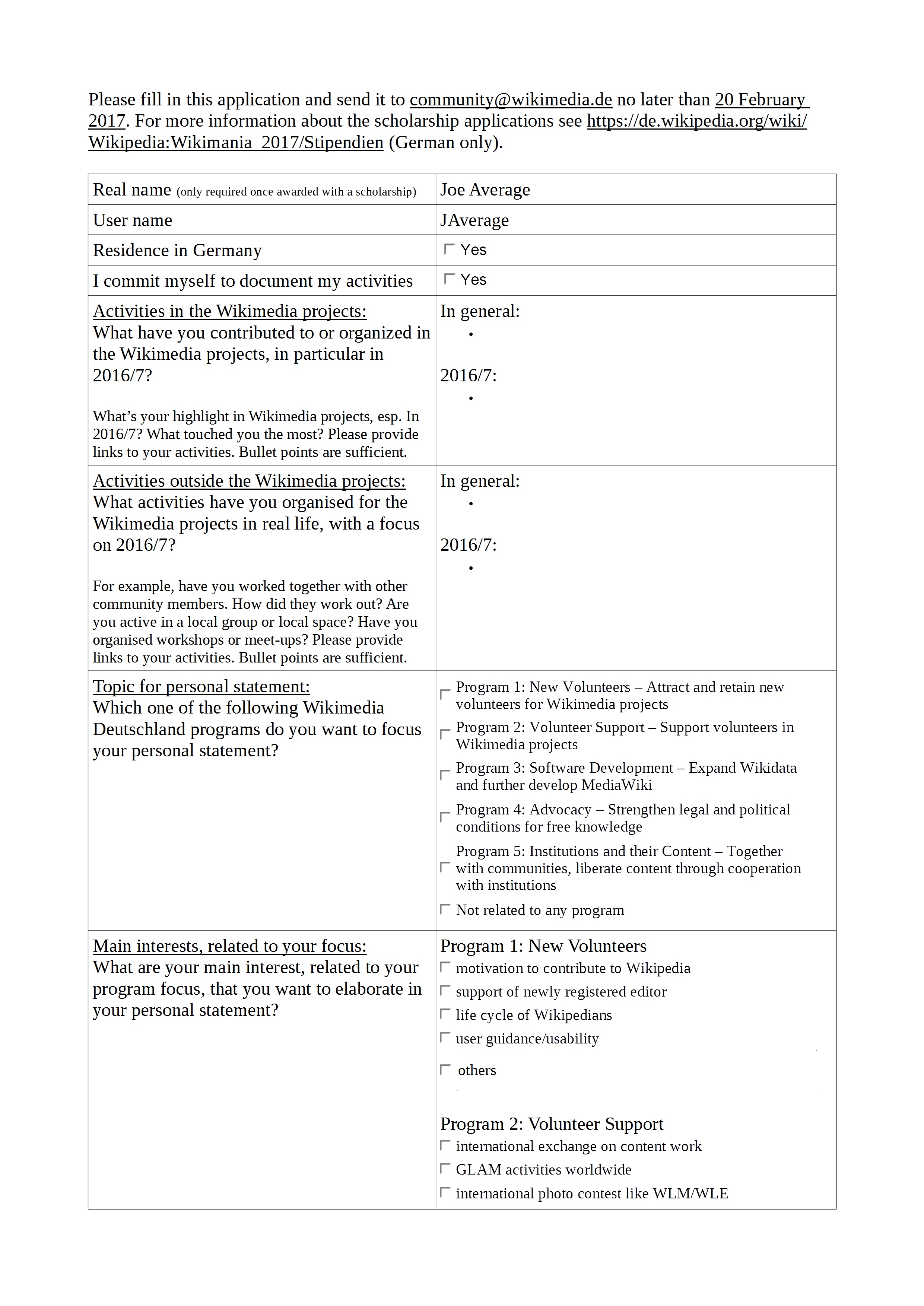
to apply government grants template pdf
Source: Wikimedia Deutschland via Wikimedia Commons
to apply government grants template google docs
Source: IDEF5 Information Integration for Concurrent Engineering Method Report, via Wikimedia Commons
to apply government grants template excel
Source: Wikimedia Commons
how to apply for government grants
Source: Grants.gov
how to apply for gov grants

Source: Grants.gov
how to apply for grant from government
Source: Wikimedia Commons
grants.gov how to apply for grants
Source: Wikimedia Commons
free government grants application tips
Source: U.S. Patent and Trademark Office document, via Wikimedia Commons
Frequently Asked Questions
What is the best format for a government grant application template?
The best format is the one that matches the task. Use a Word or Google Docs document for narrative drafting, a spreadsheet for budgets and tracking, and the official government forms or Workspace environment for the actual submission. Do not assume that your working template is an acceptable substitute for the agency’s required forms.
Can a grant template guarantee funding?
No. A template improves organization and reduces avoidable mistakes, but funding decisions depend on eligibility, program fit, competition, available funds, evaluation criteria, and the awarding agency’s process.
Is Grants.gov the same as a government grant program?
No. Grants.gov is a federal system used to publish and manage many federal funding opportunities and to support application submission. The individual funding opportunity and awarding agency determine the substantive program requirements.
Do nonprofits need a special template?
Not necessarily. A nonprofit can use the same core structure as another eligible organization, but its internal template should make organizational capacity, mission relevance, program experience, partnerships, and nonprofit-specific documentation easy to organize when an opportunity requests them.
Should I create the budget before the proposal narrative?
Build the budget and narrative together. Drafting one completely before considering the other can create contradictions. Activities should require realistic resources, and proposed costs should correspond to activities described in the narrative.
How early should an organization start a federal grant application?
Start as early as practical, especially if the organization needs SAM.gov or Grants.gov registration, new partnerships, financial information, research, or leadership approvals. Grants.gov advises applicants to allow time for registration and to submit before the deadline rather than waiting until the final moment.
Can I reuse a previous grant application?
You can reuse appropriate organizational information and some work products, but every new opportunity should be treated as a separate application. Grants.gov also provides Workspace functionality for reusing certain previously completed forms when the applicable conditions are met. Always verify the current opportunity requirements before reusing anything.
What should I do if the funding opportunity conflicts with my template?
Follow the funding opportunity. Update the template rather than forcing the opportunity into an old structure. The template is an internal tool; the current official instructions control the application.
Final Checklist Before Submission
Confirm that the organization or individual applicant is eligible for the specific opportunity. Verify that all necessary registrations and profiles are active where required.
Confirm that the project directly addresses the funding opportunity’s purpose and that the proposal answers the stated evaluation factors.
Check every required form and attachment against the compliance matrix. Do not rely on a memory-based checklist.
Reconcile the budget with the narrative, timeline, staffing model, activities, and evaluation plan. Verify formulas and totals independently.
Review every factual statement. Make sure important statistics and claims have credible sources and that hypothetical numbers are clearly treated as examples rather than real-world facts.
Review formatting, page limits, file names, file types, signatures, and submission permissions. Grants.gov’s applicant guidance emphasizes checking the application for errors and resolving problems before submission.
Submit early enough to address technical issues. Keep the tracking information and final submitted package in the organization’s records.

Conclusion
A practical to apply government grants Template should do more than provide empty headings. It should help an applicant move systematically from project definition to eligibility, opportunity research, evidence collection, narrative development, budgeting, evaluation planning, internal review, and final submission. The strongest approach is to maintain a reusable organizational framework while rebuilding the opportunity-specific compliance requirements for every new grant. For federal opportunities, use the current Grants.gov and SAM.gov instructions as the authoritative source for registration and submission requirements, and treat any Word, PDF, Google Docs, spreadsheet, or other template as a planning aid rather than a replacement for official forms. With a disciplined workflow, clear ownership, careful fact checking, and an early final review, applicants can make the grant process more organized, more defensible, and much easier to repeat.
