Medical office supervision sits at the intersection of administration, patient service, staffing, records management, scheduling, billing coordination, inventory, quality control, and workplace compliance. The exact duties vary by practice, specialty, location, staffing model, and reporting structure, so a useful template should be customizable rather than treated as a universal job standard.
This guide explains what belongs in a medical office supervisor template, how to build one, which formats work best, how to connect the template to procedures and performance reviews, and how to use it for hiring and onboarding. It also provides practical examples for supervisors who need a working document rather than a generic checklist.
The goal is not simply to create a document that looks organized. The stronger goal is to create documentation that helps a supervisor know what must happen, who owns each activity, when it should happen, what evidence should be retained, and what action should follow when a task is incomplete.
Because medical practices handle sensitive information and regulated activities, templates should also be reviewed against the requirements that actually apply to the organization. For example, HIPAA-covered entities must maintain appropriate safeguards for protected health information, while workplace safety obligations may apply to employees with occupational exposure to blood or other potentially infectious materials. :contentReference[oaicite:0]{index=0}
What Is a Medical Office Supervisor Template?
A medical office supervisor template is a reusable management document that organizes the responsibilities, workflows, checks, reporting duties, and administrative expectations associated with supervising a medical office. It can be a single-page checklist, a multi-section supervisory workbook, a procedure manual framework, or a broader operations document.
The most useful versions are modular. One section may cover opening and closing procedures, another may cover staffing, another may address scheduling and patient flow, while additional sections cover supplies, records, billing coordination, complaints, quality improvement, training, and escalation procedures.
A template should distinguish between a responsibility and a procedure. “Monitor front-desk performance” is a responsibility. “Review the daily appointment queue, identify unresolved scheduling issues, document corrective actions, and escalate recurring capacity problems” is closer to a procedure.
That distinction matters because supervisors often need both management visibility and operational detail. A responsibility tells the supervisor what they are accountable for, while a procedure tells the team how a repeatable activity should be performed.
In practice, the strongest medical office supervisor template works as a bridge between the job description and the procedure manual. It tells the supervisor what to oversee while directing the supervisor toward the documented process used to complete or verify the work.
The first design principle is scope. A supervisor should be able to see which activities are within their authority and which require approval from a physician owner, practice manager, compliance professional, clinical leader, human resources function, or another designated decision-maker.
The second principle is ownership. Every recurring activity should have a clear owner or accountable role. A template becomes less useful when it simply lists dozens of tasks without indicating who completes them, who reviews them, and what happens if the task is missed.
The third principle is frequency. Tasks should be classified as daily, weekly, monthly, quarterly, annual, event-driven, or as-needed. This prevents a supervisor from treating an annual policy review as though it were a daily opening task.
The fourth principle is evidence. Important activities should produce an appropriate record, such as a completed checklist, audit result, training acknowledgment, inventory record, corrective-action note, meeting record, or system report. The exact evidence should match the practice’s policies and applicable requirements.
The fifth principle is revision control. A medical office changes over time. Staff responsibilities change, software changes, workflows change, and regulations or organizational policies can change. A template should therefore contain an owner, effective date, review date, and version number rather than becoming an uncontrolled document.
For a new supervisor, a structured template reduces the cognitive load of remembering everything at once. Instead of relying on memory, the supervisor can work through recurring checks and reserve attention for exceptions, staff coaching, patient-service issues, and operational decisions.
For an experienced supervisor, the template creates consistency. It can make delegation easier because employees can be assigned specific sections or recurring responsibilities rather than receiving informal instructions that vary from one shift to another.
For a practice owner, the template creates visibility. A well-designed document can make it easier to understand whether essential administrative controls are actually being performed, although it should not replace formal compliance, clinical, legal, or financial review.
For an employee moving into supervision, the template can also become a development tool. Each responsibility can be connected to a competency, training activity, or performance expectation so that onboarding becomes more structured.
For hiring teams, the same framework can help translate the actual needs of the practice into a more accurate job description and interview process instead of relying on vague phrases such as “must be organized” or “must work well under pressure.”
Core Components of a Medical Office Supervisor Template
A practical template usually begins with document control. Include the practice name, department, document title, document owner, version, effective date, review date, and approval field when appropriate. This simple block helps prevent employees from unknowingly using an obsolete version.
The next component is the role summary. State what the supervisor oversees, the positions or functions that report to the supervisor, the supervisor’s reporting relationship, and the boundaries of decision-making authority.
A responsibility matrix can then translate the role summary into concrete areas such as staffing, scheduling, patient access, records, billing coordination, supplies, facilities, training, quality, communication, and administrative reporting.
A useful matrix should distinguish “responsible,” “accountable,” “consulted,” and “informed” roles when that distinction helps. Not every practice needs a formal RACI model, but the underlying principle is valuable: people should know who performs a task and who makes the final decision.
The final core component is the recurring schedule. A supervisor should be able to identify what must be checked at the beginning of a shift, during the day, at closing, at the end of the week, and during periodic management reviews.
A strong daily section may include staffing coverage, appointment readiness, unresolved messages, patient-flow issues, supplies, equipment concerns, front-desk readiness, outstanding administrative tasks, and items requiring escalation.
The daily section should not become an exhaustive clinical checklist unless the supervisor actually has responsibility for clinical activities. Administrative supervisors should avoid creating documentation that implies clinical authority they do not possess.
Weekly responsibilities may include schedule analysis, staffing patterns, outstanding training, inventory review, unresolved patient-service issues, revenue-cycle coordination, documentation audits, and follow-up on corrective actions.
Monthly responsibilities may include performance reviews, recurring reports, supply trends, overtime or staffing analysis, policy review, quality indicators, equipment maintenance tracking, and administrative meetings.
Event-driven responsibilities should cover situations such as staffing shortages, complaints, system downtime, supply shortages, equipment failure, privacy concerns, workplace incidents, or major scheduling disruptions. These should point to approved escalation procedures rather than asking the template to invent a response.
Another important section is communication. Supervisors often spend a large part of their time coordinating between front-desk staff, clinical personnel, providers, billing teams, patients, vendors, and leadership.
The template can define recurring meetings, daily huddles, shift handoffs, escalation channels, report recipients, and documentation expectations. It can also include a simple “issue, owner, due date, status” table for unresolved operational problems.
Training management deserves its own area. Record required orientation topics, system training, workflow competencies, policy acknowledgments, refresher training, and follow-up dates. Training records should be handled according to the practice’s privacy and personnel-record procedures.
Performance management can be organized around observable behaviors rather than personality judgments. Examples include schedule accuracy, documentation completeness, communication reliability, task completion, escalation judgment, staff coaching, and adherence to approved procedures.
Finally, the template should contain an improvement section. Supervisors should be able to record recurring problems, identify likely causes, assign corrective actions, and review whether the change actually improved the workflow.
One practical way to visualize this structure is as five layers: role expectations, recurring operations, documented procedures, evidence and reporting, and continuous improvement. Each layer should support the next rather than duplicate it.
For example, “inventory control” belongs in the responsibility section. The inventory-count procedure belongs in the procedure manual. The weekly count belongs in the supervisor checklist. The completed inventory record is the evidence. A recurring shortage becomes an improvement issue.
This layered design prevents a common problem in office documentation: putting every detail into one giant document. When everything is in one place, the document becomes difficult to maintain and difficult to use during a busy shift.
It is usually better to keep the supervisor template concise enough for routine use while linking it conceptually to more detailed procedures. A supervisor should not have to read a ten-page policy every morning just to confirm whether the front desk is ready.
The result is a management system that is easier to train, audit, update, and delegate. The template becomes a control panel rather than an encyclopedia.
Checklists are especially useful when the same administrative tasks must be performed repeatedly. A checklist can convert an opening routine into visible actions such as reviewing the day’s schedule, checking messages, confirming coverage, verifying supplies, and identifying known scheduling constraints.
Good checklists use action-oriented wording. “Review schedule” is better than “Schedule.” “Confirm coverage for all scheduled shifts” is more useful than “Staffing.” The wording should make completion easy to interpret.
Checklist items should also be limited to meaningful controls. If a list contains dozens of trivial boxes, staff may click through it without actually performing the important work.
Where a checklist relates to sensitive information, avoid unnecessary patient identifiers. A supervisor checklist usually needs to confirm that a task was completed, not reproduce confidential patient information inside a separate tracking document.
A medical office supervisor template is strongest when the checklist supports attention rather than becoming another administrative burden.

The example above demonstrates a form-based approach in which sections are separated into identifiable information, readiness classifications, and specific checks. A supervisor can borrow the structural idea without copying content that does not apply to a civilian medical practice.
For a medical office, the same design could be adapted into sections for staffing readiness, appointment readiness, equipment readiness, supply readiness, documentation readiness, and unresolved issues.
The important lesson is visual hierarchy. A supervisor should be able to scan the document and immediately recognize which information is descriptive, which information requires an action, and which information requires escalation.
Checkboxes are most useful for binary or clearly defined conditions. If an issue requires explanation, provide a notes or action field rather than forcing a yes/no answer onto a complicated operational problem.
Templates should also avoid pretending that every situation can be standardized. A supervisor needs room to document exceptions and direct unusual issues to the appropriate policy or decision-maker.
Another useful design pattern is the front-office checklist. Front-office activities often form the visible beginning of the patient’s administrative experience, so consistency in scheduling, registration, communication, and preparation can have an important operational effect.
A supervisor-oriented version can include a staffing check, appointment queue review, communication queue, registration exceptions, insurance-related follow-up, office readiness, and end-of-day reconciliation.
Each item should have a defined completion point. “Check messages” is vague if the supervisor does not know whether checking means opening messages, assigning them, responding to them, or confirming that all messages have been routed.
For recurring work, it can be helpful to use three states: complete, in progress, and escalated. This provides more information than a simple unchecked box while remaining easy to scan.
Where a practice uses electronic systems, the template should complement the system of record rather than becoming a competing database.
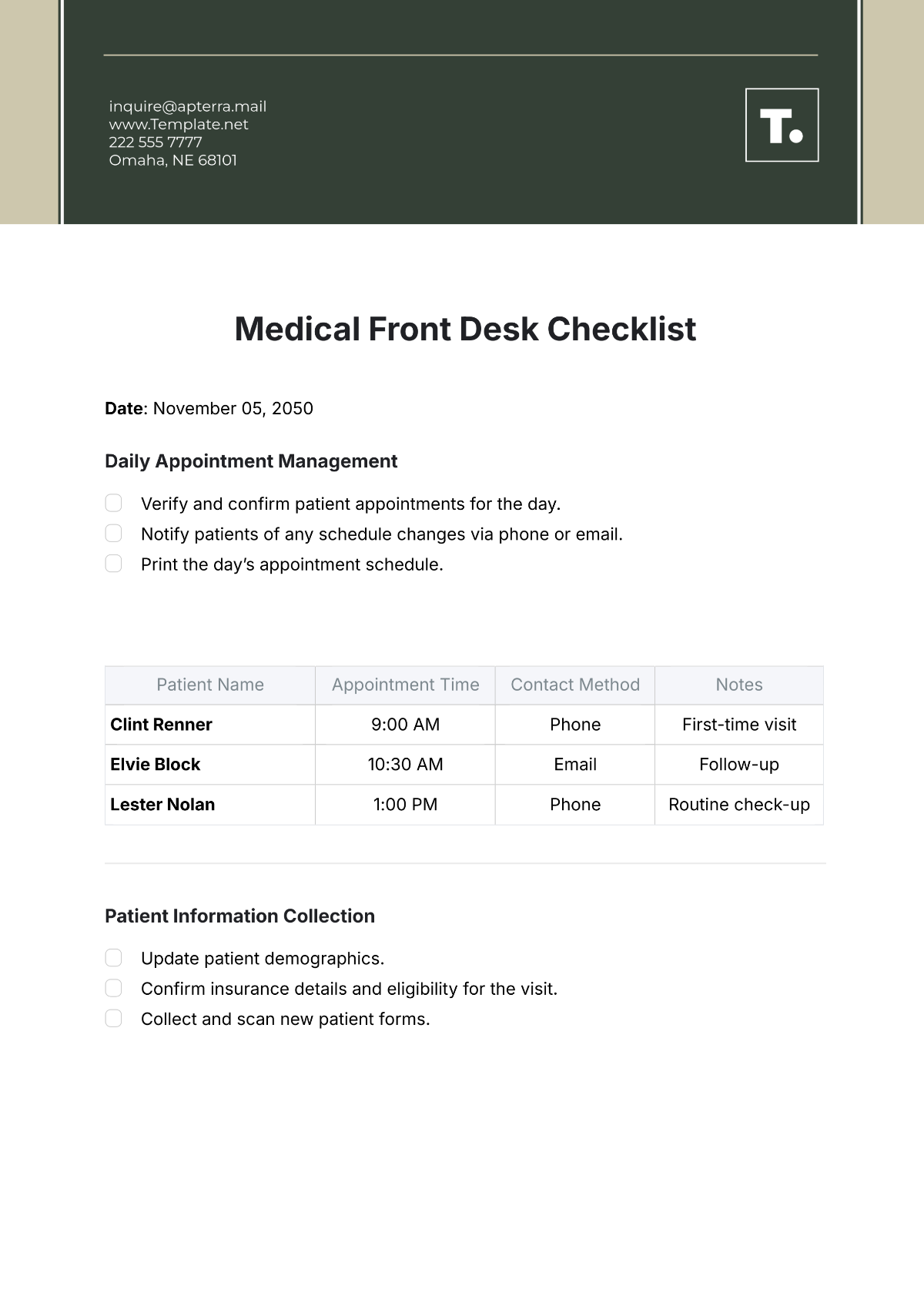
This front-desk example illustrates how opening procedures can be divided from patient-processing tasks. A supervisor can use the same concept to separate “office ready” from “patient flow ready.”
That distinction is useful because an office can be physically open while still being operationally unprepared. Printers may not work, schedules may not be reviewed, messages may be unresolved, or required forms may not be available.
A strong supervisor checklist therefore checks readiness at the level that affects the day’s workflow. It should identify problems early enough for the supervisor to correct them before they become patient-facing disruptions.
The document can also support delegation. Instead of the supervisor performing every check personally, the supervisor can assign tasks to appropriate staff and use the completed checklist to verify that the work was done.
Delegation should always respect the actual authority, training, and responsibilities of the employee. A checklist is not a mechanism for assigning regulated or clinical duties to someone who is not authorized or trained to perform them.
Inventory control is another area where templates can add substantial operational value. Medical offices need a predictable method for checking supplies, identifying shortages, recording reorder needs, and escalating unusual consumption.
An inventory section should distinguish critical supplies from routine supplies. Critical items may require a different reorder threshold or escalation path than office stationery.
Useful fields can include item name, unit of measure, expected minimum level, current level, reorder status, supplier, order date, and follow-up date. The exact fields should be adapted to the practice’s procurement process.
Supervisors should also avoid storing unnecessary clinical or patient information in inventory documents. The purpose is operational control, not clinical documentation.
When inventory records are reviewed regularly, the supervisor can identify recurring problems such as late ordering, inaccurate counts, storage issues, unexpected demand, or unclear ownership.

The medical supply example shows how inventory documentation can be separated into an overview, supply categories, quantities, and reorder information. For a supervisor template, the same structure can become a weekly control rather than a one-time form.
A supervisor might review whether critical supplies are above their agreed minimum, whether pending orders have been received, and whether any item has repeatedly fallen below the desired threshold.
The template should make exceptions visible. A simple “reorder required” indicator is often more useful than forcing the supervisor to inspect every numerical value manually.
Where the practice uses inventory software, the template can serve as an exception review rather than duplicating the software’s entire inventory database.
The best operational template minimizes duplicate data entry while preserving the management checks that cannot be delegated to software alone.
Equipment oversight can be handled in a similar way. The supervisor may not be responsible for repairing equipment, but may be responsible for ensuring that required inspections, maintenance records, vendor contacts, or service escalations are appropriately tracked.
A maintenance section can include equipment identifier, location, inspection date, status, issue description, service provider, action taken, and next review date. The supervisor should use the organization’s approved process for technical or clinical equipment issues.
Preventive maintenance records are particularly useful because they help distinguish a recurring maintenance problem from a one-time failure. They also give management a clearer view of aging equipment and service patterns.
The template should never encourage a supervisor to perform technical work outside their qualifications. Instead, it should make responsibility for inspection, reporting, escalation, and follow-up clear.
This distinction between oversight and technical execution is a recurring theme in medical office supervision.
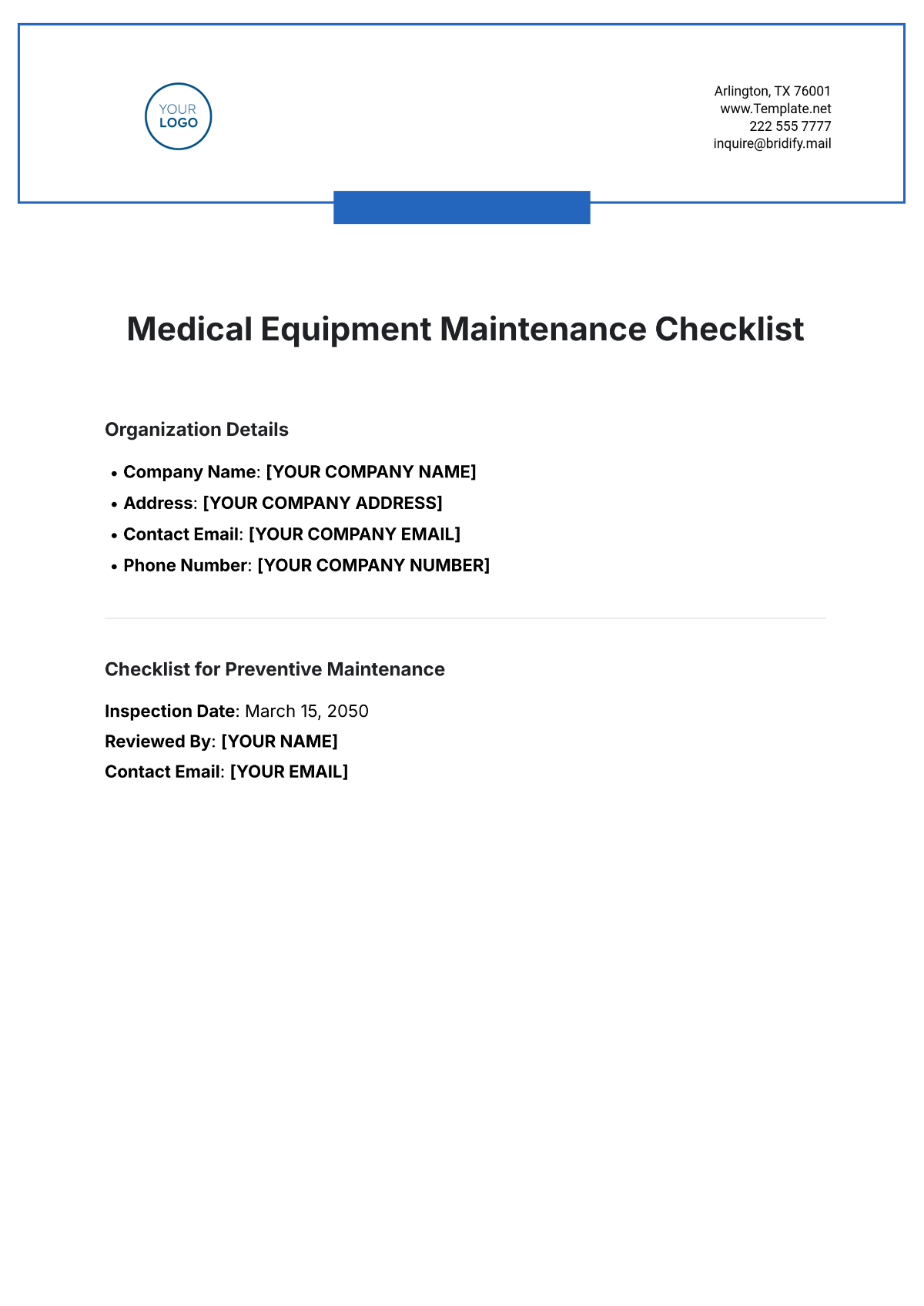
A maintenance checklist can also improve handoffs. If an equipment problem is discovered late in the day, the next responsible person should be able to see what happened, what was reported, and what remains outstanding.
Good handoff fields are brief. They should answer what happened, when it happened, who was notified, what immediate action was taken, and what follow-up remains.
This structure can be applied to many administrative issues, not just equipment. The same handoff logic works for staffing gaps, scheduling problems, supply shortages, unresolved complaints, and system outages.
Supervisors should avoid using informal notes as a substitute for official incident, employee, or patient records when a formal record is required.
Instead, the supervisor template should point to the appropriate official record and capture only the operational follow-up that belongs in the supervisory workflow.
Patient-service operations benefit from the same approach. A supervisor can track whether common administrative barriers are being resolved without turning the supervisory template into a patient chart.
Examples include unresolved registration issues, appointment coordination problems, repeated communication delays, document-routing problems, or recurring check-in bottlenecks.
The template can use categories rather than patient names. For example, “insurance verification queue,” “referral documentation,” or “provider schedule conflict” can be tracked at an operational level when individual identifiers are unnecessary.
When a specific patient issue requires documentation, the supervisor should use the practice’s approved patient-record or customer-service process rather than copying sensitive details into a general spreadsheet.
This is particularly important because HIPAA requires covered entities to implement reasonable safeguards and appropriately limit access to protected health information. :contentReference[oaicite:1]{index=1}

A sign-in format can demonstrate how a table captures operational flow without requiring a lengthy narrative. For a supervisor, the useful lesson is the organization of columns, timestamps, status indicators, and exception fields.
However, a public-facing sign-in sheet and a supervisor’s private management record have different privacy considerations. The supervisor should not assume that a format suitable for reception is automatically appropriate for internal tracking.
Whenever a template handles personal information, ask whether every field is necessary. Removing unnecessary fields reduces exposure and simplifies administration.
Supervisors can also establish retention and disposal practices for temporary operational documents. The correct retention period depends on the document type, applicable law, organizational policy, and record category.
The safest approach is to coordinate document handling with the practice’s established privacy, records-management, and compliance procedures rather than creating independent retention rules inside a template.
Record auditing is another major supervisory responsibility in many offices. An audit checklist should focus on defined quality criteria and should not become an informal substitute for professional coding, clinical, legal, or compliance review.
For administrative supervision, useful audit topics can include completeness of designated forms, correct routing of documents, timely processing, required signatures or acknowledgments, and adherence to approved workflow.
Each audit should have a defined sample or scope, reviewer, date, findings, corrective action, owner, and follow-up date when appropriate.
The supervisor should also distinguish between a one-time error and a systemic pattern. One missing field may require correction; repeated errors may indicate inadequate training, unclear procedures, excessive workload, or a flawed process.
A good template makes that distinction visible so management attention is directed toward root causes rather than only individual mistakes.

The audit example demonstrates the value of separating identification, documentation review, and compliance-oriented checks. A supervisor can adapt that structure to administrative records without copying clinical criteria that do not apply to the role.
Audit questions should be objective whenever possible. “Was the required document present?” is easier to evaluate consistently than “Was the file handled well?”
Where an answer is “no,” the template should provide a corrective-action field. That converts the audit from a passive scorecard into a management tool.
Follow-up is essential. An audit that identifies the same problem month after month without assigning an owner or changing the process provides limited value.
For recurring findings, the supervisor should consider whether the underlying procedure, training, workload, technology, or accountability structure needs revision.
Safety and infection-control administration should also be represented where relevant to the supervisor’s responsibilities. The supervisor may coordinate training, documentation, supplies, housekeeping workflows, or escalation, while clinical and safety professionals retain responsibilities assigned to them.
OSHA’s Bloodborne Pathogens Standard applies to employers whose employees have reasonably anticipated occupational exposure to blood or other potentially infectious materials and includes requirements concerning exposure-control measures, training, and other protections. :contentReference[oaicite:2]{index=2}
That means a supervisory template should never imply that a generic checklist replaces an organization’s exposure control plan, required training, or applicable safety procedures.
Instead, the template can remind the supervisor to verify that required activities have been completed, that issues have been reported, and that responsible personnel have received the information they need.
Safety documentation should always be aligned with the actual regulatory jurisdiction and the organization’s policies.

The compliance checklist visual demonstrates how status, responsible person, review date, and action fields can work together. That structure is useful for supervisory follow-up because it makes ownership and incomplete work visible.
A supervisor can adapt the same model for internal policy reviews, staff training, equipment inspections, or operational corrective actions.
The template should not label a task “compliant” merely because a box was checked. The supervisor needs a defined standard against which the task is being evaluated.
Where formal compliance is involved, the practice should identify the applicable authority and maintain the authoritative policy separately from the simplified supervisory checklist.
This keeps the template useful without overstating its legal or regulatory authority.
Medical Office Supervisor Template Formats
The format should match the job the document needs to perform. A Word document is usually strong for narrative procedures, role descriptions, policies, training guides, and printable checklists.
Excel is useful when the supervisor needs structured rows, dates, statuses, recurring reviews, inventory counts, staffing schedules, or simple calculations.
Google Docs can be useful for collaborative narrative documents when the organization permits cloud collaboration and has approved the platform for the information being handled.
Google Sheets can be useful for shared operational trackers, but supervisors should be especially careful about access controls and the kinds of patient or employee information placed into shared documents.
PDF is best treated as a distribution or finalized-document format rather than the primary editing environment. A PDF can preserve the approved appearance of a document, but the editable master should remain controlled by the document owner.
Someone searching for a medical office supervisor template free may be looking for a ready-made checklist, job description, resume, or management document. These are not interchangeable resources, so identify the intended use before selecting a template.
A medical office supervisor template free download can be useful as a starting point when its licensing terms and contents are clear. A free file should still be reviewed carefully before being adopted for actual practice operations.
A medical office supervisor template pdf can be convenient for printing or distributing an approved version. It is less convenient when the supervisor needs to revise fields frequently.
A medical office supervisor template word is generally more practical for editing narrative content, adding instructions, revising headings, and maintaining a controlled master document.
A medical office supervisor template google docs may be attractive for collaborative editing, but the practice should confirm that its technology, privacy, access, and security policies permit the intended use.

A structured document preview shows why format matters. The same underlying content can feel very different when converted from a dense page into clearly separated sections.
When creating a supervisor template, use headings that describe decisions and actions rather than abstract labels. “Weekly Staffing Review” is more useful than “Staffing.”
Tables work well for recurring information because supervisors can scan dates, owners, and statuses quickly. Narrative sections should be reserved for instructions, definitions, escalation guidance, and policy context.
Document design should also support printing. Many offices still need paper checklists or printed reference copies for certain workflows, so page breaks and readable typography matter.
A visually clean document is not merely cosmetic. Good structure reduces the time required to find information and makes errors easier to spot.
A medical office supervisor template excel can be particularly useful for operational tracking when the data is structured. For example, one row can represent a recurring task, while columns identify frequency, owner, due date, status, and follow-up.
Excel becomes more valuable when calculations are genuinely useful, such as counting completed reviews, calculating outstanding items, or organizing inventory levels. It becomes less useful when it simply recreates a narrative document in cells.
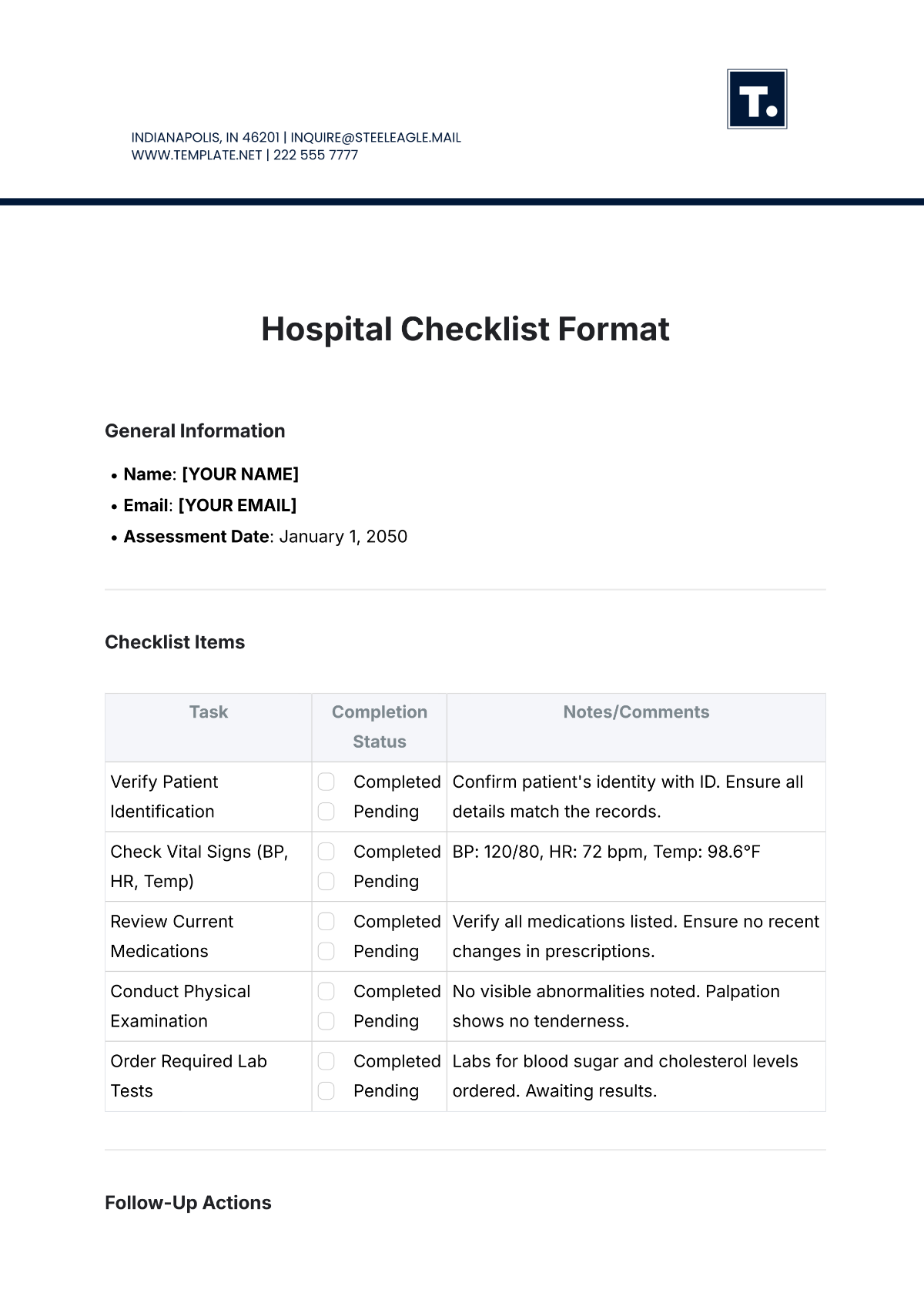
A medical office supervisor template free printable should prioritize readable spacing, checkboxes, short instructions, and enough writing room. A form that looks attractive on screen but becomes cramped on paper is not practical.
Print versions should avoid unnecessary color dependence. Important distinctions should remain understandable in grayscale if the office uses ordinary printers.
Whether the template is digital or printed, the supervisor should know where the completed record belongs and how long it should be retained.

A form-style layout illustrates the usefulness of grouped fields. Patient information, administrative information, and additional notes are separated rather than mixed into one continuous block.
For supervisory documents, grouping can be used for staffing, scheduling, supplies, quality, training, and follow-up. The goal is to help the reader process related information together.
Supervisors should also avoid unnecessary personal information in general-purpose templates. A management form usually needs less information than a clinical form.
If the template is intended for multiple locations, add fields for department or site rather than creating separate versions for every location unless local differences genuinely require separate documents.
Standardization should reduce duplication while preserving legitimate operational differences.
How to Build a Medical Office Supervisor Template Step by Step
Start by defining the purpose in one sentence. For example: “This template helps the medical office supervisor review daily operations, assign follow-up actions, and document recurring administrative controls.” A clear purpose prevents unrelated material from entering the document.
Next, list the supervisor’s actual responsibilities. Use the organization’s current job description, workflow documentation, and leadership expectations rather than copying a generic online list.
Then classify each responsibility by frequency. Daily tasks belong in the daily checklist. Monthly tasks belong in a periodic review. Rare events should point to separate procedures.
After that, identify the evidence needed to show completion. Not every task requires a form. Some require a system report, a meeting note, a training record, or a simple status update.
Finally, identify escalation points. For every important exception, specify who should be notified and what formal procedure should be followed.
The next step is to draft the daily section. Keep it short enough to use consistently. A useful daily sequence might be opening readiness, staffing, schedule review, patient-flow exceptions, communication queues, supply issues, facility concerns, and end-of-day follow-up.
Then build the weekly review. This can include recurring staff issues, unresolved operational problems, training follow-up, inventory trends, workflow audits, and outstanding actions.
Monthly sections can address performance discussions, recurring reports, policy review, equipment maintenance, quality trends, and resource planning.
Add a separate action register for issues that do not fit neatly into the recurring schedule. Include issue, owner, due date, status, and resolution notes.
Once the content is drafted, test it with a real workflow. Ask a supervisor to use it for several ordinary workdays and identify fields that are confusing, redundant, or rarely useful.
The testing phase is important because templates often fail when designed entirely from a desk. A document may look complete but require too much data entry during a busy morning.
Remove fields that do not drive a decision. Combine duplicate fields. Replace vague instructions with observable actions. Add escalation fields where supervisors repeatedly have to write the same type of note.
Next, verify that the document does not conflict with existing policies. A local checklist should not instruct staff to perform something differently from an approved organizational procedure.
Assign a document owner and review schedule. A template without ownership can become outdated even if it worked perfectly when first created.
Finally, release the approved version through the organization’s normal document-control process and train affected staff on how it should be used.

Emergency-oriented forms demonstrate why templates should separate information collection from response procedures. A checklist can help ensure important information is available, but it should not replace an organization’s emergency plan.
For supervisors, the same principle applies to operational emergencies such as system downtime, unexpected staffing shortages, building problems, or major schedule disruptions.
The supervisor template should identify the trigger and point toward the approved response process. It should not attempt to contain every possible emergency procedure in one document.
Useful emergency fields include the time of the event, issue category, person notified, immediate operational impact, action taken, and outstanding follow-up.
After the event, a separate review can determine whether the normal workflow or emergency plan should be updated.
Using a Template for Hiring and Career Development
A supervisory template can also help people preparing for the role. The same categories used to manage a supervisor can become categories for resume writing, interview preparation, and professional development.
Someone searching for a medical office supervisor resume example should look for a document that demonstrates leadership, operations, staff coordination, scheduling, administrative controls, communication, and measurable accomplishments where the accomplishments are genuine.
A resume should not simply reproduce the job description. It should show what the candidate actually did and how the work improved operations, supported staff, resolved problems, or strengthened service.
For example, “supervised front-office staff” is a basic duty. A stronger truthful statement might explain the size of the team, the types of workflows supervised, and a concrete improvement the candidate actually achieved.
Numbers should only be used when they are accurate and defensible. A hypothetical example should never be presented as a candidate’s real achievement.

A supervisor resume layout can show how professional experience, skills, and role-specific capabilities are organized. The visual hierarchy can be useful even when the candidate chooses a different design.
For healthcare administration roles, relevant experience can include staff scheduling, front-office management, workflow improvement, patient-service coordination, records administration, billing coordination, inventory, training, and quality activities.
Certifications should be listed accurately and only when actually held. The same principle applies to software proficiency, compliance responsibilities, and leadership claims.
Applicants should also adapt their resume to the actual vacancy. A supervisor position emphasizing revenue-cycle coordination may require different emphasis from one focused primarily on front-office operations.
The template is therefore a framework for presenting evidence, not a substitute for tailoring the application.
Employers can use the same framework when writing a medical office supervisor job description. A useful job description should state the role’s purpose, reporting relationship, essential responsibilities, qualifications, working relationships, and any required competencies.
The responsibilities should reflect the real position. If the supervisor does not control hiring, budgeting, clinical decisions, or compliance functions, the job description should not imply that they do.
Qualifications should also distinguish required criteria from preferred criteria. This helps applicants understand the position and helps hiring teams evaluate candidates consistently.
Job descriptions should be reviewed for applicable employment laws, classification requirements, accommodation processes, and organizational policies rather than treated as generic templates.
The final document should be specific enough to guide hiring while remaining broad enough to accommodate reasonable operational changes.

A job-description format demonstrates how qualifications and responsibilities can be separated. That makes the document easier for candidates to scan and easier for hiring teams to turn into interview criteria.
For a supervisor role, responsibilities might be grouped into people leadership, daily operations, patient-service administration, records and documentation, resource management, quality, and communication.
Each group can then be translated into interview questions. For example, a staffing responsibility can lead to a question about handling unexpected absences without compromising service or creating inappropriate workload.
Interview questions should focus on behavior and experience rather than assumptions about personality. Candidates can be evaluated against consistent criteria.
This approach makes the template useful beyond hiring: it becomes the foundation for onboarding, coaching, and performance discussions.
People searching for medical office supervisor jobs can use the same framework to compare vacancies. Look beyond the title and examine the actual scope of responsibility.
Two positions with the same title may differ significantly. One may primarily supervise reception and scheduling, while another may coordinate billing, staff performance, purchasing, compliance documentation, and multiple locations.
When comparing opportunities, examine reporting relationships, team size, schedule expectations, decision-making authority, software requirements, specialty environment, and whether the position has direct reports.
It is also useful to identify which responsibilities appear repeatedly across the vacancy and which are unique to the employer. Repeated responsibilities are likely to be central performance expectations.
A thoughtful template can help applicants prepare examples that demonstrate how they have handled those responsibilities in previous roles.
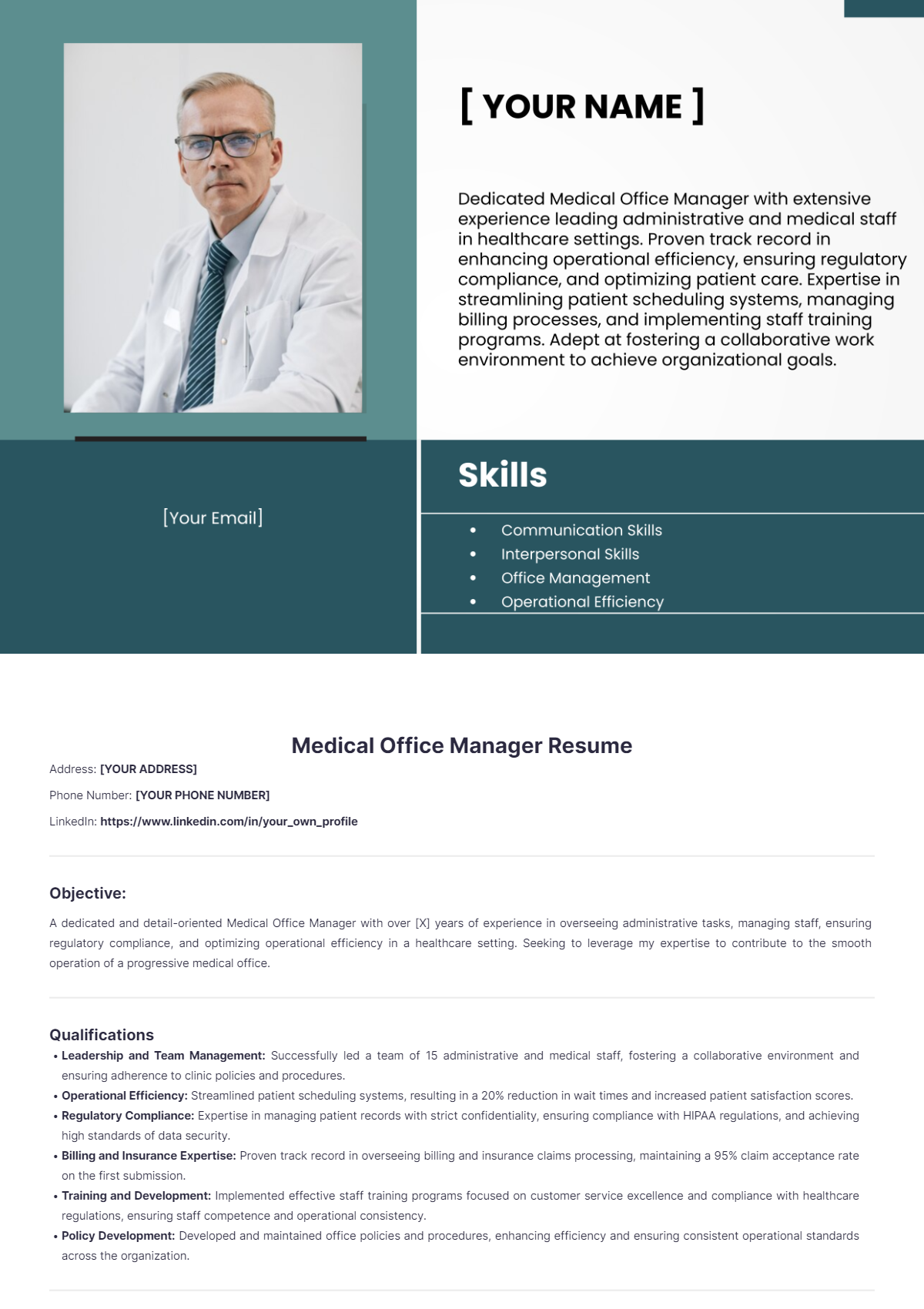
A medical office manager resume example can illustrate the difference between listing duties and describing operational leadership. The visual also shows how multiple management areas can be presented without turning the resume into a long narrative.
For candidates seeking supervisor roles, the most persuasive information is usually the experience that directly relates to the position being targeted.
Examples include coordinating teams, improving administrative workflows, resolving recurring service problems, training employees, supporting technology changes, monitoring resources, or creating consistent procedures.
Applicants should avoid claiming responsibility for outcomes they did not control. A credible resume is more valuable than an exaggerated one.
When preparing an application, the supervisor template can serve as a checklist for identifying genuine accomplishments that belong in the resume.
Connecting the Template to a Supervisors Procedure Manual Template
A checklist tells a supervisor what to review. A procedure manual tells the organization how a defined process should be performed. These documents should complement each other rather than compete.
Someone looking for a supervisors procedure manual template should therefore consider whether the document explains purpose, scope, responsibility, procedure steps, exceptions, records, approvals, and review requirements.
A procedure should use clear language. Each step should identify an action and, when necessary, the condition that triggers it or the evidence that demonstrates completion.
Policies and procedures should also have document control. Include an owner, approval authority where applicable, effective date, review date, version, and revision history.
In healthcare settings, procedures involving privacy, safety, clinical work, or regulated activity should be reviewed by the appropriate qualified personnel before implementation.
A medical office policy and procedure manual cover provides a useful visual example of a controlled operational document. The important concept is not the design but the separation between policy-level guidance and day-to-day supervision.
A supervisor might have a checklist item such as “verify staff followed the approved opening procedure.” The procedure manual contains the detailed opening process.
This structure keeps the daily checklist short while still giving staff access to the detailed instructions when they need them.
It also makes revisions easier. If one procedure changes, the practice can revise that procedure without rewriting every supervisory checklist.
Version control should make the relationship between documents clear so employees do not accidentally use an outdated procedure.
A procedure manual should generally begin with scope and purpose. Employees need to know what the procedure covers and what it does not cover.
The next section can identify responsibilities. A procedure should not assign responsibility simply because a person is physically available. Assignments should reflect the actual role and organizational authority.
Detailed steps should be written in logical order. Avoid unnecessary narrative when a short action statement will work better.
Exceptions deserve special attention. A procedure that works only under ideal conditions may leave employees unsure what to do when information is missing, a system is unavailable, or a responsible person is absent.
Finally, specify the record or evidence created by the process and identify where that record belongs according to the organization’s document-management rules.
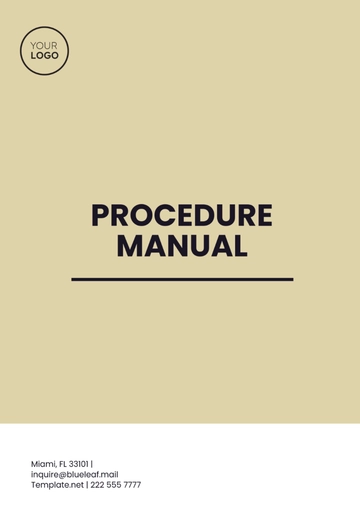
A general procedure manual cover demonstrates another useful principle: not every operational document needs a complicated visual design. Clear naming, version control, logical sections, and accessible instructions matter more than decorative elements.
Supervisors should encourage staff to use the current approved procedure rather than relying on personal notes or informal instructions that may have become outdated.
When a procedure repeatedly fails in practice, the supervisor should document the problem and route it through the appropriate review process rather than quietly creating an unofficial workaround.
This creates a culture in which procedures can improve without creating competing versions of the truth.
The supervisor template can support this process by recording procedure-related issues, owners, review dates, and follow-up actions.
Common Mistakes When Creating a Medical Office Supervisor Template
The first common mistake is creating a template that is too broad. A document that tries to cover every clinical, administrative, financial, and regulatory issue will become difficult to use and maintain.
The second mistake is confusing a checklist with a policy. A checklist should prompt an action or verification. A policy establishes organizational expectations and authority.
The third mistake is copying a generic template without checking whether its responsibilities match the actual role. Job titles differ significantly between practices.
The fourth mistake is including unnecessary sensitive information. Supervisory templates should use the minimum information necessary for the management task.
The fifth mistake is failing to assign ownership. If nobody is responsible for maintaining the template, it will eventually become outdated.
Another common problem is over-automation. Spreadsheets can calculate dates and statuses, but automation does not fix an unclear process.
Templates can also become overloaded with checkboxes. If every minor action requires a separate confirmation, staff may focus on completing the form rather than completing the work.
Another mistake is failing to test the template under real operating conditions. A form should be tested during the busiest realistic period, not only reviewed when the office is quiet.
Supervisors should also watch for contradictory instructions. If the template conflicts with an approved procedure, the conflict should be resolved before the document is used.
Finally, avoid treating completion rates as the only measure of effectiveness. A completed checklist does not automatically prove that the underlying task was performed correctly.
Best Practices for Maintaining the Template
Assign one accountable owner. Other people may provide input, but one role should be responsible for ensuring that the master version remains current.
Set a review schedule that makes sense for the document. Some operational checklists may need frequent adjustment, while a stable administrative procedure may be reviewed less often or whenever a triggering change occurs.
Use version numbers and effective dates. If an old copy is found, staff should be able to determine quickly whether it is current.
Document meaningful revisions. A short revision history can explain what changed and why without requiring employees to compare every page manually.
Train staff when changes affect their work. Publishing a revised document does not necessarily mean employees understand the new process.
Review the template against actual performance. If the supervisor routinely ignores a section because it does not provide useful information, investigate why.
Use feedback from staff who perform the underlying work. They often identify unnecessary steps, unclear fields, or workflow conflicts that a document designer cannot see.
Separate temporary improvements from permanent changes. A temporary workaround should not automatically become a permanent policy.
Protect access to sensitive documents. The more information a template contains, the more carefully access should be managed.
Finally, archive superseded versions according to the organization’s records-management policy rather than allowing uncontrolled copies to circulate indefinitely.
Practical Examples of Template Use
Consider a small primary-care office with one supervisor overseeing reception, scheduling, and several administrative support functions. The supervisor template might begin each day with staffing coverage, schedule review, unresolved communication, office readiness, and supply exceptions.
During the day, the supervisor could maintain an exception log containing only operational issues that require action. Each item would have an owner and expected completion date.
At the end of the day, the supervisor could review unresolved issues, confirm handoffs, and identify items that need management attention the following morning.
Once a week, the supervisor could review recurring issues rather than simply closing individual tasks. If the same scheduling problem appears repeatedly, the supervisor can investigate the workflow rather than repeatedly fixing the symptom.
This approach turns the template into a continuous-improvement tool.

A readiness checklist shows how recurring tasks can be organized into patient preparation, room readiness, supplies, and shift information. The same organizational logic can be translated into administrative supervision.
For example, a supervisor can divide responsibilities into staffing readiness, appointment readiness, office readiness, information readiness, and issue readiness.
Each category can have a small number of high-value checks. This creates a document that is quick to scan while still covering the major operational risks.
The checklist can then be reviewed at different points during the day instead of being completed once and forgotten.
That rhythm is particularly useful in environments where conditions change rapidly throughout the workday.
A second example is a multi-provider practice experiencing frequent schedule changes. The supervisor template could include a morning schedule review, provider availability exceptions, appointment changes, staffing constraints, and a communication follow-up register.
The supervisor would not use the template to store every patient detail. Instead, the document would identify the operational problem and point to the appropriate system or record for the underlying information.
A weekly review could categorize schedule disruptions by cause, such as staffing, provider availability, referral issues, or administrative errors.
Over time, that information can help leadership decide whether the problem is caused by capacity, communication, unclear procedures, or another operational factor.
The value comes from consistent categorization, not from collecting as much information as possible.
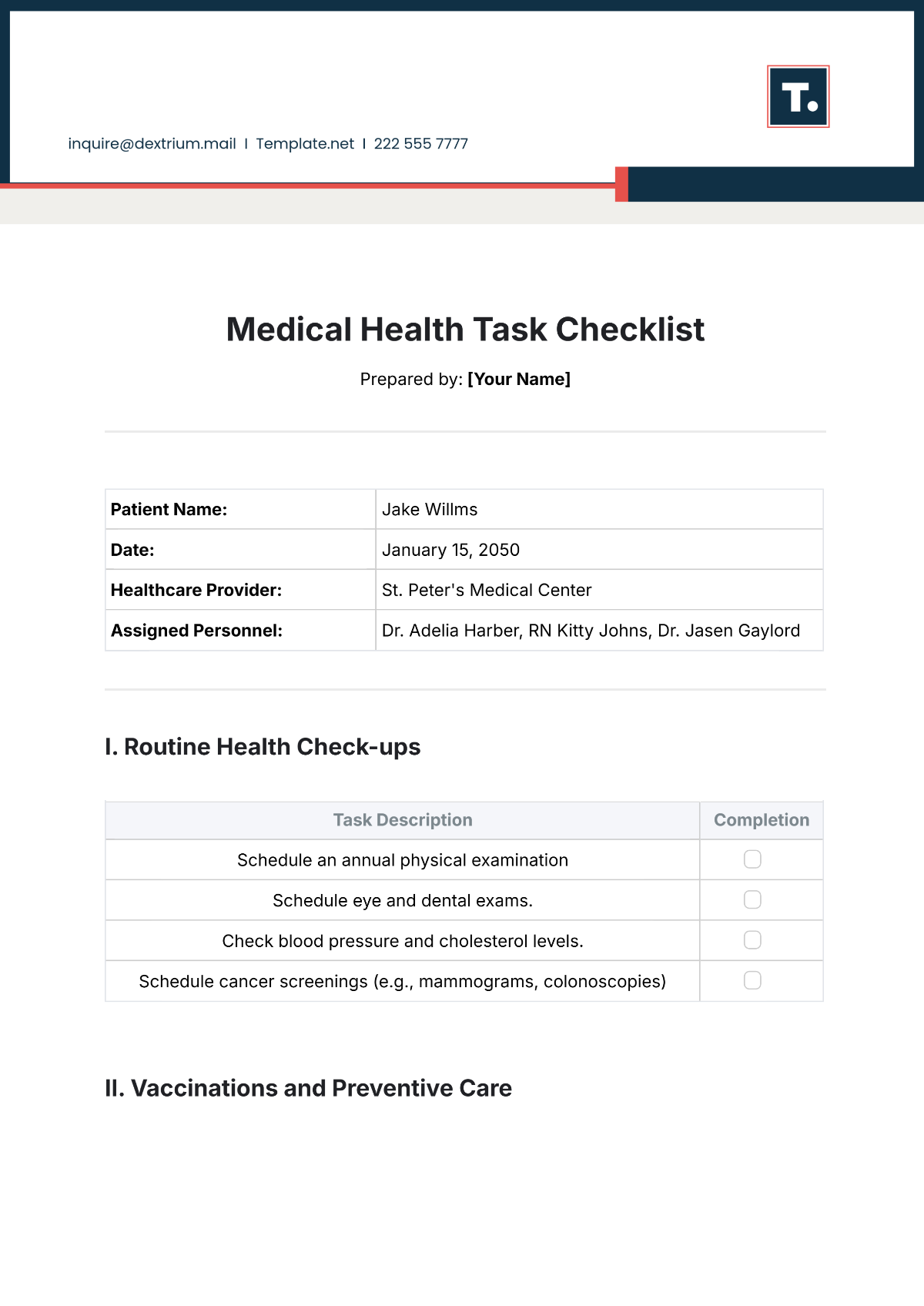
A task checklist demonstrates how recurring activities can be broken into identification, measurement, and task completion. Supervisors can apply that structure to administrative work without turning the document into a clinical record.
For example, an administrative quality review might contain the date, workflow reviewed, responsible staff member, criteria checked, finding, and action required.
Where performance involves clinical judgment, the supervisor should route the issue to the appropriate clinical authority rather than creating an administrative shortcut.
The template should make these boundaries clear so that staff understand when to stop and escalate.
Clear escalation boundaries are one of the most important characteristics of a responsible supervisory document.
A third example is a practice preparing for a new employee. The supervisor can use the template to organize orientation into role expectations, systems access, workflow training, communication standards, privacy responsibilities, safety requirements, and competency follow-up.
The new employee should receive the detailed policies and procedures relevant to their role rather than relying solely on the supervisor checklist.
The checklist then serves as an onboarding control: it helps the supervisor confirm that required orientation steps were completed.
Follow-up can be scheduled after the employee has had time to perform the work independently. This allows the supervisor to identify areas where additional coaching is needed.
Onboarding documentation should be handled according to the organization’s personnel and training-record procedures.

A daily checklist illustrates how a recurring shift record can combine schedule information, task completion, observations, and notes. Supervisors can use the structural idea for administrative shift handoffs.
For example, a handoff might record unresolved appointment issues, pending vendor contacts, staffing changes, system problems, and tasks that must be completed by the next shift.
Keep handoff language factual and concise. A handoff is more useful when the next person can immediately identify the action required.
Where an issue involves sensitive information, use the authorized system of record rather than copying details into a general handoff form.
This makes the template both more useful and safer to manage.
How to Analyze Template Performance
After implementation, evaluate whether the template actually improves operations. Start with usability. Can supervisors complete it without excessive time? Can staff understand the wording? Can managers identify outstanding issues quickly?
Next, review completeness. Are important responsibilities missing? Are staff repeatedly recording the same information in multiple places?
Then evaluate actionability. When the template identifies an issue, does someone know what to do next? If not, the document may need clearer ownership or escalation guidance.
Also examine recurring exceptions. If the same item remains incomplete every week, the issue may be process design rather than employee effort.
Finally, review whether the template has become outdated. A good template should evolve as the organization changes.

A chart can help supervisors move from raw operational records toward pattern recognition. For example, a weekly issue log could be summarized by category rather than reviewed as a long list of individual incidents.
Possible categories might include scheduling, staffing, supplies, documentation, equipment, communication, and patient-service administration.
The numbers should be interpreted carefully. A rise in recorded issues could indicate worsening performance, better reporting, increased workload, or simply improved use of the tracking system.
Charts therefore work best when paired with context and qualitative review rather than treated as automatic proof of causation.
The same principle applies to any performance dashboard connected to the supervisor template.
Practical Solution: Build a Working Medical Office Supervisor Template
Start with a one-page daily control sheet rather than a massive manual. Include document control, staffing readiness, schedule readiness, communication exceptions, facility or supply issues, unresolved actions, and end-of-day handoff.
Next, create a separate weekly review sheet. Include staff issues, workflow audits, training follow-up, inventory exceptions, equipment follow-up, recurring patient-service issues, and open corrective actions.
Third, create a master responsibility matrix. Map every major responsibility to an owner, frequency, evidence, escalation point, and related procedure.
Fourth, connect each recurring checklist item to the relevant approved procedure. The supervisor should be able to move from a short checklist item to detailed instructions when needed.
Fifth, test the system for two to four normal operating cycles, collect feedback, remove low-value fields, clarify ambiguous instructions, and formally approve the revised version.
For a small practice, a Word-based template with a printable checklist may be enough. For a larger operation, an Excel or approved collaborative spreadsheet may provide better tracking of owners, dates, statuses, and recurring actions.
Do not choose a format simply because it is popular. Choose the format that fits the information, the staff’s technical ability, the organization’s security requirements, and the document’s purpose.
Keep sensitive information out of general supervisory trackers whenever it is unnecessary. Use identifiers and links only when the organization’s approved systems and policies permit them.
Make the supervisor responsible for follow-up, not necessarily for personally completing every task. The template should reinforce delegation and accountability rather than encouraging micromanagement.
Review the document periodically with the people who use it. If a section no longer supports a decision, remove it. If an important recurring problem is not represented, add the appropriate control.
A practical implementation sequence is simple: define scope, map responsibilities, classify frequency, identify evidence, assign ownership, connect procedures, build the daily checklist, build the weekly review, test the document, approve the version, train staff, and review performance.
For privacy and safety topics, involve the appropriate organizational experts. HIPAA requires appropriate safeguards for protected health information, and OSHA requirements can apply to occupational exposure and healthcare workplace hazards. :contentReference[oaicite:3]{index=3}
For employment documentation, coordinate with the appropriate human-resources or legal function. For clinical workflows, involve qualified clinical leadership. For billing and coding, use the organization’s approved revenue-cycle and compliance processes.
The supervisor template should remain an operational management tool. It should not be presented as legal advice, clinical guidance, an official regulatory document, or a substitute for the practice’s approved policies.
When these boundaries are respected, the template can become a practical daily instrument that improves consistency without creating unnecessary administrative complexity.
Reference Examples
The following reference examples illustrate different document formats that can inform the structure of a medical office supervisor template. Availability, licensing, editing features, and download conditions can vary by source and should be checked on the original resource before use.
medical office supervisor template free
Source: Template.net
medical office supervisor template free download

Source: Template.net
medical office supervisor template pdf
Source: Template.net
medical office supervisor template word
Source: Template.net
medical office supervisor template google docs
Source: Template.net
medical office supervisor template excel

Source: Template.net
medical office supervisor template free printable
Source: Template.net
medical office supervisor resume example
Source: Template.net
medical office supervisor job description
Source: Template.net
medical office supervisor jobs
Source: Template.net
supervisors procedure manual template
Source: Template.net
medical office manager sample resume template
Source: Template.net
Frequently Asked Questions
What should a medical office supervisor template include?
At minimum, include role scope, responsibilities, recurring tasks, ownership, frequency, escalation points, documentation expectations, and review information. A more complete version can add staffing, scheduling, inventory, training, quality, communication, and corrective-action sections.
Should a medical office supervisor template be a Word document or spreadsheet?
Use Word for narrative procedures, role descriptions, policies, and printable instructions. Use a spreadsheet when the primary need is structured tracking, dates, status fields, inventory, recurring actions, or simple calculations. Many practices benefit from using both.
Can a free template be used immediately in a medical office?
A free template can be a starting point, but it should not automatically be treated as an approved organizational procedure. Review its content, privacy implications, licensing, responsibilities, and compatibility with the practice’s policies before adoption.
What is the difference between a supervisor checklist and a procedure manual?
A checklist prompts or verifies recurring work. A procedure manual explains how a defined process should be performed. The two work best together: the checklist provides a concise management control while the procedure supplies detailed instructions.
How often should a supervisor template be reviewed?
The review schedule should match the document’s purpose and the organization’s document-control process. Review it whenever a major workflow, software system, staffing structure, policy, or applicable requirement changes, and conduct periodic reviews even when no obvious change has occurred.
Should patient names appear in the supervisor template?
Only when genuinely necessary and permitted by the organization’s procedures. General supervisory tracking should use the minimum information needed to manage the issue. Detailed patient information should remain in the authorized system of record when possible.
How can supervisors prevent a checklist from becoming paperwork?
Keep only high-value controls, use clear action wording, remove duplicate fields, automate simple calculations where appropriate, and review whether each item actually drives a decision or confirms an important control. If a field is consistently ignored, investigate whether it belongs in the template at all.
Can the same template be used for every medical practice?
No. The basic structure can be reused, but responsibilities differ by specialty, organization size, staffing model, technology, location, and leadership structure. Treat a general template as a framework that must be adapted and approved for the specific practice.
Conclusion
A useful medical office supervisor Template is more than a formatted checklist. It is a practical framework for translating supervisory responsibilities into recurring actions, clear ownership, appropriate documentation, effective escalation, and continuous improvement.
The strongest approach is modular: keep the daily checklist concise, maintain separate weekly and periodic reviews, connect recurring tasks to approved procedures, and protect sensitive information by using the minimum necessary data.
Templates also become more valuable when they support the entire employee lifecycle. The same responsibility framework can inform hiring, onboarding, coaching, performance discussions, procedure updates, and operational reviews.
Whether the final document is created in Word, Excel, Google Docs, or PDF, the format should serve the workflow rather than dictate it. The most important characteristics are clarity, accuracy, ownership, usability, controlled revision, and alignment with the organization’s actual policies.
When thoughtfully designed and regularly maintained, a medical office supervisor template can give supervisors a dependable operational reference while helping the wider practice work with greater consistency, accountability, and clarity.
Before adopting any template, validate the document against the practice’s current procedures, privacy requirements, workplace-safety obligations, employment practices, and clinical or administrative governance. A well-built template should make good processes easier to follow—not replace the professional judgment, approved policies, and responsible oversight that make those processes safe and effective.
