A contractor schedule of values is one of the most useful financial control documents on a construction project because it converts a single contract price into identifiable portions of work. Instead of treating the contract as one large figure, the contractor assigns a scheduled value to mobilization, sitework, concrete, framing, mechanical systems, electrical work, finishes, closeout, and other defined scopes. Those values then become the foundation for measuring progress and preparing periodic payment requests.
The search intent behind a contractor schedule of values Template is usually practical rather than theoretical. Contractors want to understand what the document should contain, how detailed the line items should be, how values should reconcile to the contract, and how the same structure can be carried forward from one billing period to the next. Owners, architects, project managers, and subcontractors also use the document to review whether claimed progress is consistent with the physical work and contract terms.
A useful SOV is therefore more than a formatted spreadsheet. It is a controlled financial breakdown that connects scope, budget, progress, stored materials, retainage, change orders, and remaining value. A good structure should be detailed enough to support verification without becoming so fragmented that every billing period turns into an administrative exercise. The right level of detail depends on the contract, project size, payment terms, and review requirements.
What a Contractor Schedule of Values Is
A schedule of values, commonly abbreviated SOV, divides the contract sum into individual work items and assigns a monetary value to each one. The total of those line items should reconcile with the relevant contract value, subject to the way approved changes are handled. The document can then be updated as work progresses so that each billing period has a consistent financial reference.
For example, a commercial renovation might have separate lines for mobilization, demolition, concrete repairs, framing, drywall, doors and hardware, painting, plumbing, electrical, HVAC, testing, cleanup, and closeout. A larger project could use cost codes or trade divisions to organize hundreds of lines. A smaller project may use fewer, broader categories. The goal is not to create the longest possible list; it is to create a defensible breakdown that can be measured.
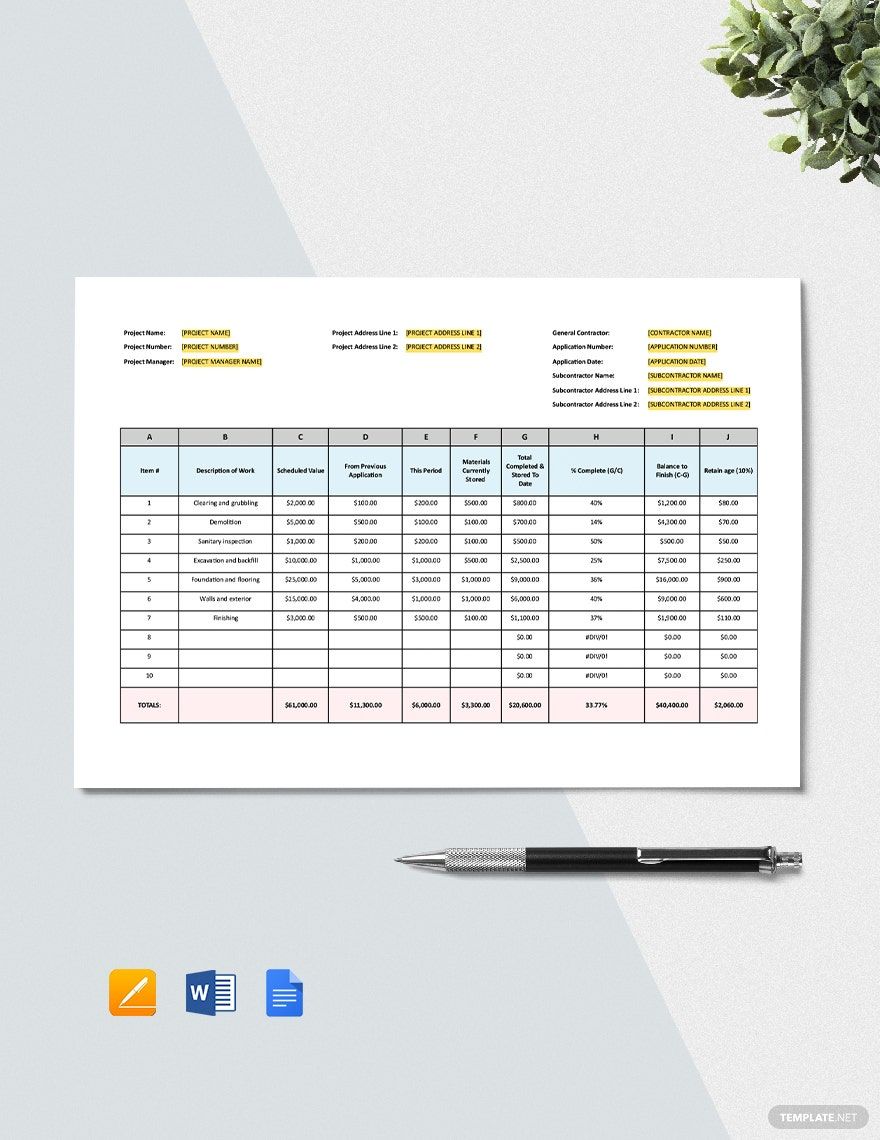
A schedule of values template construction document normally contains project identification, item numbers, descriptions, scheduled values, progress columns, materials information, balance calculations, and retainage fields when required by the contract. Some formats also include cost codes, change-order references, billing dates, approval areas, and notes. These additions can make the schedule easier to reconcile with accounting records and other project controls.
Why the Schedule Matters for Construction Billing
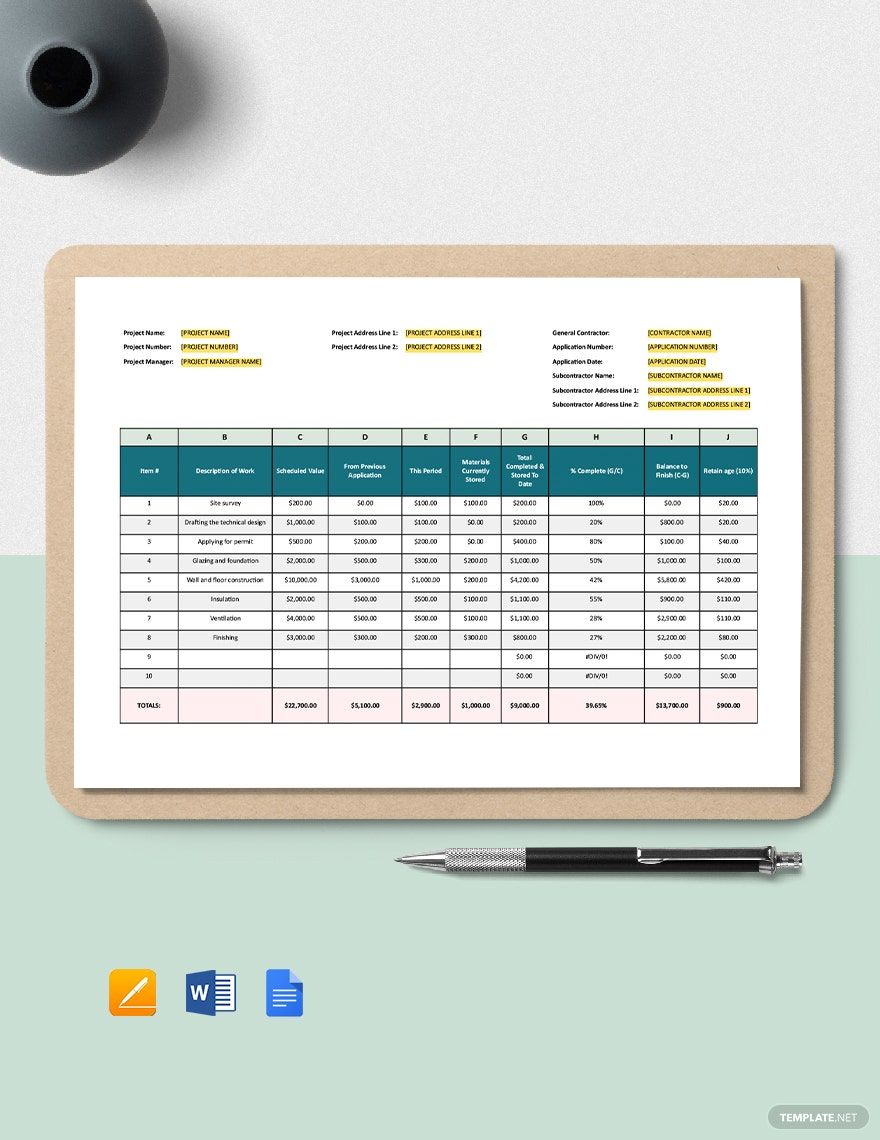
The most important function of an SOV is to connect completed work with the amount being claimed. Without an agreed breakdown, a progress payment request can become a debate over how much of the overall contract price belongs to work that has actually been completed. A detailed SOV gives reviewers a common reference point and makes each billing period easier to compare with the previous one.
The schedule also supports financial forecasting. When each line contains a scheduled value, completed amount, and balance remaining, project teams can see where the remaining contract value sits. A contractor can compare billed progress with internal cost information, while an owner can compare claimed progress with observed project status. The SOV does not replace a full project budget or cost report, but it provides an important bridge between contract value and payment administration.
Another benefit is consistency. Once the line items and values are agreed, they can remain stable across billing periods. The current period changes, while previous-period progress carries forward. This creates a record of how the contract has been billed over time. Consistency is especially valuable when multiple parties review the same payment request or when a project has a long construction duration.
Core Sections in a Contractor Schedule of Values Template
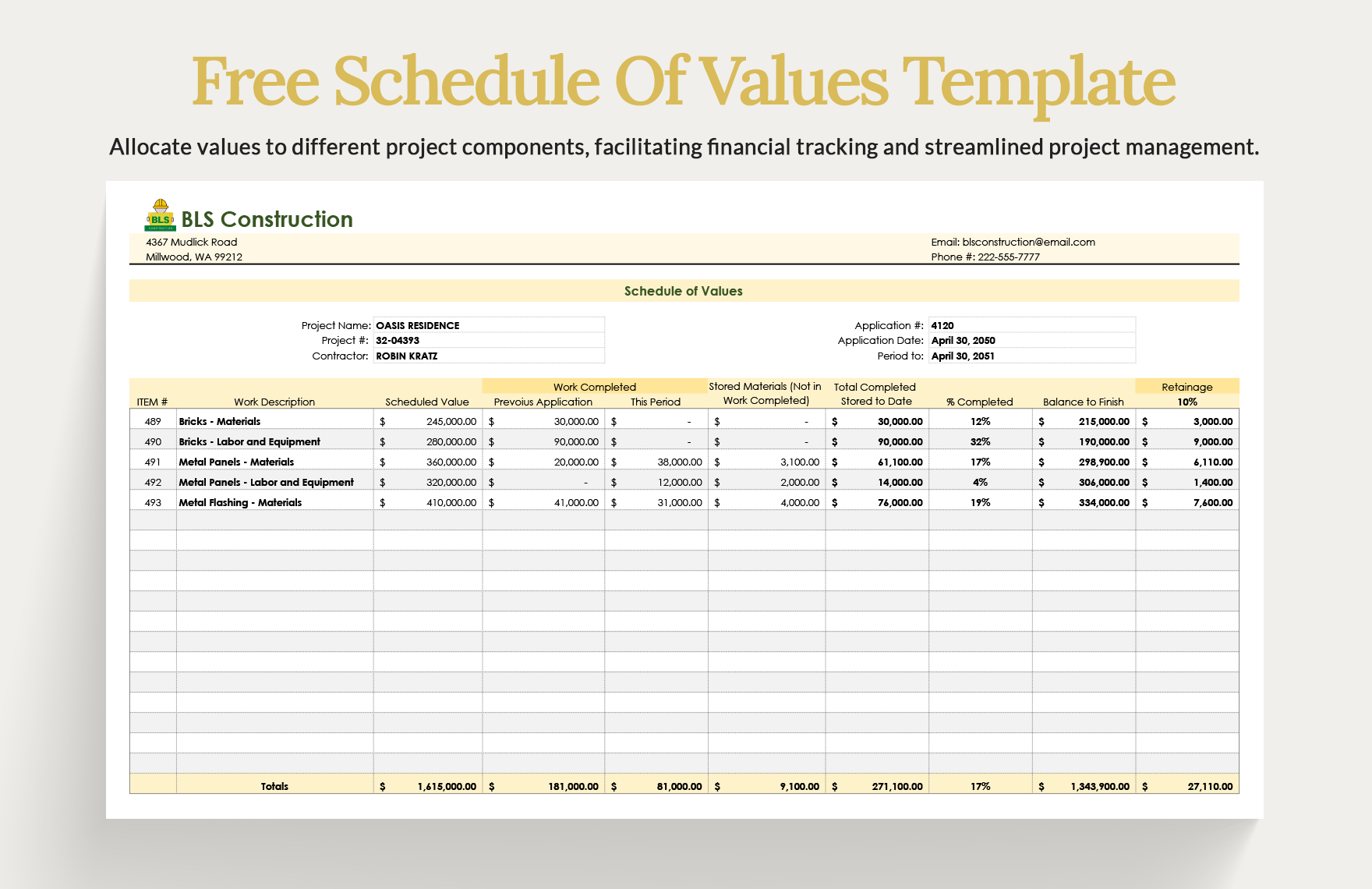
The header should identify the project and contract clearly. Typical fields include project name, project number, contractor, owner or client, contract reference, billing period, schedule revision, and payment request number. These details matter because an SOV may be revised during a project, and reviewers need to know which version they are examining.
The main body contains the work breakdown. Each row should have a stable item number and a concise description. Descriptions such as “Concrete,” “Electrical,” or “Finishes” may be adequate on a small project, but complex work often benefits from more specific descriptions. A line such as “Level 2 electrical rough-in” is easier to verify than a broad line called “Electrical Work” when progress is reviewed.
The scheduled value is the monetary amount assigned to each line. The sum of scheduled values should reconcile to the applicable contract amount. If the contract changes through approved modifications, the SOV may need corresponding adjustments. The method for handling those changes should follow the governing contract and the project’s established payment procedures rather than an arbitrary spreadsheet convention.
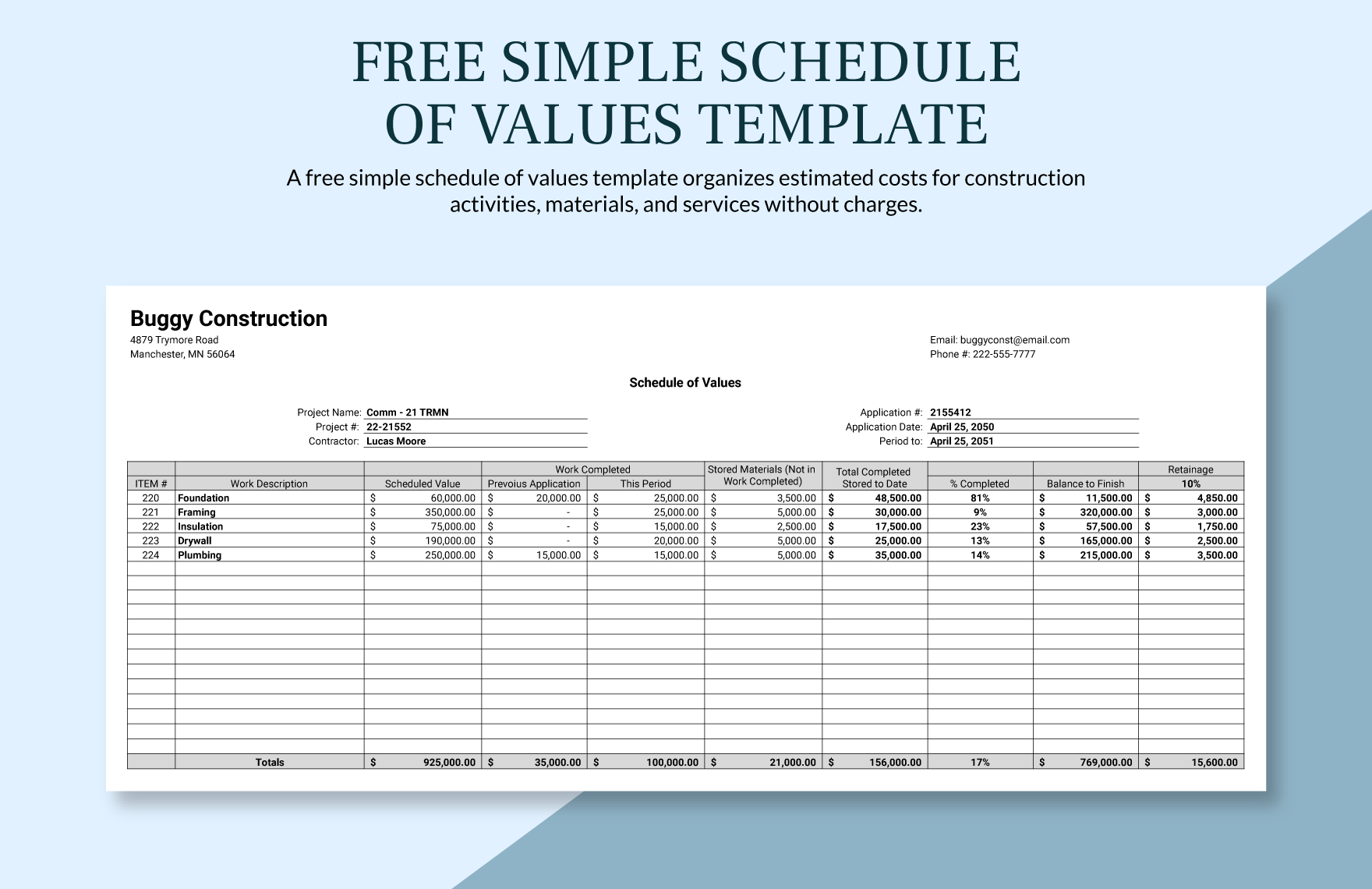
Progress columns commonly distinguish previous-period work from current-period work. This prevents the same completed value from being claimed repeatedly. A cumulative completed amount can then be calculated from prior progress plus current progress and qualifying stored materials, depending on the contract and payment rules.
Stored materials deserve special attention. Materials may have been purchased and delivered but not yet incorporated into the work. Whether those materials can be included in a payment request, and under what documentation conditions, depends on the contract. A well-designed SOV keeps stored materials separate from installed work so the financial record remains clear.

Choosing the Right Format
Searches for a contractor schedule of values template excel usually reflect a need for calculation, repeat billing, and easy reconciliation. A spreadsheet format is particularly useful when the schedule contains formulas for cumulative progress, percentage complete, balance to finish, and retainage. It can also make revisions easier when the project has many line items.
A contractor schedule of values template pdf is more appropriate when the priority is a fixed presentation for review, printing, recordkeeping, or formal submission. A PDF is useful as a controlled representation of a completed schedule, but it is less convenient for changing formulas or maintaining the underlying calculations. Teams often prepare the working schedule in a spreadsheet and issue a fixed document for review when required.
A contractor schedule of values template word can work well when the schedule is relatively simple or when the project team needs a document-oriented format with explanatory notes. Word-based layouts can be useful for smaller contracts, but once the SOV requires extensive calculations and repeated billing periods, a spreadsheet generally provides stronger calculation control.

The important distinction is not the software brand or file extension. The format should support the project’s actual workflow. A schedule with twenty carefully calculated line items can be more useful than a highly elaborate workbook containing hundreds of poorly defined rows. Select the format that allows the team to preserve line-item consistency, verify totals, document revisions, and communicate clearly with reviewers.

How to Build the Schedule Step by Step
1. Start with the Contract Scope
Begin with the signed contract, scope documents, pricing breakdown, drawings, specifications, accepted proposal, and approved alternates or modifications that are applicable at the time the schedule is prepared. The SOV should represent the actual contractual scope rather than an unrelated internal estimate. Starting from the contract reduces the risk of omitting work or assigning value to items that are not part of the agreement.
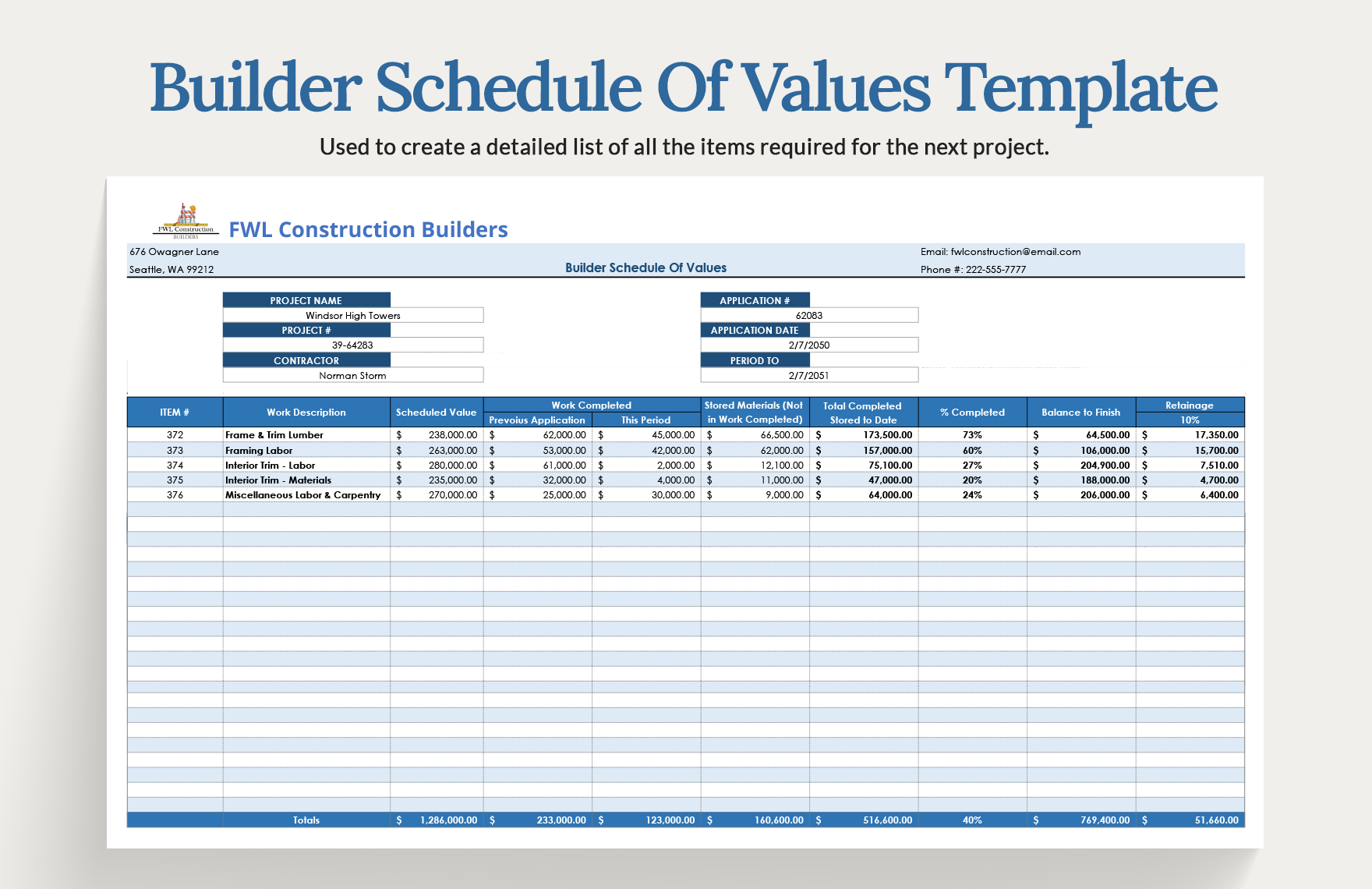
Break the work into measurable packages. For a building project, that might mean site preparation, foundations, structural work, exterior enclosure, interior construction, mechanical systems, electrical systems, finishes, testing, and closeout. Within each package, create additional rows where the work will be reviewed or billed separately.
2. Establish Stable Item Numbers
Use item numbers that can remain consistent throughout the project. If line 120 represents concrete foundations in the first billing period, it should still represent concrete foundations in later periods. Stable numbering makes previous-period reconciliation easier and gives reviewers a reliable reference when discussing individual claims.
If a change requires a new line, document the reason and maintain the relationship between the original scope and the revised value. Avoid renumbering the entire schedule merely because a new item has been introduced. Historical consistency is more valuable than a perfectly sequential appearance.
3. Assign Defensible Values
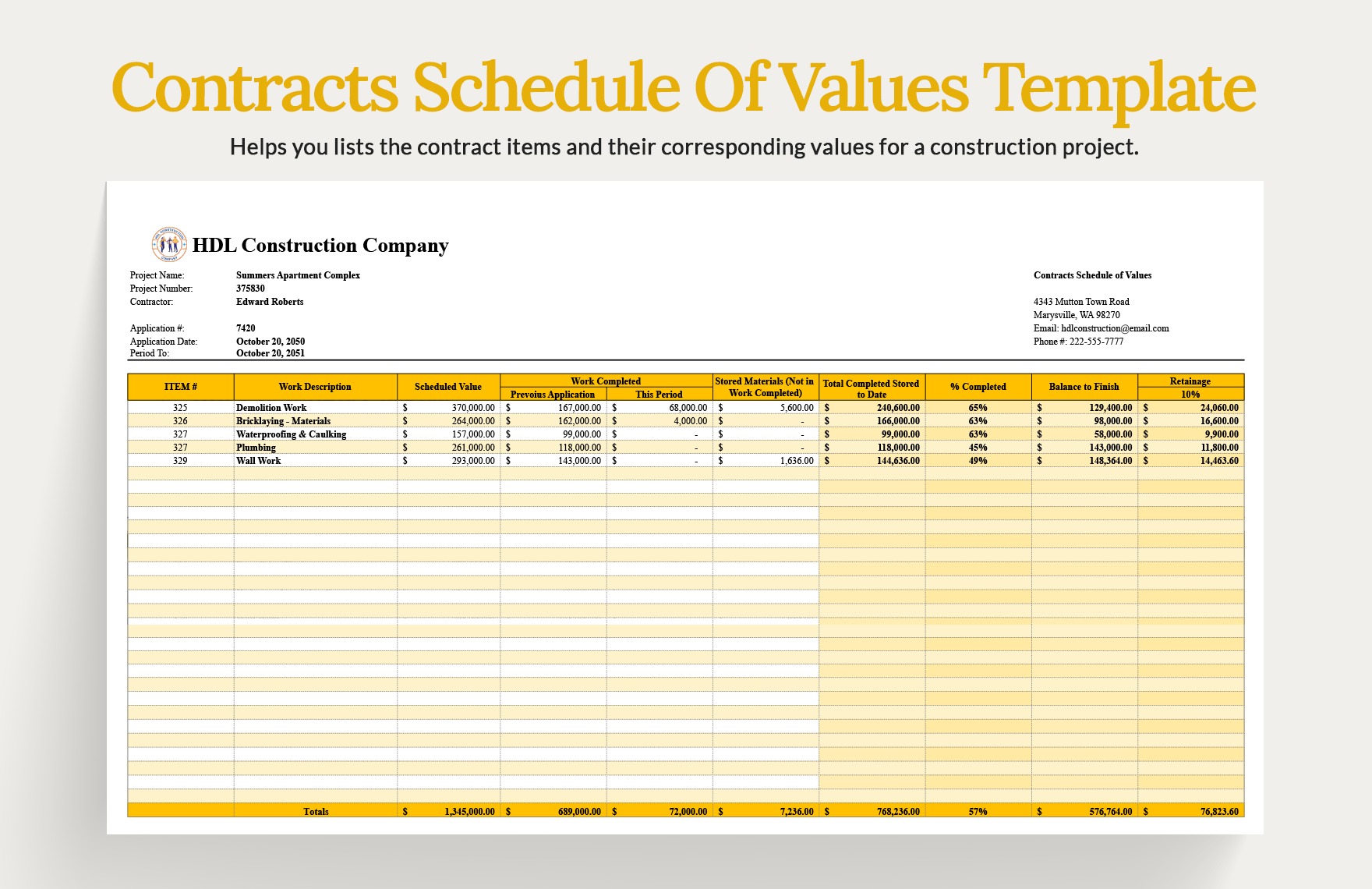
Allocate the contract value across the defined work items using the pricing basis that supports the contract. Values should be reasonable in relation to the scope represented by each line. A reviewer should be able to understand why a particular portion of the contract has the value assigned to it.
Avoid excessive front-loading. Front-loading occurs when a disproportionately large amount of the contract value is assigned to early work so that more money can be billed before the corresponding physical work has been performed. A defensible SOV distributes value in a way that reasonably reflects the cost and progress of the work represented by each line.

4. Add Progress Calculations
The working schedule should distinguish cumulative progress from current-period progress. A common structure includes previous completed work, current completed work, qualifying stored materials, total completed and stored to date, percentage complete, and balance to finish. The formulas should be tested before the schedule is used for an actual payment request.
For a hypothetical line with a scheduled value of $100,000, suppose $35,000 was recognized in prior periods and $15,000 is recognized during the current period. If $5,000 of qualifying stored material is separately recognized, total completed and stored to date would be $55,000. The percentage complete would therefore be 55%, and the remaining balance would be $45,000 before considering any separate contractual adjustments.
5. Handle Retainage Carefully
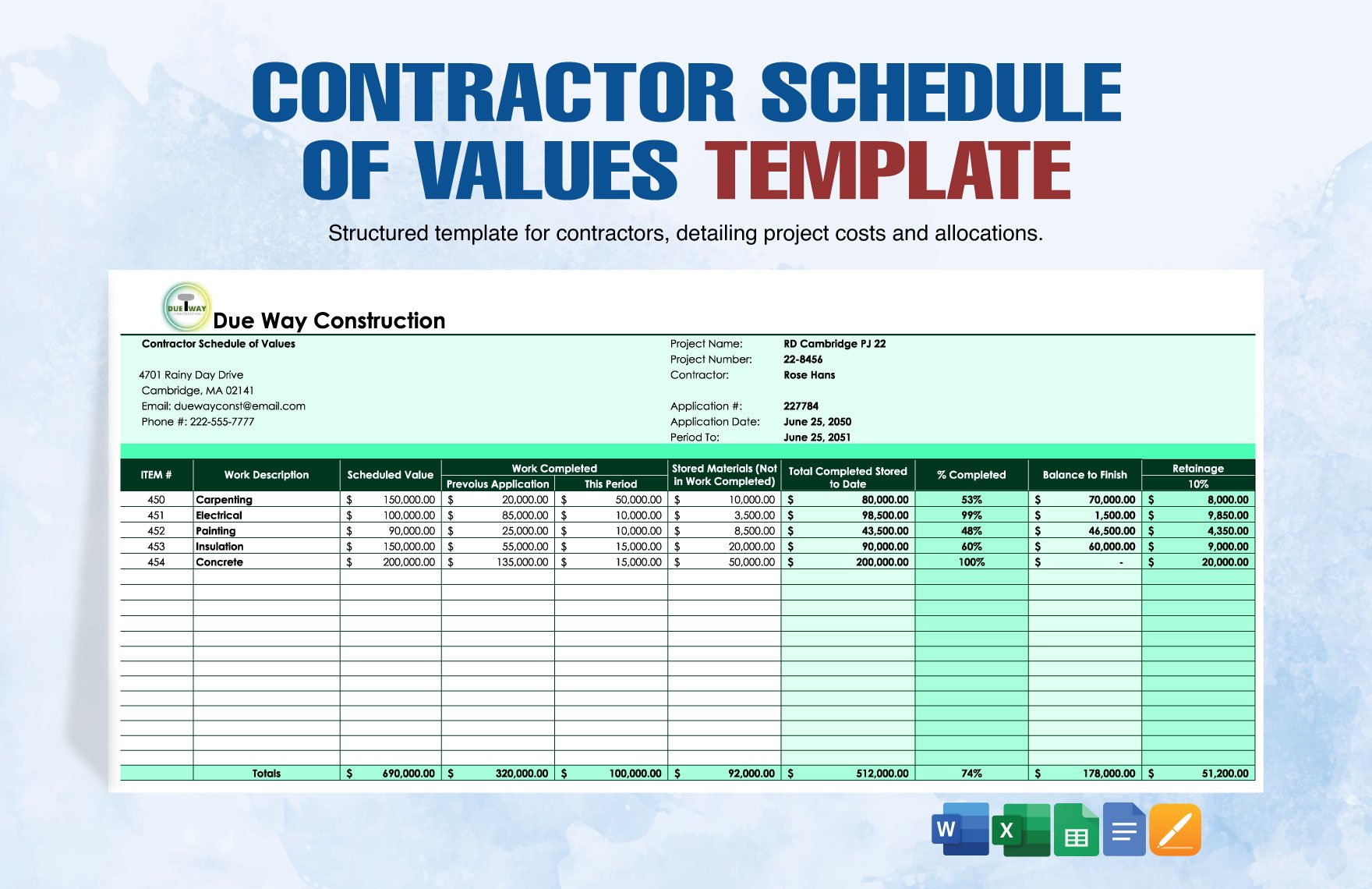
Retainage is an amount withheld from otherwise eligible progress under the contract’s payment terms. The exact rate, basis, release conditions, and treatment of stored materials can vary by contract and jurisdiction. A template should therefore provide a calculation structure without assuming that one percentage applies universally.
For example, if a contract specifies 10% retainage on eligible completed value and a line has $20,000 of eligible progress, the retained amount would be $2,000. If the contract uses different rules for stored materials, the calculation should reflect those rules rather than automatically applying the same formula to every column.

6. Reconcile Change Orders
Approved changes can alter the contract value and the SOV structure. A change order should not simply be inserted into the spreadsheet without confirming its status and relationship to the contract. Pending, rejected, or disputed changes should be distinguished from approved changes according to the project’s procedures.
Some teams create separate change-order lines while others revise existing work packages. Either approach can work when the audit trail remains clear. The important point is that the revised schedule should explain how the current contract value was reached and how the new value affects future billing.

7. Check the Totals Before Submission
Before a schedule is issued, verify that the line-item values reconcile to the applicable contract amount, formulas are functioning correctly, cumulative progress does not exceed the line value without a documented reason, and balances are mathematically consistent. Review stored-material entries separately because they can be a common source of duplication.
A second review should compare the SOV with the field status and supporting records. The financial percentage should have a reasonable relationship to observable progress. If the schedule shows 80% completion on a trade that is visibly much less advanced, the discrepancy should be investigated before the payment request is submitted.
Understanding a Sample of Schedule of Values for Construction
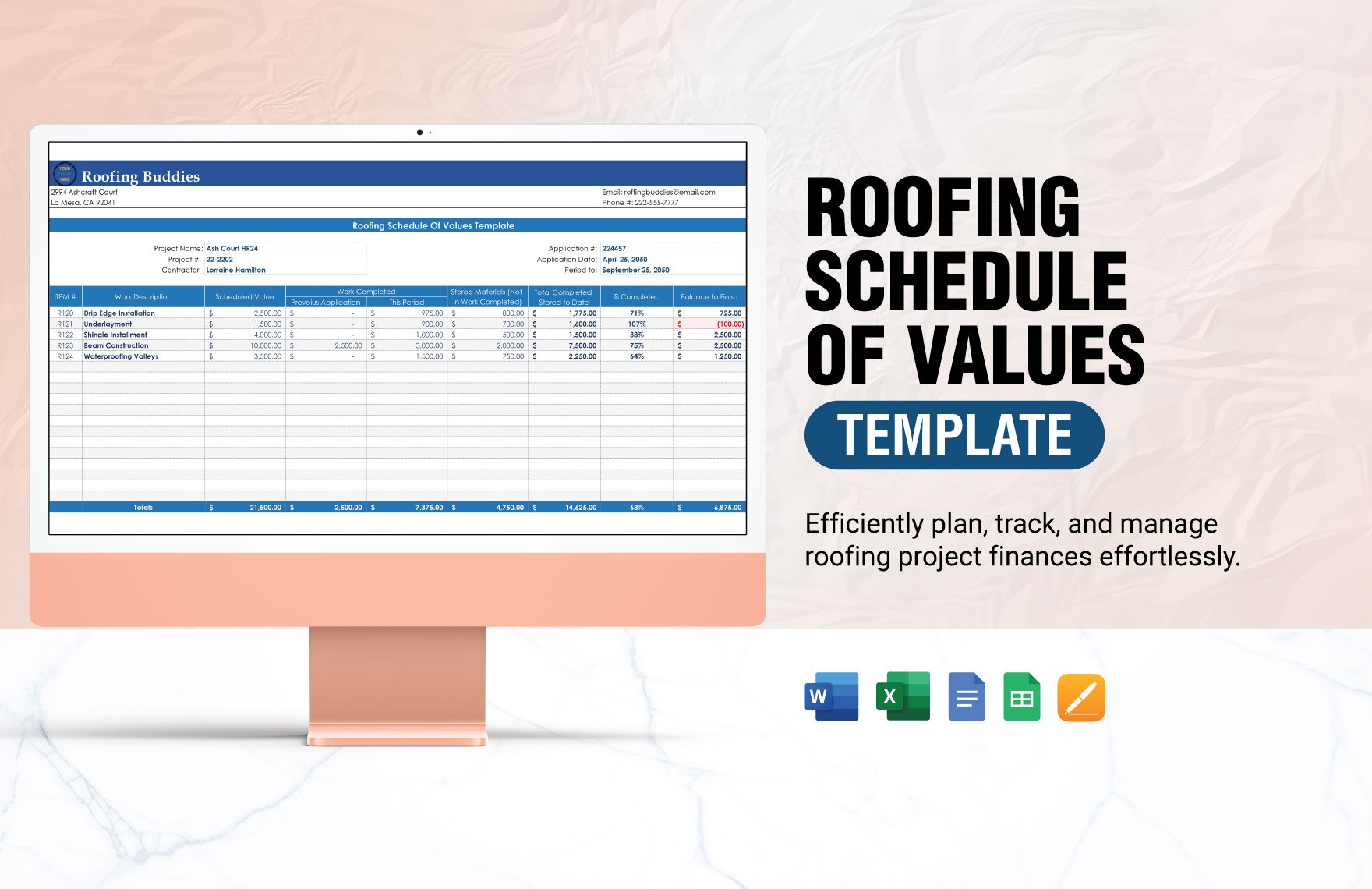
A useful sample of schedule of values for construction should show more than a list of trade names. It should demonstrate how a project moves from contract value to measurable work and then from measurable work to a payment request. The most useful samples therefore include enough columns to show scheduled value, prior progress, current progress, stored materials, cumulative progress, remaining value, and applicable retainage.
Consider a hypothetical $500,000 renovation. The SOV might assign $25,000 to mobilization, $60,000 to demolition and preparation, $110,000 to structural and framing work, $90,000 to mechanical systems, $75,000 to electrical, $80,000 to finishes, and $60,000 to testing and closeout. These figures are illustrative only; an actual project would use its contractual pricing and scope.
During the first billing period, the contractor might recognize $25,000 of mobilization, $30,000 of preparation, and $10,000 of framing. During the next period, those values would carry forward as previous progress while new current-period amounts are entered. The structure makes it possible to see both the history and the current claim without rewriting the entire schedule.

Construction Schedule of Values Examples by Project Type
Construction schedule of values examples should reflect the way different projects are actually built. A residential project may be organized by mobilization, foundation, framing, roofing, exterior work, plumbing, electrical, finishes, and final inspection. A commercial project may require more detailed trade divisions, cost codes, commissioning, testing, and closeout documentation.
For specialty contractors, the schedule can be even more focused. An electrical contractor may separate rough-in, feeders, panels, lighting, controls, testing, and final connections. A plumbing contractor may separate underground piping, domestic water, drainage, fixtures, equipment connections, testing, and commissioning. The line-item structure should make progress measurable rather than simply repeat the trade name across multiple rows.
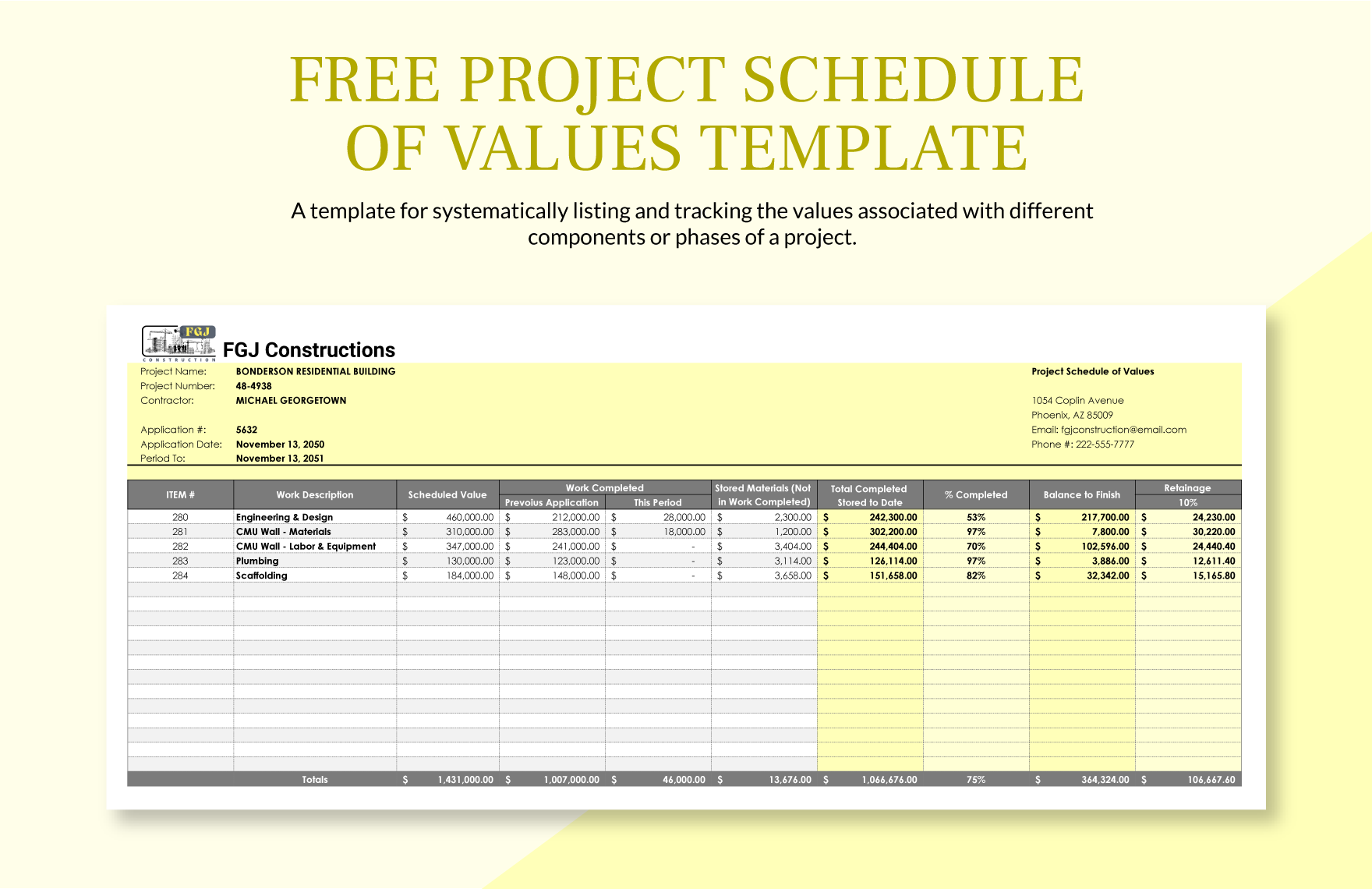
A schedule can also be organized around phases where the contract requires milestone billing. In that case, each milestone should still correspond to clearly defined deliverables. A milestone should not become a vague substitute for measurable scope when the reviewer needs to determine whether the claimed value has actually been earned.

Subcontractor Schedules and Coordination
A subcontractor schedule of values form should align with the subcontractor’s actual scope while remaining compatible with the general contractor’s payment structure. The subcontractor may need a more detailed breakdown than the prime contract because the general contractor needs to understand exactly how a broad subcontract scope is progressing.
For example, a mechanical subcontract might have a single prime-contract line called mechanical systems but internally divide that value into equipment procurement, ductwork, piping, controls, insulation, testing, balancing, and commissioning. The detailed subcontractor schedule allows the general contractor to evaluate progress without requiring the prime contract to contain every internal production detail.
Coordination is particularly important when multiple SOVs roll into a larger project. The sum of subcontract commitments should be reconciled with the corresponding contract budget, while differences between subcontractor billing and observed progress should be investigated. A detailed SOV can make those relationships much easier to review.

Common Problems to Avoid
One common mistake is making the line items too broad. A row labeled “General Construction” may be easy to create but difficult to verify. If most of the contract value sits in a few vague categories, the reviewer may have little visibility into what has actually been earned. The opposite problem is excessive fragmentation, where dozens of tiny lines create unnecessary administrative work.
Another mistake is treating the SOV as an internal cost budget. Internal cost information can be valuable, but the external schedule should reflect the contract value and billing structure. A contractor may know the actual cost of labor, materials, equipment, overhead, and subcontracting without exposing every internal cost detail in the contractual SOV.
Inconsistent descriptions are also problematic. Changing “Level 1 Electrical Rough-In” to “Electrical Level One” in a later period may appear harmless, but repeated naming changes make reconciliation harder. Stable terminology improves auditability and reduces confusion when payment records are compared across months.
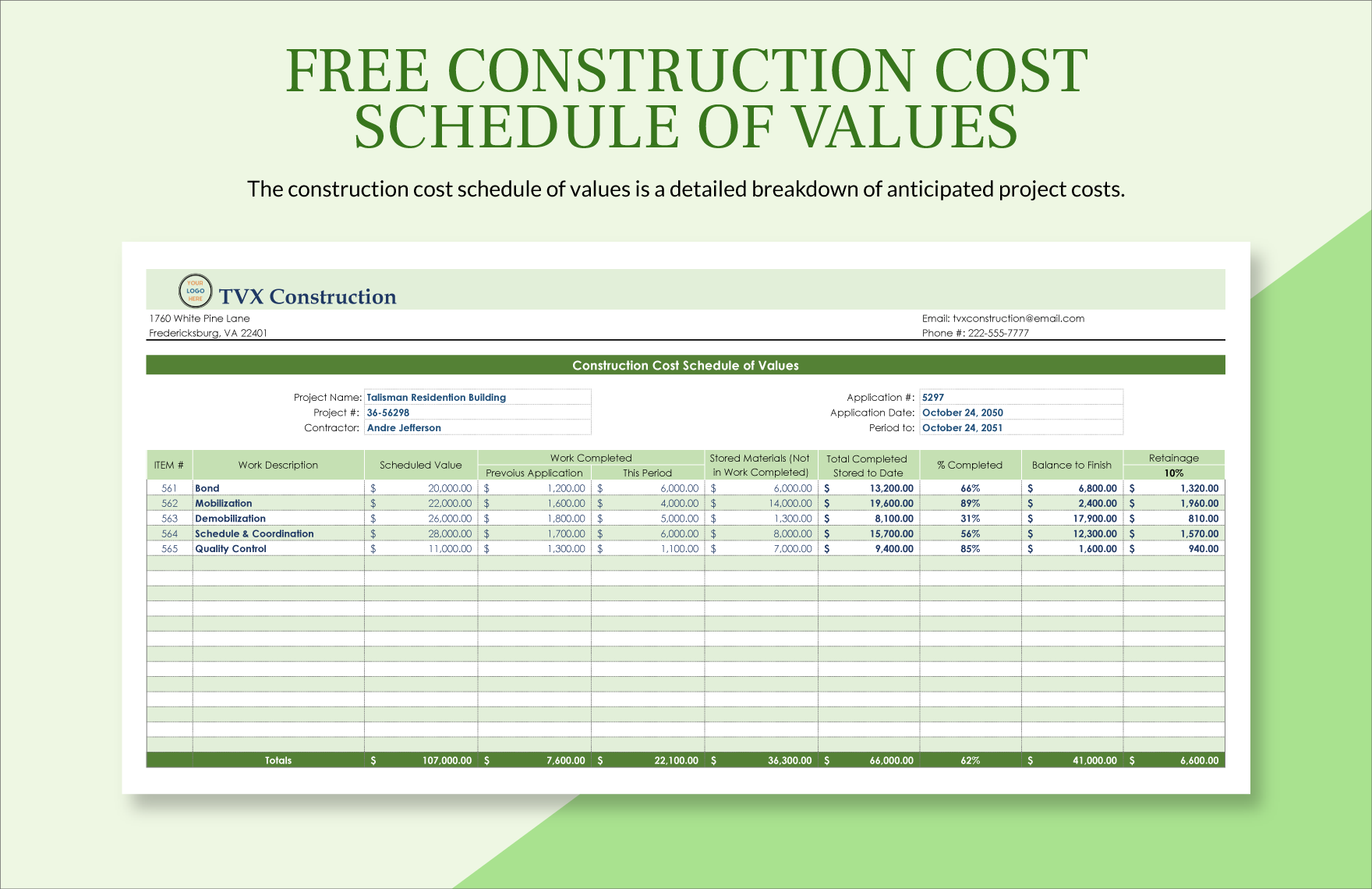
Finally, do not let spreadsheet formulas replace contractual judgment. A formula can calculate a percentage correctly while the underlying progress entry is wrong. The strongest process combines mathematical checks with scope verification, supporting records, field observations, and review of the contract’s payment provisions.
Practical Solution
The practical solution is to build the contractor schedule of values Template around a single controlled line-item structure that can survive the entire project. Start with the contract scope, create stable item numbers, assign defensible values, and make sure the scheduled-value total reconciles with the applicable contract amount. Then build the progress columns so previous work, current work, stored materials, cumulative progress, remaining value, and retainage can be reviewed without manual reconstruction.
Next, establish a repeatable billing workflow. Before each payment period closes, update current progress from verified project records, carry prior-period values forward, review stored materials separately, record approved changes, and run mathematical checks. Have someone other than the preparer review the schedule when the project size or contractual risk justifies a second review. This simple separation can catch duplicated progress, incorrect retainage, and mismatched totals before submission.
For spreadsheet users, protect formula cells and clearly distinguish input fields from calculated fields. Use consistent number formats, stable item numbers, and a revision field. Keep a controlled copy of each issued period rather than overwriting historical records. If the schedule is revised after approval, document what changed and why. The goal is to preserve a reliable financial history rather than merely maintain the latest spreadsheet.

For teams choosing among formats, use a spreadsheet when recurring calculations and progress tracking are central, a fixed document when presentation and record control are the priority, and a document-oriented layout when the schedule is small and calculation demands are limited. Regardless of format, the underlying logic should remain consistent. A format change should not change how the contract value, progress, stored materials, retainage, or balance are interpreted.
Before final submission, perform a five-point review: confirm the contract total, confirm every line item, verify current-period progress, reconcile cumulative progress, and check the payment summary against the SOV. Then compare the financial claim with actual project status. If those two views tell materially different stories, investigate the difference before the payment request proceeds.

Reference Examples
The following references illustrate the central structure of a contractor schedule of values Template: identifiable work items, scheduled values, progress by period, cumulative completion, remaining value, stored materials, and retainage where applicable. The visual examples differ in layout and level of detail, which is useful when deciding how a project should be organized. Some show a continuation-sheet style, some emphasize payment summaries, and others focus on the line-item schedule itself. They should be treated as visual references rather than universal contractual forms, because the governing contract determines the actual payment rules and required documentation.
When comparing these examples, pay particular attention to the relationship between the work description and the financial columns. A strong contractor schedule of values makes each amount traceable to a defined portion of work and keeps prior progress distinct from current progress. The references also demonstrate why a good SOV should be easy to read at both the line-item and total-project level. A reviewer should be able to identify what is being billed, how much has already been recognized, what remains, and how the current period affects the overall contract position.

Schedule of Values Excel Template
Source: CrewCost

AIA G702 Schedule of Values Continuation Sheet
Source: WordTemplatesOnline
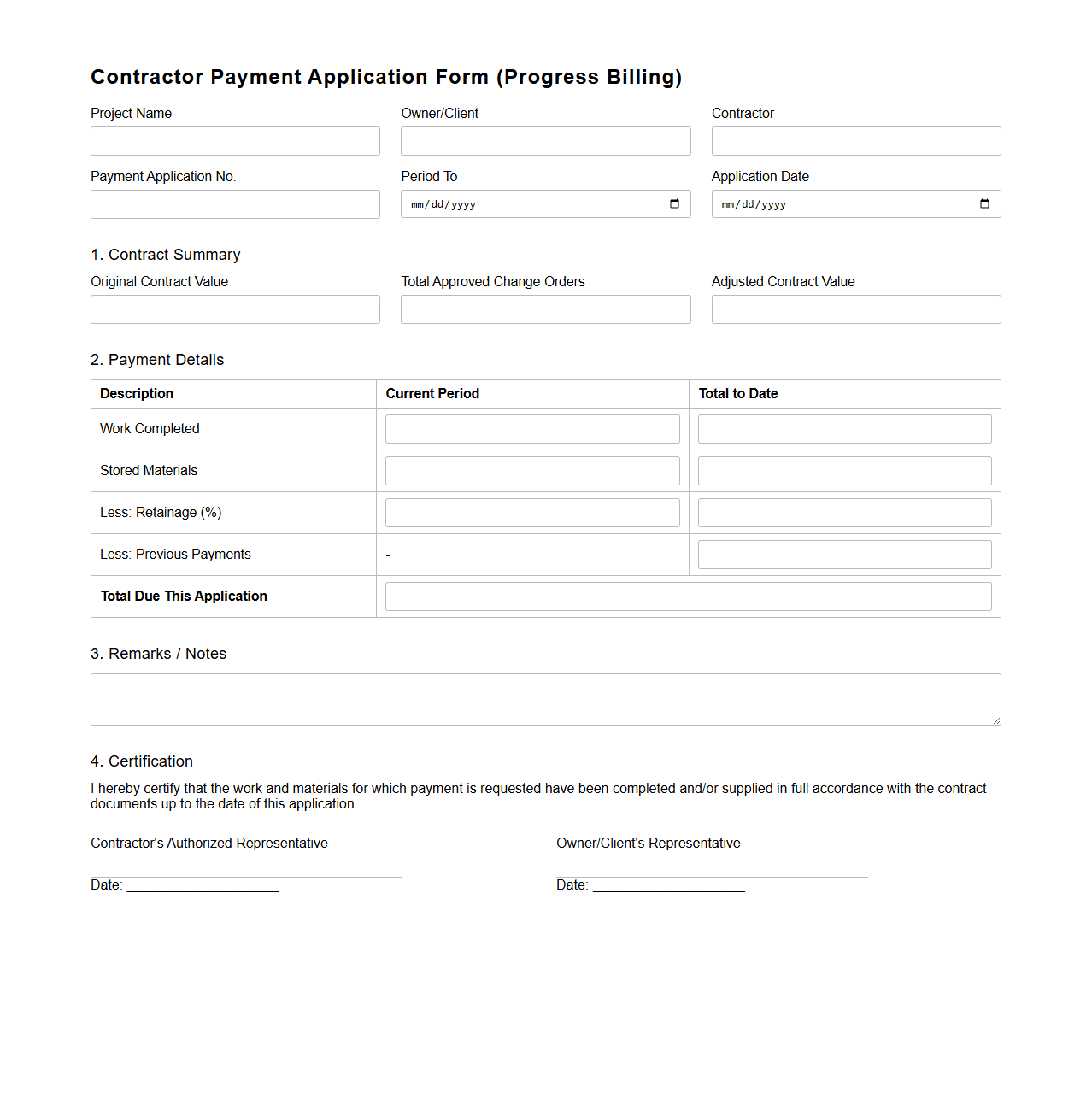
Contractor Payment Application Form (Progress Billing)
Source: Documentof
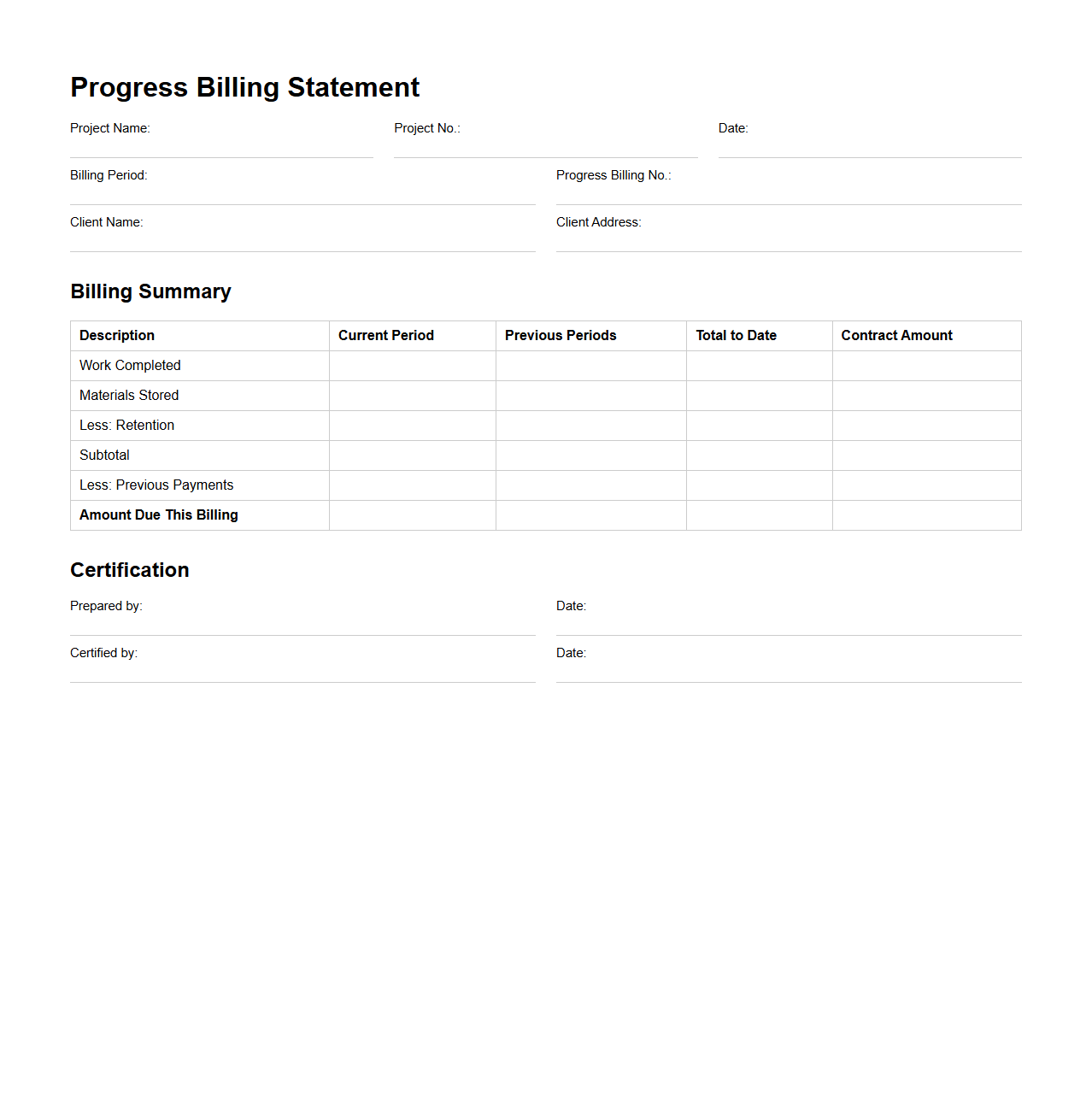
Progress Billing Statement
Source: Documentof
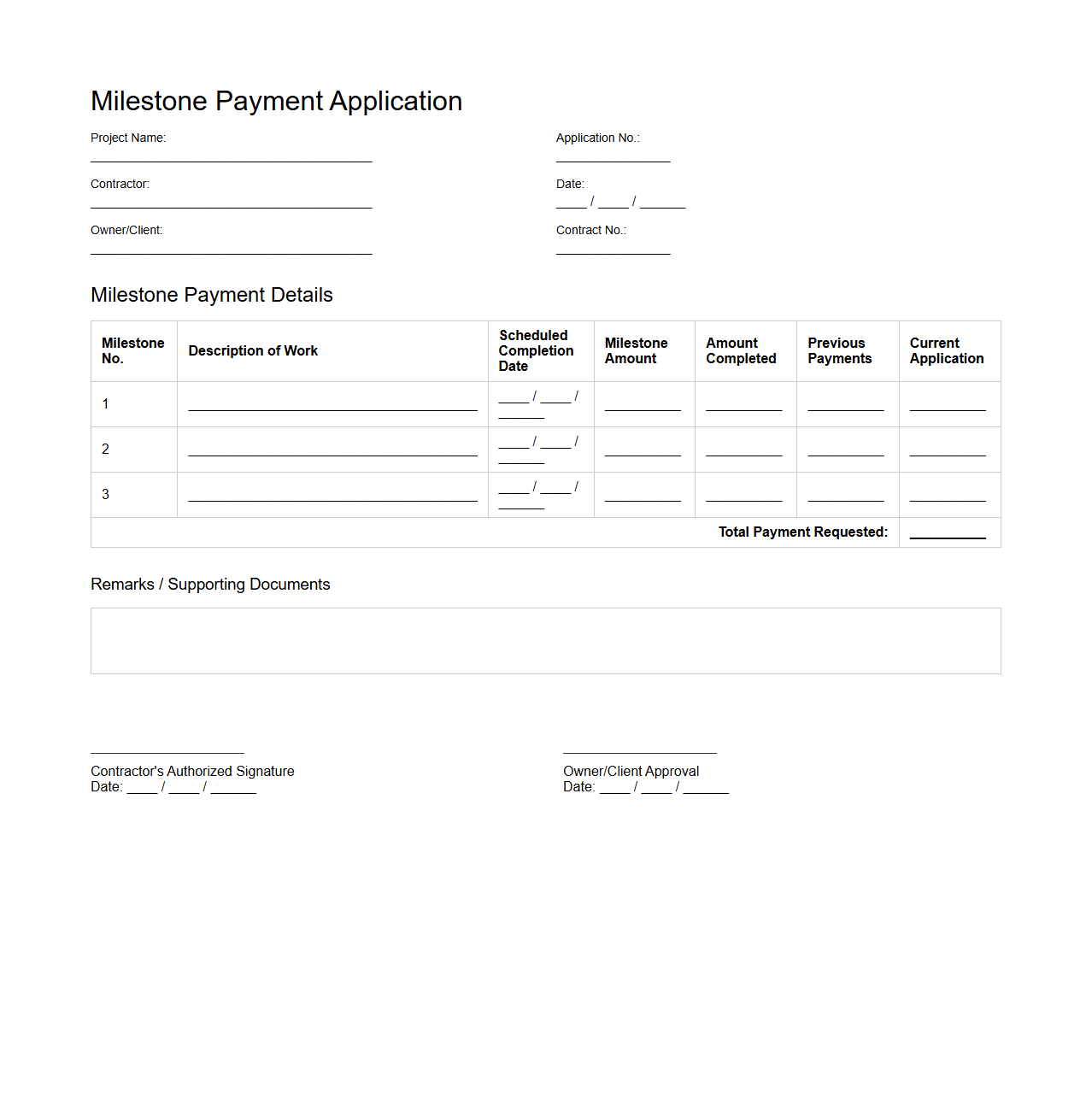
Milestone Payment Application
Source: Documentof

Schedule of Values
Source: TypeCalendar

General Contractor Schedule of Values Template
Source: Smartsheet
AIA G702/G703 Application and Certificate for Payment

Source: Scribd
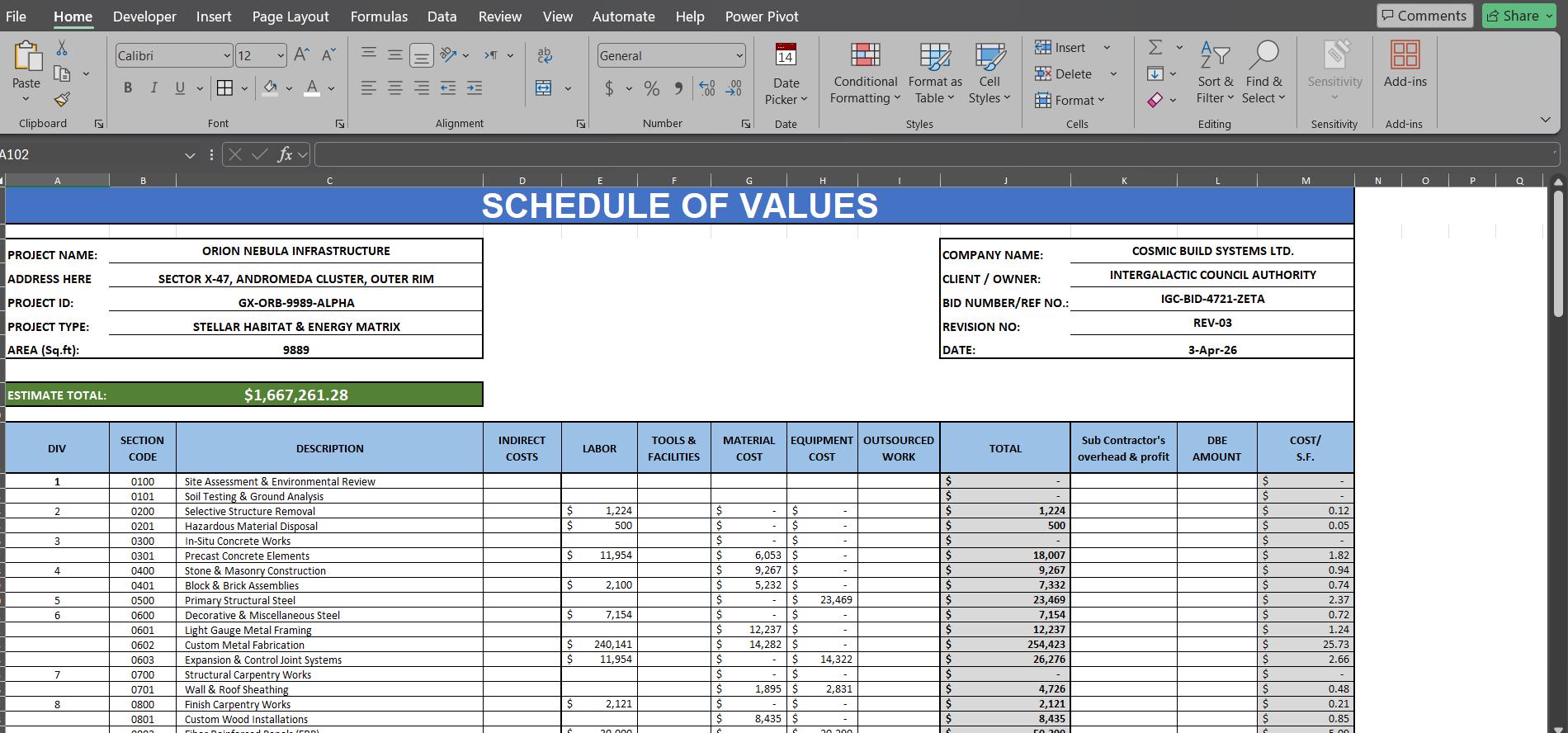
Construction Schedule of Values Excel Template
Source: Etsy
